Writer Henry Filloux-Bennett talks TOAST

HFB

When Nigel Slater released his 2004 autobiography TOAST: The Story of a Boys Hunger, it’s doubtful he ever imagined it would be made into a BBC film let alone become a critically-award winning play which after wowing the West End is now touring the country to packed audiences every night.

Here at Opening Night we were lucky enough to catch up with writer Henry Filloux-Bennett ahead of the shows return to The Lowry to hear a little more about the process of taking the book from page to stage as well as what audiences can expect from this heart-warming adaptation which critics have described as ‘delicious’.

Opening Night: “How did you first become aware of the autobiography and did you read it with the intention of adapting it for the stage?”

Henry Felloux-Bennett: “I was a cook working in London, weirdly in the same hotel that Nigel works in at the end of the book, I was knackered as kitchen hours are stupidly long and I didn’t have any money so I had to live outside of London and commute in. To keep me awake, I would read a book. I was given TOAST one Christmas and it was the first book I picked up as I left one day. I just started reading it on the bus back and forth from the kitchen not only did the story resonate because he has an interesting upbringing and then goes into cooking and I thought – ‘Oh that’s like me’, but also I didn’t have anything to do with theatre but I sort of wanted to do something in theatre, and I thought: ah, that could be the show.”

Toast 1

ON: “Once you’d decided to create the piece was it an instant yes from Nigel?”

HFB: “I tried originally to get the rights for a show in Edinburgh but Nigel said no, thank God because ten years later, the play became much more of a considered thing. Back then, I would have just done it in two hours and hoped for the best. It would have been rubbish so thank God he did say no.”

ON: “Your perseverance clearly paid of as 10 years later Nigel finally gave his backing to the adaptation.”

HFB: “Yes, the Lowry was doing a festival called Week 53 and it was about coming-of-age, Nigel also turned 60 the year it started so I think that had something to do with it. I think also it was something to do with this festival because it wasn’t a big glamorous West End show. We were trying to create this small experience for a very limited number of people that I hoped showed I genuinely wanted to do it. I think a lot of adaptations happen because it’s going to make money – I think he worried about that, not that it would be a big cash cow but that it was cynical. I just thought, oh we can get some foodies to come and see this.”

Toast 4

ON: “What is the starting point when taking a book from page to stage?”

HFB: “I think one of the big challenges of adapting any book to stage is how you a make it interesting to watch. Obviously if you’re reading a book you can be totally absorbed in it. You can enjoy the characters and you can enjoy the plot, but actually when you’re faced with watching something that sort of takes it in a different direction. The challenge with TOAST is that it’s not a narrative-based book, it skips around quite a lot. Finding a journey to go on, from start to finish, was a massive challenge because it doesn’t flow in a linear way. But that’s what made it more fun as well because I didn’t have to stick to normal storytelling rules.”

ON: “Did Nigel have an absolute veto on anything?”

HFB: “Mainly language. There is a bit where they go to Bournemouth on holiday and there is a line about looking out on the sea and the guy who used to play Nigel once said ocean instead of sea. Apparently, that is a massive no-no because Nigel would never have said ocean in the 60s. It’s the details – like making the labels for the damson jam props. He made a lot of props. The general shape of the play he’s always been quite happy with because he understands that you send a book out into the world and it’s up to everyone else how they deal with it”.

Toast

ON: “Were you worried about Nigel Slater’s reaction to what you had produced?”

HFB: “I was terrified about Nigel’s response. I think you always think that what you’re doing you quite like but then you have to present it to people who’ve never read it before and you have to present it to the person who it’s about, who wrote the thing itself – that’s terrifying. He was very nice about it. He said he wouldn’t read it until I was happy with it, which was a massive bonus because we didn’t know each other. I might’ve massacred his memoir, which would’ve been awful. Touch wood, I haven’t done that. But he was very generous in saying do whatever you need to do. When I was writing it, I read an interview with Lee Hall, who wrote the screen play for the film. And Lee Hall basically said that you can’t care the person is still alive and you can’t care about the person reading it. You have to write the thing you need to write. If the person hates it you can change it, which he did a little bit, but you have to write the thing that you want to write and don’t worry that there’s a real-life Nigel Slater who will be there at some point. It was great advice, which I followed.”

Toast 2

ON: “Why do you think the tastes and smells are so important in both the autobiography and the play?”

HFB: “If you read the book, which you absolutely should, you’ll know that all the chapters are named after food, like Apple Pie, Marshmallows or Digestive Biscuits. Angel Delight was what I responded to when I read it. Butterscotch Angel Delight is probably the best thing ever invented, it’s an amazing pudding and it takes five minutes to make – who wouldn’t love it? It’s those memories – and the smells. Everyone knows the smell of certain things. If you open a packet of digestives, you know that smell. The same with toast. If you think about it, everyone can tell what toast smells like, just when it’s just starting to burn a little bit. All of those things are in his chapters so we had to respond to that in the play.”

ON: “How involved has Nigel been in the process?”

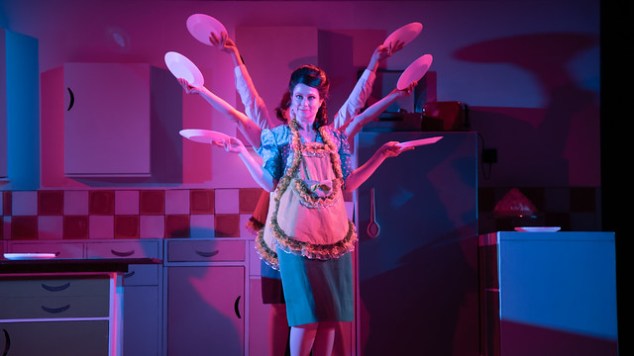
HFB: “He was literally involved from day one. He was there for the workshop week with The Lowry six months before we made the show and then he was there for every step of the way with the food. I think the tech period for him was the most exciting bit because he works in TV so he’s not used to being involved with how the sets get made. At The Lowry, he made half the props with us. He was literally in the dressing room making labels. I’ve still got the label he made for the Damson Jam bottle, it’s my favourite thing. Oliver, who is the Executive Chef at The Lowry’s Pier Eight, worked very closely with Nigel and James [Thompson], our Food Director, to create things that everyone would get to taste. Nigel came up for tastings and was like ‘this bit needs this’ and ‘it needs a bit more sharpness in the lemon meringue tarts’ so he was really involved.”
Toast 5

ON: “Does any cooking take place on stage?”

HFB: “Yes, I’m not going to tell you what. But there is a scene when we cook on stage. Have you ever seen Billy Elliot? In the script I wanted to copy the bit where he does the angry dance and he can’t express himself any other way. There’s a moment in the play when Nigel gets told something and he doesn’t know how to respond. In my head the only way he could’ve responded was to cook and so it’s meant to be the angry dance for Nigel. It’s a really interesting thing because there is no talking for nearly five minutes. It’s quite intense and Giles had to learn how to cook that dish perfectly. Hopefully it resonates and you’ll find it interesting, but for some people it’s the only bit that I didn’t write and it’s the bit that people cry at. That bit certainly gets people because they can smell and see. The sound of food cooking in a frying pan is amazing, especially in a theatre”.

TOAST returns to The Lowry where it first premiered in 2018 on Monday 11th November for a limited one week run until Saturday 16th November. Tickets available here.
Interview | Jodie Prenger | A Taste of Honey

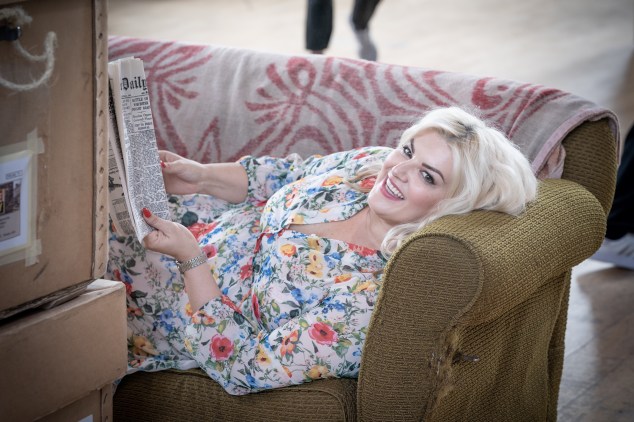
The National Theatre brings Shelagh Delaney’s ground-breaking play A Taste of Honey to The Lowry this month as part of a new autumn UK tour. Returning the northern classic back to its roots, Bijan Sheibani’s production takes an enthralling look at working-class life in post-war Salford.

Jodie Prenger takes on the iconic role of Helen, a single mother who takes off with a car salesman leaving her feisty teenager Jo to fend for herself. Jo’s relationship with a sailor comes unstuck when after promising to marry her he heads off back to sea leaving art student Geoff to take on the role of surrogate parent. Things get even more interesting when Geoff innocently calls on Helen to help, opening the doors for this unconventional set up to unravel.

We were lucky enough to catch up with Jodie Prenger during rehearsals to hear a little more about the production and what it means to be tackling such an exciting role written by Delaney when she was just 19.

I first watched it about 8 years ago now, a dear friend of mine Bobby Delaney (no relation) gave it to me to read and I absolutely fell in love with it.” Jodie explains “…it was so real, so honest and so tender. It was the mother and daughter relationship that really got me, for me, my Nan and all that side of the family were all from Manchester so it was just like hearing my Nan’s voice. The feistiness and the fight that my Nan had I saw a lot of that in Helen.”

Prenger has played many strong women on stage including the ultimate Scouse independent woman Shirley Valentine; we asked Jodie what is was about northern writing that makes for such a memorable and original piece. “Northern writing just has a real warmth…it’s witty, it’s tender, there’s a zest and spiciness to these strong female characters who I think are always interesting to watch in theatre, in film and TV. The way Shelagh Delaney wrote is just so great that the story comes to life and I just love reading it and watching it.” Explaining what makes the North so special Jodie said, “There’s a beating heart within the North, in Manchester and Salford and within the play itself. Even though people are up against so much they still fight and strive and still have that warm genuine humour. It’s like me and my Mum we can be battling royal but then one of us will say ‘oh have you finished then’ it’s a type of humour that you don’t often find in every corner of the UK.”

The play was famously seen a very taboo when it first premiered due to the themes and characters, “We’ve come a long way but we still have a long way to go, the cast were told they may have to evacuate the theatre when it was first put on, you’d not have that happen now, that wouldn’t even be entertained today but back then it was. I think we’re getting better well at least I hope we are. Yes back then it was taboo and although not so much now it’s still very, very poignant”.

Aged just 19 when she wrote this debut piece, Prenger sees Delaney as a courageous writer, “I think she unleashed a really strong genuine female voice which around that period was unknown. It was very brave, I think it’s the same kind of woman’s voice we’d hear today but then it seemed shocking and taboo.”

The role of Helen has famously been played by several incredible actresses including Angela Landsbury and Avis Bunnage, Jodie explained how she goes about making a character people know so well her own. “You do feel the pressure of those who have gone before you but that’s what gives you the drive to work hard and gives you the confidence to decide how you are going to create your character. It’s about my Nan’s ethic almost of rolling up your sleeves and getting stuck in. It’s important you develop the character how you want to develop her and that comes from working with your fellow cast members. I think she’s real; the only way you can play a character like her is by playing the truth.” 

Drawing on her experiences with her own family when it comes to the mother daughter scenes Jodie states “Making the mother daughter relationship believable I think comes from taking your experiences and using them. Taking experience and inspiration from characters you’ve met along the way. Definitely the relationship you have yourself with your mother, sometimes I find although Helen and Jo are polar opposites they are also so similar I think that’s why they come up against each other so much.”

Set famously in the 1950’s Prenger explained how those elements will still very much be present but with some additional styling from designer Hildegard Bechtler. “It’s the same production team who worked on the 2014 production at the National, but what they are really, really set on is keeping those elements of the 1950’s but making it poignant for today. There’s music like Nina Simone, Peggy Lee and Amy Winehouse, there’s live jazz, there’s folk music. The aesthetic of Amy Winehouse really influences the design, her style, look and music. The costumes will be 1950’s but not so much starched dresses etc that it couldn’t be any other time but will hint at modern day as well, same with the props and set too.”

Launching the tour in Salford the birthplace of Shelagh Delaney feels appropriate; we were interested to hear Jodie’s thoughts on what her character Helen would make of 2019 Salford. “My brother Marco lives nearby and I can’t believe how much it’s changed, perhaps she’d find the nearest gin bar, she’d have a great choice. I’m sure she’d love it; you always love home don’t you. That’s what Shelagh Delaney was like, she says there’s not many places she’d like to live, maybe London but then she’d always come back home. Home is home.”

A Taste of Honey opens at The Lowry on Friday 13th September and runs until Saturday 21st September, tickets available https://thelowry.com/whats-on/nt-a-taste-of-honey/


Mythos: A Trilogy

📷 David Cooper
Reviewed by Nikki Cotter

Opening Night verdict ⭐️⭐️⭐️⭐️⭐️

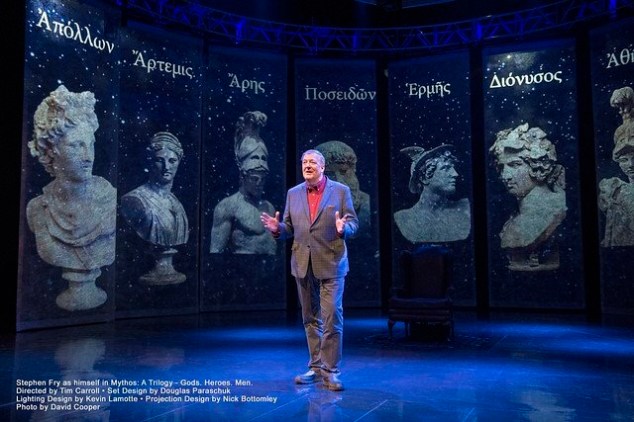
Fresh from taking the Edinburgh Fringe by storm, Stephen Fry brings his one-man trilogy to the Lowry as part of his first UK tour in almost 40 years.

Mythos: A Trilogy based on his best selling books Mythos and Heroes allows Fry to focus on a different subject matter in each of the three shows starting firstly with Gods, then secondly Heroes before thirdly and finally taking on Men.

Effortlessly charming and unquestionably entertaining Fry weaves through the history of Greek mythology right from the origins of the Ancient Greek Gods all the way through to the realisation that mortal man had progressed so far that perhaps the glorious Gods who’d ruled with such majestic power were no longer needed. Each and every story is packed with brilliant and witty observations as the Great Gods are brought to splendid and spectacular life.

Sitting centre stage on a throne-like leather armchair, Fry, a natural storyteller draws his audience in as though huddled round a campfire: his knowledge and enthusiasm bursting to be shared. Large screens surround him as projections of animations and classical paintings play out.

Stories roll off Fry’s tongue captivating the audience while delving deep into the origins of the Greek Gods. The names of the Original 12 Gods, their children, their cousins, heroes, creatures and mortals are reeled off effortlessly as Fry adds depth to his delivery with witty anecdotes and entertaining ad libs.

Stories are made accessible with Fry designating regional accents to the various individuals and comparing their personalities to modern day references, Heracles for example is a Brummie while Titan is described as being a “bit of an emo”.

As well as Fry’s captivating storytelling he adds various interactive elements to each show firstly in the form of the ancient version of trivial pursuit, in this case ‘mythical pursuit’. Audience members are invited to pick a subject from which Fry regales the listeners with interesting facts about said subject. In addition to this Fry opens up his oracle during the interval giving audience members an opportunity to email their burning questions in the hope of Mr Fry selecting theirs for discussion at the start of Act II. Sadly on this occasion even the oracle was stumped when the word Brexit emerged.

Wonderfully this Herculean sharing of what can only be described as an encyclopaedic knowledge never feels overwhelming or inaccessible. Fry’s warm and playful nature ensures every audience member feels part of this mythological ride and will leave the theatre armed with both a huge respect for the ancient Greeks and plenty of interesting facts to wow their friends and family with thus achieving Fry’s aim of returning to a storytelling society.

Mythos: A Trilogy covers all bases, there is love, war, heroism and devilment, with each and every story told with passion and joyful delight. The ancient is brought to wondrous life in this epic trilogy of olympic storytelling we have just one request: please Mr Fry don’t leave it another 40 years.

Mythos: A Trilogy can be seen at various locations across the country further information can be found here.

Letter To Boddah

64441462_496479654454538_5024441734306725888_n

Reviewed by Matt Forrest

Opening Night verdict ⭐️⭐️⭐️⭐️⭐️

In the song Hey, Hey, My My (Out of the Blue) Godfather of grunge Neil Young muses the statement: “It’s better to burn out, than to fade away”.  Sadly, this was a question posed in Kurt Cobain’s suicide letter, tragically titled Letter to Boddah.

Writer Sarah Nelson has used this desperately heart-breaking event as the inspiration behind her play, also titled Letter to Boddah. Set entirely in the disabled toilet of a Tesco store, we find childhood friends Billy (Sam Glen) and Neil (Jordan Reece): the pair are dressed in full military combats, armed to the teeth and carrying a ruck sack packed full of explosives ready to blow up the supermarket, its customers, and if necessary themselves.  What has brought these two to this point? Is there any going back for the pair?

Nelson has written a pitch-black comedy drama which explores themes of friendship, grief, domestic abuse and lost potential. Taking a setting more associated with that of a British ‘sitcom’, we are treated to some razor-sharp one-liners and darkly comedic dialogue, mixed with moments of heartbreak, as well as a few twists that will have you on the edge of your seat.

Both leads are excellent. Sam Glen puts in an intense, gut-wrenching turn as grief-stricken Billy, whilst Jordan Reece plays Neil to perfection, striking the right balance between comedy sidekick and unhinged psychopath.  The chemistry between the two is outstanding and fully believable, which makes their actions seem all the more desperate. The two manage to captivate and entirely hold your attention throughout.

This is an important production that addresses issues of male depression and suicide, as well as containing strong political themes of globalisation, and commentary on a lost generation without a voice. Powerful, dark, shocking and packed full of humour, with a finale filled with tension. This is an outstanding piece of work that deserves to be seen by as many people as possible, and on the strength of the quality on display tonight, will surely find an audience.

Letter to Boddha is on at the Edinburgh Fringe throughout August at C CUBED (Venue 50) daily at 1:15pm tickets available here.


Henry V

Reviewed by Nikki Cotter

Opening Night verdict ⭐️⭐️⭐️⭐️⭐️

Petty political point-scoring, a none democratically elected leader making decisions shaping the future of our nation, decisions driven by a lust for power…sound familiar? Nope this isn’t a political commentary of the UK right now but Shakespeare’s Henry V.

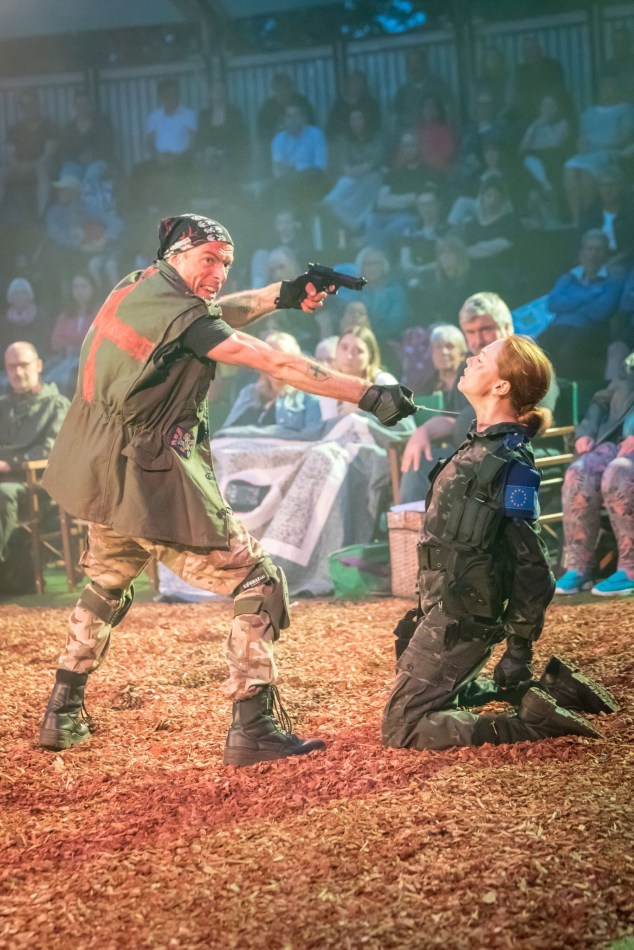
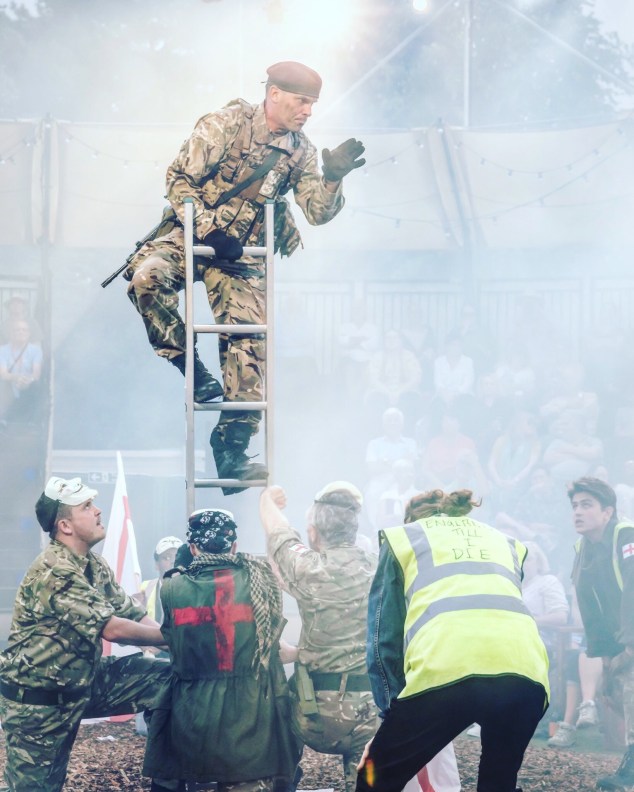
Director Loveday Ingram places the production amidst the current political climate, (or should that be crisis?) St George’s crosses fly high as soldiers swill down booze while chants of ‘England ’til I die’ ring out from the yellow vests.

Shakespeare’s France very much represents the EU with the cast dressed in familiar vibrant blue as yellow starts billow in the breeze.

It may be 2019 but Henry V feels more pertinent now than ever before as Shakespeare’s social and political observations continue to ring true, centuries after they were first penned.

Joseph Millson takes on the role of the heroic leader. Persuasive and full of charm one moment, ruthless and murderous the next. Millson revels in the complexity of the monarch exploring every layer with subtlety and style.

He tackles Shakespeare’s famous “Once more to the breach, dear friends” monologue with a solid and rousing conviction: his army literally chomping at the bit, breathless for the battle to begin. In contrast the commanding warrior loses all composure when attempting to woo Katherine, faltering over his words as he bashfully fumbles in French.

Millson is supported by an impressively strong cast notably Samuel Collings as Pistol, Seren Vickers as Fluellen and Vanessa Schofield as Scroop/High Constable while Mitesh Soni and Sarah-Jane Potts inject some well delivered humour as Alice and Katherine.

Director Loveday Ingram and her cast not only find the heart of Henry V but also the humour too in this solid and potent production as keen observations of the human spirit play out.

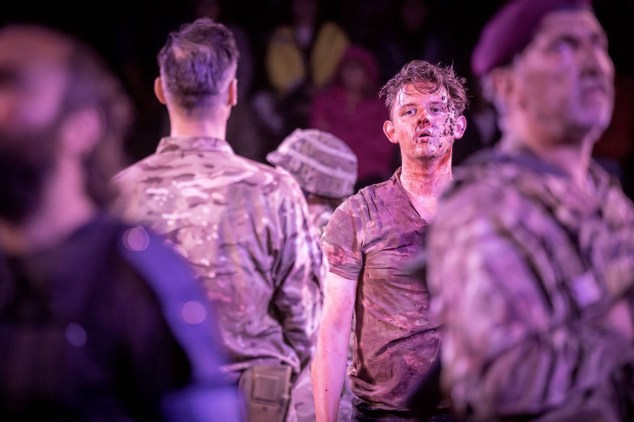
Vulnerabilities of leaders are masked with chest pumping and posturing while the battlefield scenes remind us of the catastrophic consequences of decisions driven by political self-promotion. The scene after the battle of Agincourt packing a deeply emotional punch as the cast hauntingly sing to the skies.

Andrew Patterson’s dynamic lighting design adds atmosphere and depth while Paul Benzing’s fight direction adds authenticity and impact.

This is a cleverly constructed piece which will stay with audiences long after viewing. Vibrant storytelling at its finest.

Henry V is on at Grosvenor Park Open Air Theatre until Sunday 25th August tickets available here.

Twelfth Night

Reviewed by Nikki Cotter

Opening Night verdict ⭐️⭐️⭐️⭐️

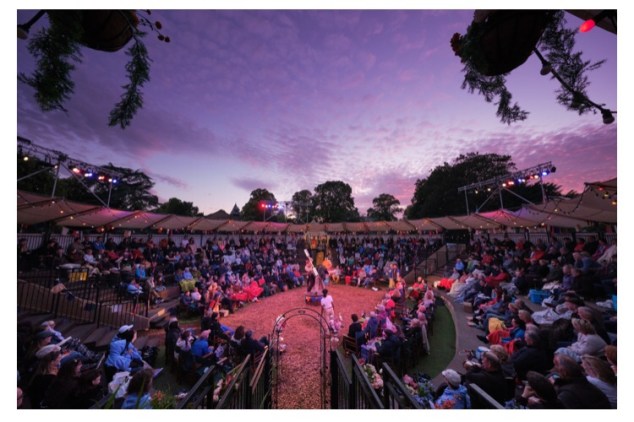
Twelfth Night has long been known as one of Shakespeare’s greatest comedies; in celebration of their 10th birthday Grosvenor Open Air Theatre are happy to prove why.

Locating the action in the Bohemian Balkans the celebratory festival vibe is strong, there’s flowers in hair while the drink is free flowing. The abundance of music and laughter indicate that Director Julia Thomas is prepared embrace the fun of this comedic and jubilant production.

This is an ode to the joyful and silly; there’s mistaken identities, unrequited love, a shipwreck, subterfuge as well as a whole host of entertaining characters.

The talented cast deliver Shakespeare’s verse with clear conviction while their enthusiasm and wit gives the piece both a light and accessible feel.

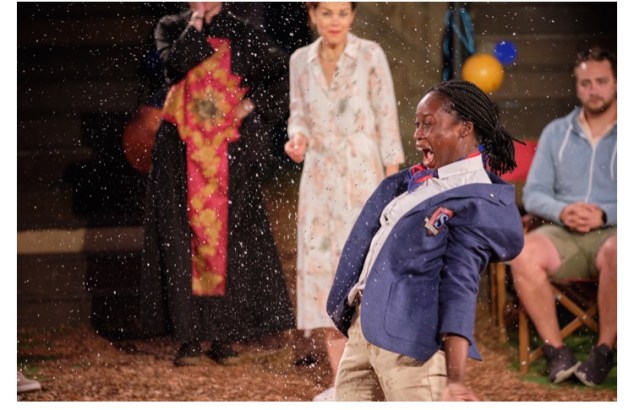
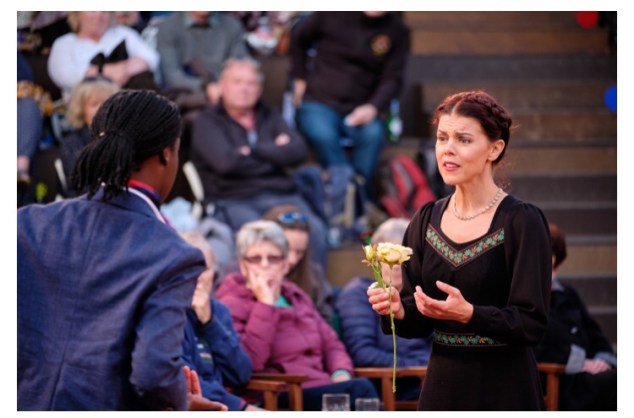
Separated twins Viola (Whitney Kehinde) and Sebastian (Marc Benga) each arrive on the shores of Illyria after a shipwreck; Viola first, allowing her 3 days of getting acquainted with the locals, enough time for two to fall in love with her while another two attempt to fight her albeit while she’s now dressed as as a man (Cesario) in a bid to keep the spirit of the brother she believes to be dead alive.

Kehinde is excellent as Viola/Cesario, cool and commanding she handles the confusion and complexities of life in Illyria with sass and style.

Sarah-Jane Potts shines as Olivia, hot in pursuit of her happy ending while Samuel Collings brings the house down as the put upon Malvolio whose transformation from stiff upper lipped steward to stocking wearing, downward dog facing smiler is pure genius.

Mitesh Soni is an absolute joy as Sir Andrew Aguecheek. His physical comedy, facial expressions and nice but dim personality really bringing this piece to life. Kudos to Soni for successfully delivering Shakespeare’s prose whilst flossing, impressive!

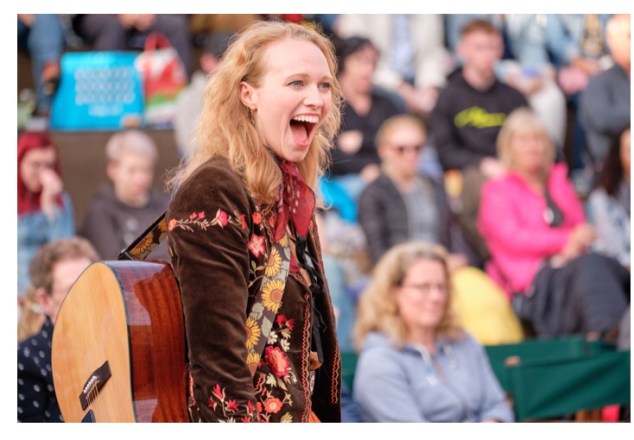
Jessica Dives as Feste takes on the form of a modern day wandering minstrel, offering an almost narrator like musical accompaniment while adding a wonderfully melodic energy to proceedings.

Director Julia Thomas isn’t afraid to embrace the silly or the slapstick and is greatly rewarded for her choices. Her cast embrace the opportunity, having a lot of fun with the piece while the audience reap the benefits.

A stand out moment which really embodies the playful nature of the production is the hilarious fight scene, outrageously farcical and absolute comedy perfection. The frequent witty exchanges between cast and audience further add to the playfulness and accessibility of this piece.

A highlight of Chester’s summer season for ten years now with productions as strong as this there is no doubt the Grosvenor Park Open Air Theatre will be celebrating birthdays for many years to come.

Outrageously good fun for all the family.

Twelfth Night is being performed at various dates over the summer further information and tickets can be found here.

Rotterdam


Reviewed by Matt Forrest

Opening Night verdict ⭐️⭐️⭐️⭐️

Every once in while a play comes along that really strikes the right chord, one that you would encourage as many people as possible to go and see, writer Jon Brittain’s Rotterdam is that play!

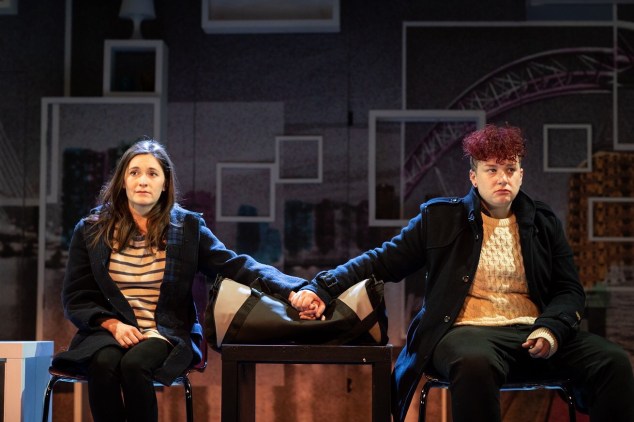
First performed in 2015, this Olivier Award winning play offers an honest, raw portrayal of gender dysphoria and the impact that it can have not just on the individual but their loved ones as well.

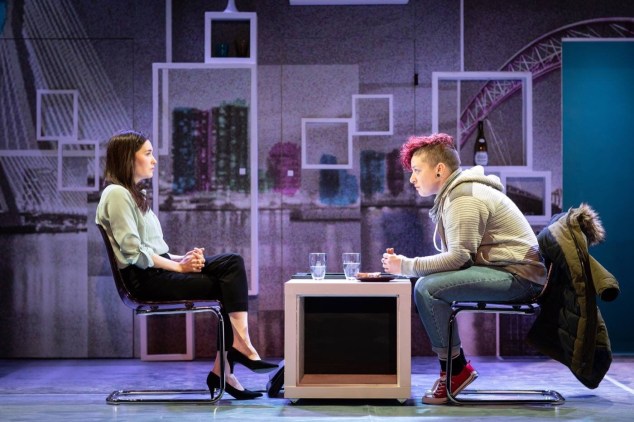
Set in the Dutch city of Rotterdam, a vibrant port town where people come and go as much as the cargo that passes through its docks; however, this isn’t the case for Alice (Rebecca Banatvala) and her partner Fiona (Lucy Jane Parkinson).

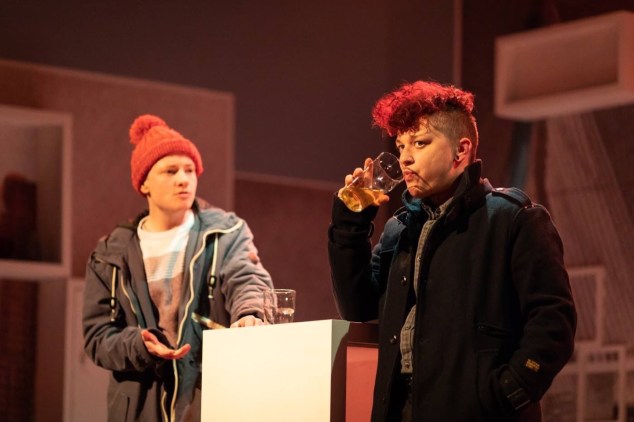
The pair have been living there for seven years now, with both trying to come to terms with who they are. It’s New Years Eve and Alice has finally decided to come out as gay to her parents, with much encouragement from Fiona. However, before Alice undertakes this brave step, Fiona also has a confession to make that she wishes to be recognised as a man and would like to be called Adrian from now on.

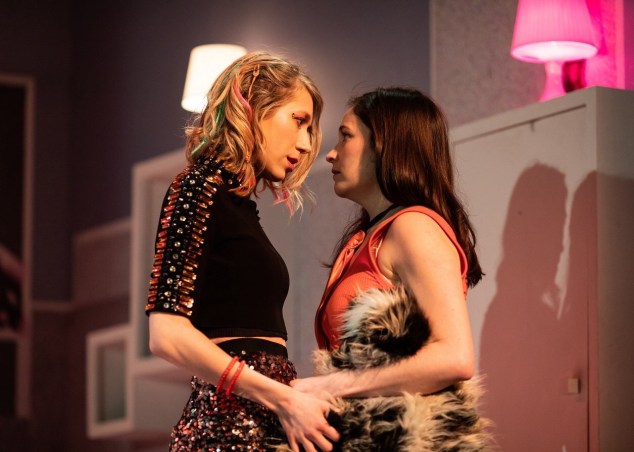
This revelation has a huge impact on the pair and their relationship as Adrian seeks acknowledgement from a world that he sees will not accept him as a man, whilst Alice questions her own sexuality. Through their journey of discovery, the pair are supported by Lelani, (Stella Taylor) Alice’s free-spirited work colleague, who has more than friendship on her mind as it pertains to Alice. Making up the quartet, is Josh (Paul Heath) Fiona/Adrian’s brother who is also the former boyfriend of Alice.

This could so easily fall into a ‘preachy’ message driven play about transgender issues, instead focusing on the impact Adrian’s decision to transition impacts on those around him. The script handles its subject intelligently and sensitively, whilst pulling no punches. There are moments of levity throughout with some sharp, funny throw away lines.

The cast under Donnacadh O’ Brian, skilful direction are superb, with Parkinson giving a raw at times feral turn as Adrian: filled with conflict and heartbreak. Whilst Banatvala is also outstanding giving a more restrained but no less gut-wrenching turn as Alice. Both Taylor and Heath are on good form in their supporting roles, with the pair turning in great comedic performances, demonstrating a gift for timing and delivery.

There are some plot contrivances that test plausibility, such as Josh’s decision to stick around despite losing the women he loves to his sibling, but this is a minor quibble on what is a weighty, heartfelt, powerful piece of theatre that will make you laugh and may even cause you to get the odd bit of sand in your eye too.

Transgender issues despite having some media coverage are still hugely unrepresented. Productions like Rotterdam are much needed and important to help educate and hopefully create more positive conversations. This however is not the shows key drawing power, that comes because it is a beautifully told story about the struggles of relationships and real life that will resonate with us all.

Rotterdam is at the Manchester Opera House till 15th June. Tickets available here.


The Importance of Being Earnest

Opening Night verdict ⭐️⭐️⭐️1/2

Reviewed by Nikki Cotter

While the Octagon Theatre undergoes an extensive refurbishment the company are performing in various venues across the town, one of the most impressive and merely a stones throw from the theatre itself is the beautiful Albert Halls. Part of the Town Hall the impressive Albert Halls acts as a perfectly fitting backdrop for Oscar Wilde’s much-loved Victorian comedy.

Our two protagonists, the dashing upper class cad Algernon (Jack Hardwick) and the seemingly more upstanding Jack Worthing (Dean Fagan) lead double lives in a bid to have some fun away from the strict social constraints of Victorian Britain whilst attempting to court the affections of headstrong City girl Gwendolen (Elizabeth Twells) and pouting country princess Cecily (Melissa Lowe) all of course to the distasteful displeasure of the domineering Lady Bracknell (Sarah Ball).

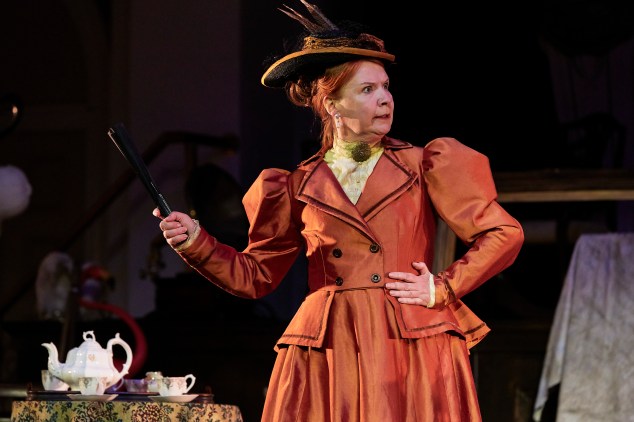
The play moves at a good pace once you get used to the slightly echoey acoustics within the lofty Albert Halls; Director Suba Das and designer David Woodhead have injected a real sense of style into this production. The stage resembles a photographer’s studio giving the cast opportunities to strike a pose and wink knowingly at the audience during some of the most quotable lines while the production opens with catwalk style vogueing from the cast by way of introduction.

Confusion and deception are the order of the day as we romp from the city to the countryside in this stylish interpretation. Jack Hardwick is exceptional as a flirty and flouncing Algernon. Hugely charismatic and convincingly charming you can’t help but root for this idle scamp. Dean Fagan’s contrastingly sensible Jack compliments Hardwick’s Algernon perfectly and the two bounce off each other offering some great comedy highlights.

Elizabeth Twells is in fine form as the determined Gwendolen. Strong and sassy she is a force to be reckoned with, the engagement scene is an absolute comedic delight while Melissa Lowe embraces the opportunity to play the brattish but ballsy Cecily with gusto.

There’s a slowing of pace during some of the scenes with Lady Bracknell, despite Sarah Balls’ authoritative performance some of her dialogue is lost due to the wordier nature of her lines in the expanse of the Albert Halls. The classic “A handbag?” however is delivered to perfection and gets the generous reaction it deserves.

david-cardy-jack-hardwick-and-vicky-entwistle

Vicky Entwistle and David Cardy as Miss Prism and Dr Chasuble bring an endearing frivolity to proceedings while Dan Shearer happily carries out his instructions as the put upon butler in various stages of undress.

Act I at more than an hour and a half does have the audience shifting in their seats a little while Act II at 35 minutes absolutely sails by, something a tweak or two could easily remedy.

sarah-ball

This stylish piece of theatre works and works well; it is fun, frivolous and delivered with a playful conviction. Another success for the Octagon Theatre in this faithful production dusted with a sprinkling of creative surprises.

Catch The Importance of Being Earnest at the Albert Hall until Saturday 15th June here.


The Exonerated

Reviewed by Nikki Cotter

Opening Night verdict ⭐️⭐️⭐️⭐️

Since its premiere off-Broadway in 2002 Jessica Blank and Eric Jensen’s The Exonerated has been performed all over the world picking up multiple awards along the way and even making it onto the big screen in the 2005 film starring Susan Sarandon and Danny Glover.

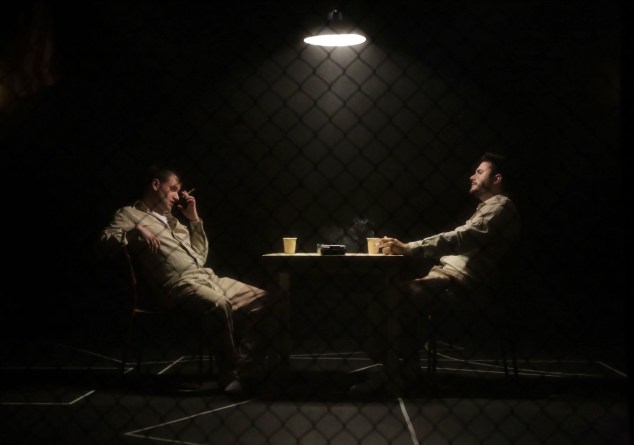
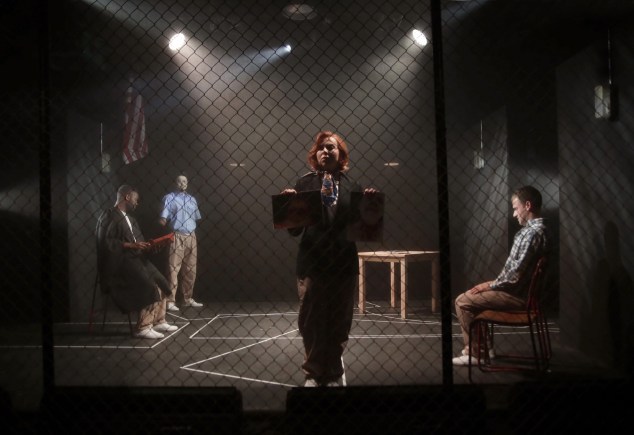
This ambitious adaptation embraces the nation’s current obsession with binge-worthy true-crime Netflix style documentaries by cleverly combining recorded first person accounts with live theatrical flashbacks of interrogations, murders, court scenes and the grim reality of life on death row.

Jessica Stanton’s innovative design places audiences as central observers as a Netflix style menu dominates the large screen above the stage. The click of a remote control can be heard as this evening’s viewing selection is made. Audiences sit either side of a central stage which is surrounded by prison style wire fencing and rough barbed wire, only glimpsing sight of each other when the stark interrogation lighting illuminates the space.

Grant Archer’s documentary style film feels authentic and grips from the start as the lives of the wrongly convicted play out before us. The fusion of film and live action works exceptionally well as the six extraordinary stories of those wrongfully sentenced to death unfold.

Joseph Houston has directed the pre-recorded interviews in such a way that they feel entirely genuine, the pain, the emotion and most touchingly the hope expressed by each character is as fascinating as it is moving.

The live action scenes work superbly well, adding depth and authenticity to the harrowing accounts of injustice, exposing the corruption of the authorities and their manipulation of these damaged individuals. The shattering and lasting impact of their lost years on Death Row bringing devastation not only to themselves but to the lives of their friends and families also.

Charles Angiama as Delbert takes on a measured narrator style role, the Texan who spent many years on death row for a rape and a murder he did not commit guides the audience throughout, observing with us the injustices and manipulation taking place. He weaves together the other five stories as the rest of the small cast take on several roles bringing life and vision to the harrowing real-life stories.

Though the subject matter is intense and the corruption utterly horrifying the production is delivered in a way which allows for a heart-warming portrayal of the human ability for hope even in the most desperate of situations. Sunny Jacobs being the most perfect example of this: a gentle mother of two who lost not only 16 years of her life to Death Row but even more tragically her beloved husband whose wrongful execution was made all the more horrific when the electric chair malfunctioned. Pippa Winslow’s performance as the good-natured hippie is exceptional, portraying her class and composure to perfection.

The Exonerated directed by Joseph Houston. Hope Mill Theatre Manchester. Photo Shay Rowan

This inspired and impressive adaptation telling six interwoven stories marks a bold innovation in story-telling theatre. The decision to mix live theatre with pre-recorded footage pays off adding an element of authenticity to proceedings. The second half feels a little screen heavy compared to the first but this does not take away from the power of the piece. While you go into the production expecting to hear about harrowing miscarriages of justice you don’t quite anticipate the impact these stories of survival and hope will have, a true testament to the quality and care that’s been put into this inspired and innovative production.

The Exonerated is on at Hope Mill Theatre until Sunday 16th June, tickets available here.

Images by Shay Rowan Photography

Hobson’s Choice

Reviewed by Nikki Cotter

Opening Night verdict ⭐️⭐️⭐️⭐️⭐️

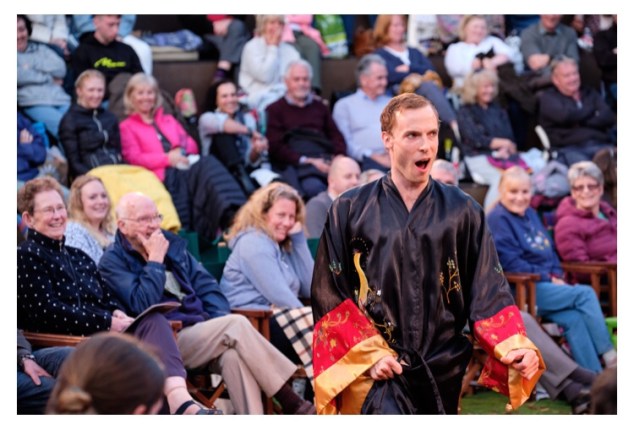
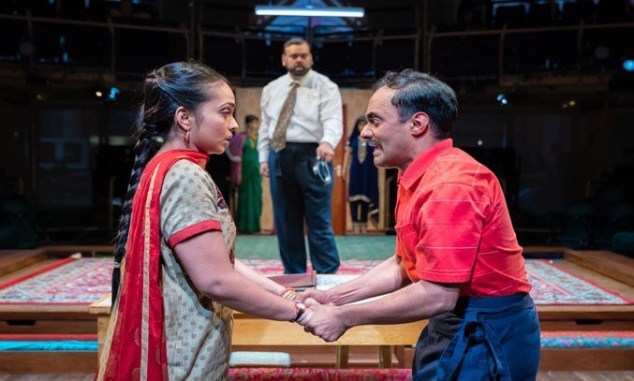
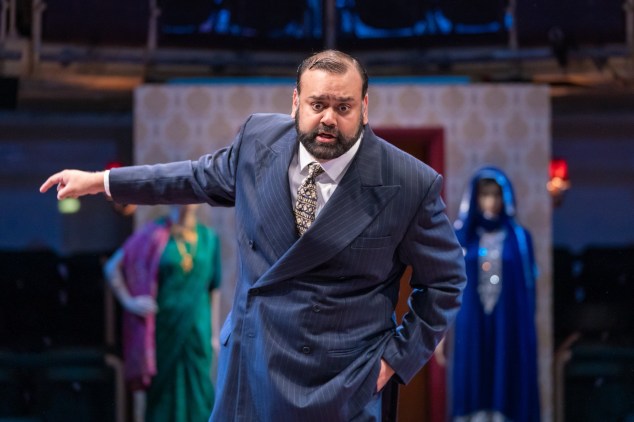
Innovative adaptations and the Royal Exchange Theatre go hand in hand; just looking at this week’s Autumn/Winter programme announcement confirms the theatre’s reputation as bold decision makers who delight in mixing things up. Interestingly Hobson’s Choice doesn’t relocate too far from its Salford origins, settling on the streets of a fledgling Northern Quarter but it’s reimagining by playwright Tanika Gupta brings a fresh vibrancy to this classic Northern comedy. The Hobson’s are now an enterprising Ugandan-Asian family running a tailor’s business in the city’s 1980’s backstreets thanks to the diamonds Mrs Hobson (then Patel) managed to smuggle out of Uganda in a batch of pakoras.

Hari Hobson (Tony Jayawardena) is a firm believer in what we’d now describe as wildly out-dated attitudes, his social standing means the world to him, a world in which he thinks women should be seen but preferably not heard and that at age 30 any female is well and truly past her prime. He delights in reminding his daughters that it is indeed a man’s world whilst he attempts to keep up appearances as head of the household despite it being clear for all to see that eldest daughter Durga (Shakini Peiris) clearly rules the roost.

His second generation daughters are desperate to break the mould, led by eldest sister Durga who has grown increasingly sick and tired of being the brains behind the business with little in gratitude or reward.

Tanika Gupta’s innovative adaptation enriches the story with well-timed humour, sparkling exchanges and touching sincerity which are made all the better by the well-researched Ugandan-Asian historical references. The strength of the cast is key to the success of this piece with each and every cast member giving a performance that is second to none.

Tony Jayawardena is outstanding as the ill-tempered family patriarch Hari who revels in his adopted Britishness yet despairs when his daughters attempt to explore their new culture. His comedic timing is perfection particularly during his superb exchanges with eldest daughter Durga (Shakini Peiris). They butt heads throughout with both hilarious and touching consequences.

Shakini Peiris is commanding as determined and hardworking Durga, the real innovator in the family. She convinces entirely as ambitions Durga whilst achieving a relatable balance of frustration and love for her infuriating father.

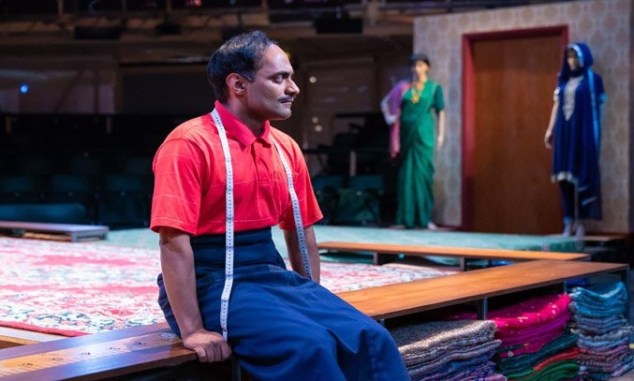
Special mention must go to Esh Alladi whose portrayal of introverted tailor Ali Mossop is an absolute joy. The journey he goes on is remarkable, starting out as a quaking bundle of nerves he is shaped with genuine tenderness by Durga, never losing his warmth and innocent charm and providing the audience with some of the best laugh out loud moments in the production.

Rosa Maggiora’s set design uses the Exchange’s unique space to great effect with Matt Haskins lighting design adding atmosphere and depth to proceedings.

This brilliantly portrayed and beautifully developed comedy piles on the laughs while director Atri Banerjee also ensures the moments of calm and consideration are allowed to gently develop. Family life in all its ugly complexities and wonderful contradictions are exposed in this delightful production. There is very little to criticise here, a slight lull in pace during Act II perhaps but this really is a minor quibble. This is an innovative and fresh take on a classic Northern tale with storytelling brought to beautiful and brilliant life by a skilled cast and creative team. Uplifting and joyous theatre told with true heart.

Catch Hobson’s Choice at the Royal Exchange until Saturday 6th July tickets available here.


Image

The Mousetrap

The Mousetrap,

The Mousetrap: The Lyric Theatre, The Lowry.

Reviewed by Matt Forrest

Reviewed13/05/19

Opening Night star rating: ****

About 25 years back I was watching a TV programme staring Paul Kaye as comic creation Dennis Pennis, a rogue TV presenter who pranked the great and good of the 90’s celebrity world. It wasn’t just famous people who Pennis targeted, but everyday folk too. On one occasion he accosted some old ladies as they were about to see The Mousetrap and committed the cardinal sin of revealing who the killer was!  As a teenager it was hilarious, if slightly mean spirited yet little did I realise that many years later I’d be going to see probably the world’s most famous “whodunit” already knowing the ending. (Shame on you Paul Kaye).

You see despite a near 70 year run and smashing a whole host of records, Agatha Christie’s The Mousetrap has one of the best kept secrets in theatreland. The fact that it still has the ability to shock and surprise in the modern world shows just how revered the play is and on the basis of tonight’s production it’s easy to see why.

It begins at Monkswell Manor, a converted guest house in the country ran by a young couple, Mollie and Giles Ralston (Harriet Hare and Nick Biadon). They are preparing for the arrival of their first guests to the house, but a nasty snowstorm is hampering their preparations. At the very start of the performance we hear the news through the radio that a woman named Maureen Lyon has been murdered in London. This broadcast is repeated as the guests been to arrive: who include Major Metcalf (John Griffiths), a mischievous architect named  Christopher Wren (Lewis Chandler), a no nonsense battle-axe of a women in Mrs Boyle (Gwyneth Strong), the private and guarded Miss Casewell (Saskia Vagncourt-Strallen), and finally the Mr Paravicini (David Alcock) a mysterious traveller who is caught up in the snow storm.

As the weather worsens word reaches the house that the police are sending an officer, a Sergeant Trotter (Geoff Arnold). When Trotter arrives, he explains that there is a link between the recently diseased Mrs Lyons and Monkswell Manor, his theory is later proven when one of the guests is strangled. The big question is will Trotter be able to solve the mystery before the killer strikes again?

The Mousetrap,

What instantly strikes you about this production is just how much fun it is and that’s down to the direction of Gareth Armstrong: he allows the cast to play it straight when required but also to poke fun at the genre, never really taking itself too seriously. The ensemble cast are superb, traversing the tightrope between ‘hamming it up’ and paying respect to this well-established theatrical institution.

As one might expect with an Agatha Christie, the script is littered with clues, red herrings and the key element of suspense that will keep you guessing throughout. There is some rather clunky and at times dated dialogue which the cast play for laughs, albeit with dead pan seriousness, which again only adds the enjoyment.

Because the murder mystery genre is one, we are so familiar with, it’s easy to forget that Christie is arguably the main reason we know its troupes so well, however director Gareth Armstrong has manged to keep it fresh, entertaining and certainly well worth catching. Despite knowing the identity of the villain, it still managed to come as a surprise which is of course down to Christie’s criminal mind. Based on this production The Mousetrap still has plenty of life in the old girl yet, unlike the late Mrs Lyons!

The Mousetrap is on at the Lyric Theatre, the Lowry till 18th May. Tickets available here:

https://thelowry.com/whats-on/the-mousetrap/


Equus

Equus Production Photos ©The Other Richard

Reviewed by Matt Forrest

Opening Night verdict ⭐️⭐️⭐️⭐️

Back in 1973 Equus premiered to huge commercial and critical success, and thus a modern classic was born. Back then the story of a teenage boy with a troubled mind shocked, captivated and enthralled and here in 2019 it still manages to do so and more.

Psychiatrist, Martin Dysart (Zubin Varla) is charged with finding out why a stable boy, Alan Stang (Ethan Kai) would commit the repugnant act of blinding six horses with a spike.

What follows is journey into the fragile mind of a young man who is confused by an overbearing father (Robert Fitch) and devoutly religious mother (Syeeta Kumar). Their bruised, repressed relationship with each other, seeps into the soul of their son with devastating consequences.

Equus Production Photos ©The Other Richard

Dysart uses a great many tricks and techniques to discover the root of Stang’s illness and builds a strong relationship with the boy but at what cost? For Dysart has his own demons to concquer: trapped in a loveless marriage and constantly questioning his chosen profession. Can Dysart get to the bottom of what happened that horrific night in the stable, and if so at what personal cost to him?

Director Ned Bennett has done an outstanding job creating an intense, intimate psychological drama, that focuses on the reasons why, rather than the act itself. The two leads are exceptional: Varla shows the frailty of Dysart, smoking constantly, somewhat nervous, his interactions with Stang flip the doctor/patient dynamic on its head. He plays the world-weary shrink with humanity and warmth whilst still unsure of his place in the world.

Equus Production Photos ©The Other Richard

Ethan Kai is equally impressive turning a brave, physical performance filled with nervous energy, anger and fragility. The interactions between the two are leads are what anchors the productions. They are supported by a fantastic cast who have dual roles as humans and horses, it sounds ridiculous but under Bennett’s direction is effective and with clear use of lighting and stage design works fantastically well. The cast should be commended for their hard work and dedication to the craft.

This is visceral, unsettling look at mental health and raises some interesting points about it’s treatment and the ethics that go into getting the results, add into the mix a superb cast and a creative production team at the top of there game, and you get a powerful, brutal piece of theatre that looks fantastic and pulls no punches.

Equus is on at the Lowry until Saturday 27th April tickets available here.