The revival of the 2023 Olivier Award-winning Best New Play has opened at The Lowry for a month-long away fixture offering regional audiences their first chance to catch this inventive production outside of the Capital.
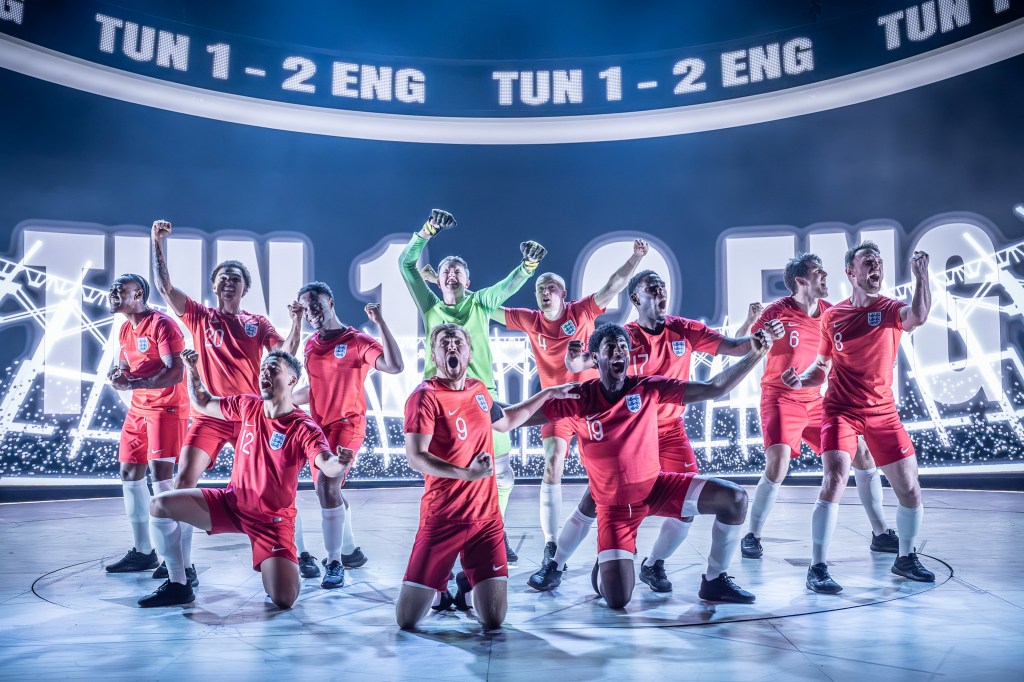
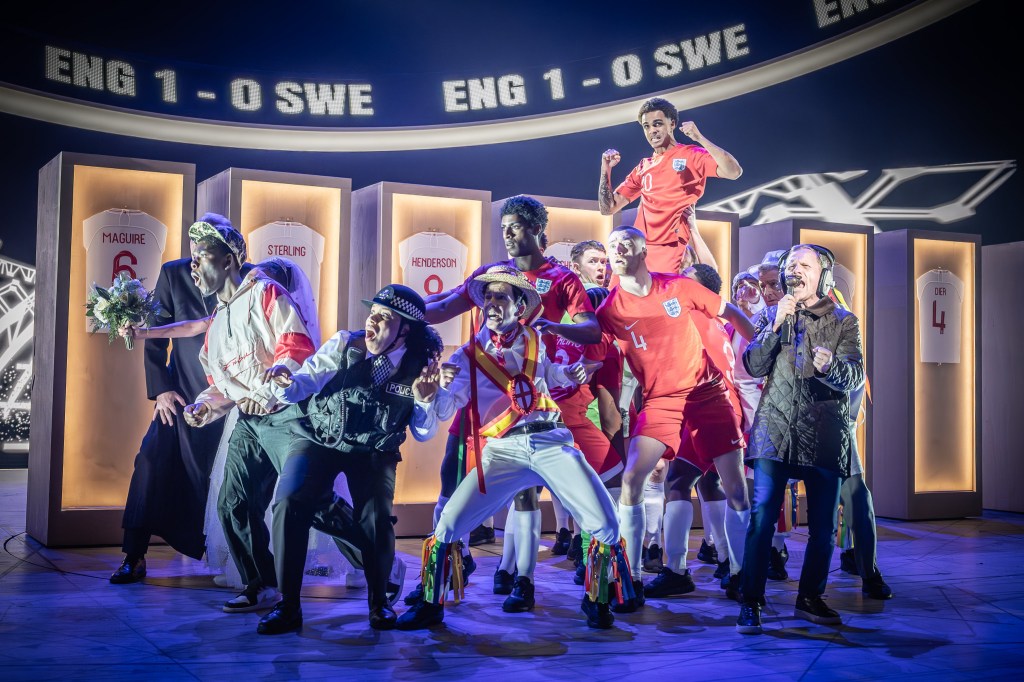
Following the fascinating story of Gareth Southgate’s memorable eight years as England Manager this National Theatre production has all the exhilarating highs and gut-wrenching lows familiar to football fans; however, it goes far beyond the sport itself offering a thrilling and insightful exploration of culture, connection and what it means to hold the hopes and dreams of a nation in your hands.
Having updated the ending to reflect England’s 2024 Euro’s journey, writer James Graham grabs every opportunity to show the audience that this truly is a game of two halves, at times joyous, other times brutal but always authentically honest.
Beginning with a flashback to Euro ’96 as a young Southgate steps up to take the now infamous missed penalty, this moment cleverly sets the tone and returns as a running theme to challenge Southgate (Gwilym Lee) throughout the piece. As we fast-forward to 2016 we see Southgate drafted in as caretaker manager following Sam Allardyce’s sacking after just one game in charge. Determined to make a positive change and do things differently, Southgate brings in sports psychologist Pippa Grange (Liz White), what follows is an incredible journey that goes way beyond football.
Taking on the role of Southgate is an impressive Gwilym Lee, having seen Lee portray Brian May so accurately in Queen biopic Bohemian Rhapsody it comes as no surprise that he hits the mark once again. With every measured tilt of the head, folding of the arms and blink of the eyes his nuanced performance is perfection. He leads this fine cast with a gentle hand and captures the essence of Southgate perfectly.
Liz White as Pippa Grange is a consistent presence of calm, challenged by resistance from both players and coaching staff she never wavers. Graham in his writing uses Grange’s character to gently remind us that while Southgate was becoming a mentor and father figure to many in the team he was also battling his own demons, struggling to show himself the kindness he was so brilliantly instilling in others.
The ensemble cast compliment Lee and White perfectly, they portray their real-life counterparts with incredible accuracy. Josh Barrow as Jordan Pickford is mesmerising. He fizzes with energy throughout, his subtle shift from raw, untamed, chomping at the bit goalie to trusted teammate and backbone of the squad by the end if fascinating to watch.
Ryan Whittle steps into Harry Kane’s Captain’s boots with a well-observed nervous hesitation and grows in stature throughout while Gamba Cole as Raheem Sterling opens up to reveal his fears and disappointments as he learns to trust in his team mates.
While there is incredible humour and lots of it, the play doesn’t shy away from the harsher themes that sadly have dogged both football and English culture for many years. Most notably here the appalling racism faced by young black players specifically during the 2020 Euros final. Tane Siah, Jude Carmichael and Kadell Herida as Bukayo Saka, Marcus Rashford and Jadon Sancho highlight these dark moments with an honesty that reminds you just how quickly supposed loyal fans can turn and just how important standing up collectively to that hopefully small minority truly is.
The ensemble cast work tirelessly to showcase Rupert Goold’s inventive staging (with Elin Schofield as revival director) with a slick, swift brilliance. Co-movement directors Ellen Kane and Hannes Langolf score no own goals with their incredibly tight sequences as this cast convincingly recreate matches, penalty shootouts and meaningful dressing room moments. Es Devlin’s inspired set design is perfectly lit by Jon Clark while Dan Balfour and Tom Gibbons sound design and Ash J Woodward’s video design hit the back of net.
From euphoria to crushing heartbreak, Dear England takes audiences on a thrilling journey inviting us into the very heart of the action, allowing us to scratch way beyond the surface with its carefully crafted storytelling and visual brilliance. We live through the highs and the lows as one with the team, willing for the result to be different, hopeful, heart-warmed and inspired by the end of this groundbreaking piece. This is theatre at its absolute finest which taps right into the heart of what it is to be human, to believe in yourself and to have the bravery to face your fears regardless of the magnitude of the situation.
Whether you’re a football fan, a theatre fan or just love a fascinating story brilliantly told this is a must-see production that will capture the imagination of audiences night after night, so good, so good, so good!
Dear England is on at The Lowry until Sunday 29th June, tickets are available here.
Following a record-breaking run in the West End the National Theatre, Olivier award-winning production of Dear England comes to Salford from 29th May for a four-week run.
Written by award-winnng writer James Graham (Sherwood, BBC) and directed by Rupert Goold (Patriots, Cold War), this incredible play tells the uplifting, inspiring and often emotional story of Gareth Southgate’s revolutionary tenure as England manager. We all know the feelings of hope, heartbreak and elation being an England fan entails, Dear England dramatises this incredibly through one of the most ground-breaking and exhilarating pieces of theatre you’re ever likely to see as the reality of expectation and reality play out.
Ahead of its arrival in Salford next month we headed to the capital to catch this 5-star production and chat with four of the plays talented cast. Gwylim Lee (Gareth Southgate), Liz White (Dr Pippa Grange), Josh Barrow (Jordan Pickford) and Jude Carmichel who makes his stage debut as Marcus Rashford.
How challenging is it to play such well-known characters who are so prevalent in the media?
Josh Barrow (Jordan Pickford) : You don’t get much in terms of characterisation when they’re on the pitch they are very much their player self and the same really in the post-match interviews so you’re gonna have to go digging for scenes like in the locker room for example when it’s just them and you have to kind of make your choices with the characterisation that you make that’s when you get to play around a little bit. I think you don’t want to ever become a caricature of that person because they are so prevalent at the other top of their field, and they are still at the top so you still want to be able to serve them and also holding in mind the ideas from the play of what they have learnt and their ark from what Southgate has taught them.
Gwylim Lee (Gareth Southgate): I think we benefited during Southgate’s tenure from them opening up to the England fans with social media and everything else because we now get to see those YouTube videos for instance that go behind the scenes at St Georges and that’s really illuminating because when you watch them do post-match interviews they present in a version of themselves which is quite considered and placed for the media whereas when you see them in those videos when they’re with the inflatables in the swimming pool or just messing around that’s when you see them kind of free and without those constraints.
While you’re not a caricature of Gareth Southgate and I just wonder how much study you did because your interpretation is so convincing.
Gwylim Lee (GS): You start from the outside in when you’re working with a real person, which is kind of the opposite way round to how I would probably usually approach a character ’cause so much of it is just there for you to find but I suppose the trick is to find the whys, you know constantly ask that question, the physicalities like ticks and twitches and whatever his mannerisms might be, I wonder why he moves like that what is it about his character that makes him move like that. When you start filling in that kind of light and shade and that detail then it becomes less a mechanical thing and more a matter of character or intent you can let the mannerisms play out through the intentions that you are playing in the scene and the person that you’re in a scene with and all that stuff so that’s the hope anyway. We’re not impersonators, we’re actors and so the aim of an actor I hope is to try and find humanity of the character and also to find you in that character a little bit so it’s like this is very much my version of Gareth, I’m not trying to be a Rory Bremner or whoever else and yes they’re talented in what they do but I think it’s a different kind of craft so it’s just about trying to find your version cause we’re all playing those real people.
The staging is so impressive featuring three revolves, how much of a challenge is that when you’re performing?
Josh Barrow (JP): We had a whole portion of the rehearsals to learn how to use the revolves as it’s three tiers so one goes this way, the other goes this way, the other goes that way so we do we have to really practice hard how to walk on a moving stage.
Liz White (Dr Pippa Grange): I wasn’t there that morning and when we were in the rehearsal room doing the second scene when Pippa meets the security guard and then she walks through the locker and then has to cross all revolves, literally every time I was doing a Frank Spencer, going flying, thankfully I’m alright now ha ha.
Gwylim Lee (GS): You’ve just got to be braced for it at all times, just keep your knees slightly flexed, jut in case it goes!
Liz White (Dr PG): I don’t know if anyone else gets it, but I find when I’m on a train platform I suddenly get that moving sensation like the floor is moving.
Jude, how does it feel knowing you’re going to be playing Marcus Rashford a stones throw from Old Trafford?
Jude Carmichal (MR): When my agent called me to say I’d got the job it was like the fear came through, I was thinking when we go to Manchester everyone’s gonna be like ‘Go on then’ ha ha.
Gwylim Lee (GS): When you get closer to the weekend you get some football crowds in and that’s really that’s really fun ’cause you know you’ll have people that react when the players come out and say I’m Leicester City or Man City etc, I love it.
Josh Barrow (JP): We feed off that really, when you go to the theatre you sit down, you watch the show, you applaud the actors but I think with this it almost demands participation, it’s like we’re gonna throw this out to you and there’s laughs and cheers even boos but then it culminates in this a massive party at the end which is Sweet Caroline and I think the more a crowd lean into that and the more a crowd really give themselves over to you the more fun. As you said (Gwylim) when we do get some football fans in an audience that end moment is just wild, almost like a rock concert.
Gwylim Lee (GS): We talked in rehearsals a lot about having A’s, B’s and C’s so A’s would be your football buffs people that you just know everything all the way back and then C’s being that polar opposite. I’m probably a C+, maybe even a B now. But the play appeals to all three it has to appeal to all three of those audiences at any one time people come not knowing anything about football but it resonated on a different level and then polar opposite people come expecting it to be a football play which it is but then it’s a kind of Trojan Horse it’s about so much more.
This play feels so special because while we know the outcome we all watched and still felt hopeful, thinking just maybe just maybe…
Josh Barrow (JP): You clock audience members at the end of like the penalties at the end of Act One and everybody knows how it goes as it was such a big moment, but everyone is sat watching gripped and is so engaged, it’s just perfect.
Jude Carmichal (MR): You kind of get swept up in it, while you know the outcome obviously, you know what it means to be a fan watching and then even the aftermath whether that be good or bad you know that meaning, you can’t help but get caught up in it.
Josh Barrow (JP): With penalties it’s almost like the Colosseum there’s a roaring crowd cheering and cheering then this one person steps up in front of everybody and its gladiatorial and you feel that with the audiences that everybody’s watching you.
Jude Carmichal (MR): When Harry misses his penalty every time backstage I’m like arrggghhhhh.
Gwylim Lee (GS): It’s testament to these guys as well, because it’s a show it has to have a shape to it and a choreography to it which has to be kind of the same every night you know ’cause there’s a production that fits in around it but you can’t just go through the motions and do the moves, these are young athletes at the pinnacle of their game at the highest level of performance with adrenaline coursing through their bodies and you can’t just run to the penalty spot and take it, you’ve gotta fill it with all of that and they do every night they do and every rehearsal they do like there is no let up for the boys they work so so hard and that’s what sells it really.
Josh Barrow (JP): With Jordan Pickford when he’s on stage there’s so much tension, he’s almost rattling in the best kind of way and again that goes back to what we were saying before about making them real people I’m sure Jordan Pickford doesn’t go home and he’s like that, when he’s in the scenes in the class room that’s when you get to play around with it a little bit more, there’s not just that one version of him so you think about how he’d respond to Pippa to Gareth to the other players. It almost feels like an engine constantly running, I keep that image in my mind, everybody else is charged as well and you have that feeling that the keeper at the back like the last line of defence.
Have any of you performed at the Lowry before?
Gwylim Lee (GS): I was part of a tour years ago where we did King Lear up there with Derek Jacobi, I’m looking forward to going back, I love it, it’s a beautiful theatre and a perfect match to the Olivier, it’s a very similar kind of spaces and a great city it’s gonna be fun taking it to a new audience up there and seeing how they’ll respond to it.
There are so many themes in this play what do you want audiences to take away from it?
Gwylim Lee (GS): It was very interesting watching Gareth Southgate’s lecture last week and it feels like everything that was kind of touched on in that lecture is the heart of this play and it really is about resilience and belief and it’s trying to give people resilience and really encourages resilience and belief in people.
Liz White (Dr PG): Masculinity is an interesting part of it too, I’ve really enjoyed researching Pippa because I get to listen to all her strategies and her approaches for a better, calmer life and one that’s filled with deeper joy and deeper loss as well. She talks about how to lose, someone laughed today as I said well England have to learn how to lose and I thought, yes I can imagine it sounds quite defeatist but actually what she’s just saying is if you can look at it in a very reflective way and let that feed the way you approach your next battle or your next match…so I feel kind of infused by her lessons really and I hope that for people watching it as well to look at the way they approach things differently in a more whole, holistic way.
Gwylim Lee (GS): I think one of my favourite things of Pippa’s is when she talks about winning that’s kind of inferred in the play is the idea of winning deep and winning shallow and there’s a difference to just winning at all costs. It’s like winning with integrity and winning you know with depth.
Liz White (DR PG): I feel like that means that actually if you got out there and play with integrity after all your prep and put the effort in regardless of the outcome you’ve won. I think interestingly when COVID gets mentioned it’s so poignant as we’re not far away from it and yet we have enough time for hindsight to come in and when the Euro’s came to Britain as a bit of a surprise for us all it was the first time a lot of people have been able to go out together and even watching it from home we really needed it you needed to see.
Gwylim Lee (GS): We need these national moments of togetherness because when have them you realise how brilliant this country is and how great the people in it are and it’s a divided world at the moment, even at times a divided society. When Gareth wrote that Dear England letter it was a galvanizing moment, encouraging people to come together, there’s something about this country and when we do come together it’s brilliant and has power and strength and it can be glorious. He says I tell my players that what we are all a part of is an experience that lasts in the collective consciousness of our country and there is such a thing as a collective consciousness of England. I think that’s why this play has such power because it taps into that collective consciousness and hopefully that’s what audiences take away from it. There’s hope, there’s joy, there’s power in being together.
Liz White (Dr PG): On a very base level all of those things say, you’re not alone. Someone else is there having the same experience as you, it’s so powerful.
Gwylim Lee (GS): There are a lot of parallels, sport is about performance, we’re dealing with fear, I was scared about taking on this job,I read the script and thought yes you’ve got to take on your fears and go for it. Put yourself in the uncomfortable position and see what happens.
Dear England opens at The Lowry on Thursday 29th May and runs until Sunday 29th June tickets and further information are available here.
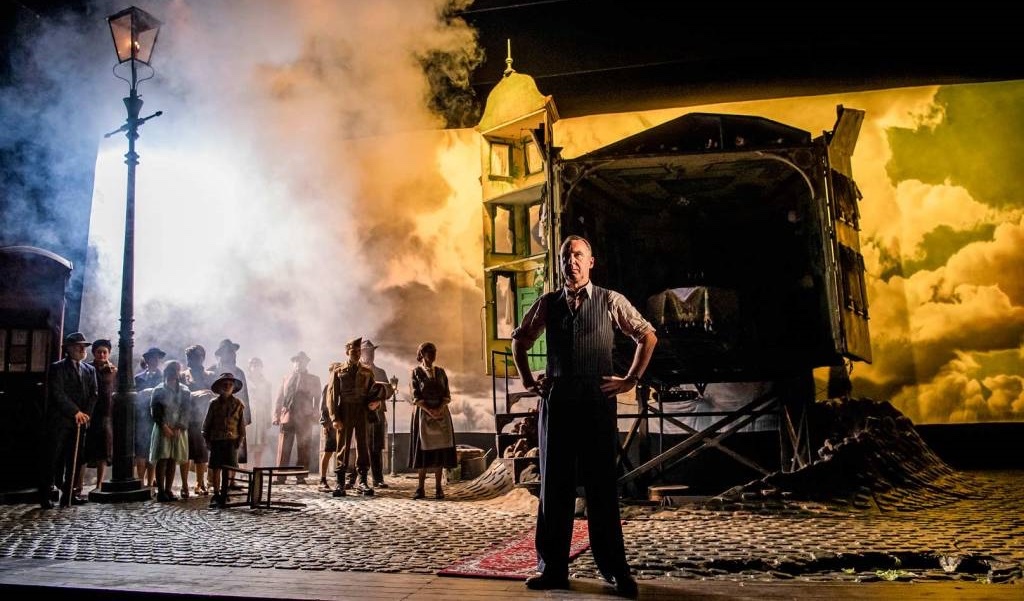
It’s been 17 years since Nick Stafford’s adaptation of writer Michael Morpurgo’s novel, War Horse first hit the stage. When the book was originally published in 1982, it’s impact was moderate, however, with time and a little attention from The National Theatre, this heartbreaking, beautiful story was brought to brilliant life, and still today both the book and play manage to wow and amaze audiences of all ages.
Telling the story of Devon farm hand, Albert Narracott (Tom Sturgess) and his relationship with a foal, Joey. A family feud between Albert’s father Ted (Karl Hynes) and his brother, Arthur (Gareth Radcliffe), sees the pair try and outbid each other for a young horse, at market. Ted wins the battle for the horse, but at a hefty financial price.
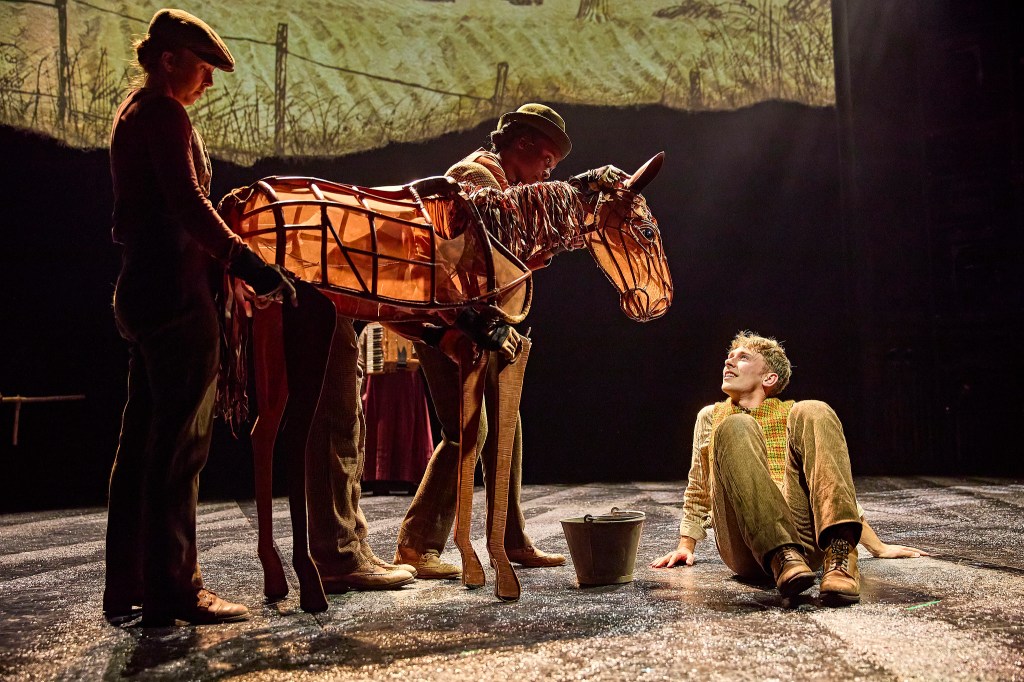
With Ted not really interested in the care of the horse it falls on Albert, who with time, patience and a unique understanding strikes up a special friendship with Joey. As Joey becomes a fully-grown colt the pair can be seen coursing through the fields of the village, and eventually he becomes a great asset to the family in the upkeep of the farm.
However, with the outbreak of World War One, Joey is sold to the war effort by Ted, seemingly ending the friendship between Albert and his beloved horse. With Joey out on the frontline somewhere in mainland Europe, Albert refuses to give up hope of being reunited with his horse and a year later enlists in the army, much to the anguish of his mum, Rose (Jo Castleton). So begins a journey that will see them both face great peril and adversity which will change the pair forever.
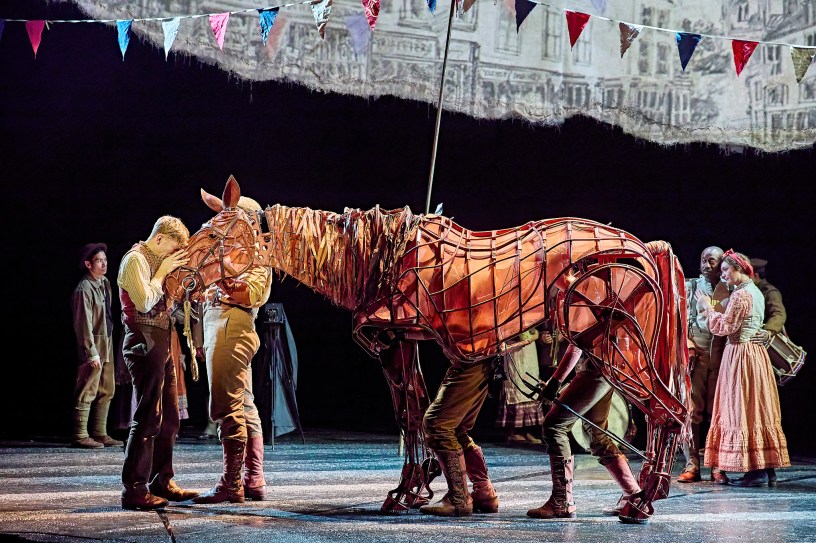
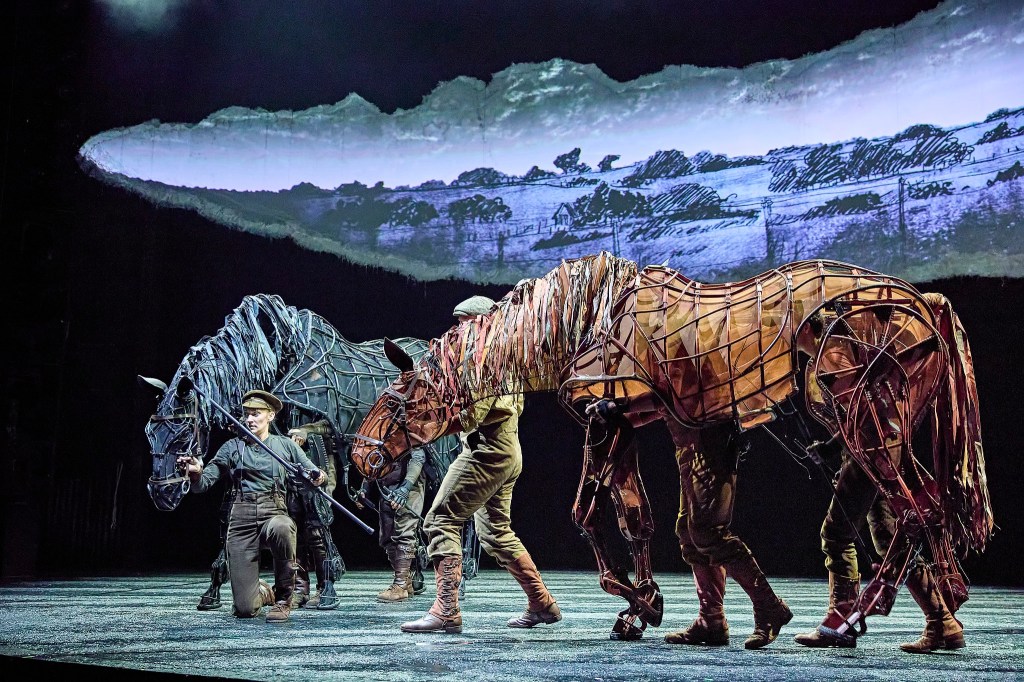
War Horse is live theatre at its finest: high production values from start to finish, captivating storytelling and an ensemble cast at the top of their game. Visually it’s as close to perfection as you’re likely to see. The mesmerising puppet control of the Handspring Puppet Company who bring not only Joey to life, but other animals including the great stallion, Topthorn and the Norrcott family’s sassy goose. This exceptionally talented group of puppeteers/actors pack these creatures full of character and personality: this married with the superb attention to detail on each puppet makes for a visual treat.
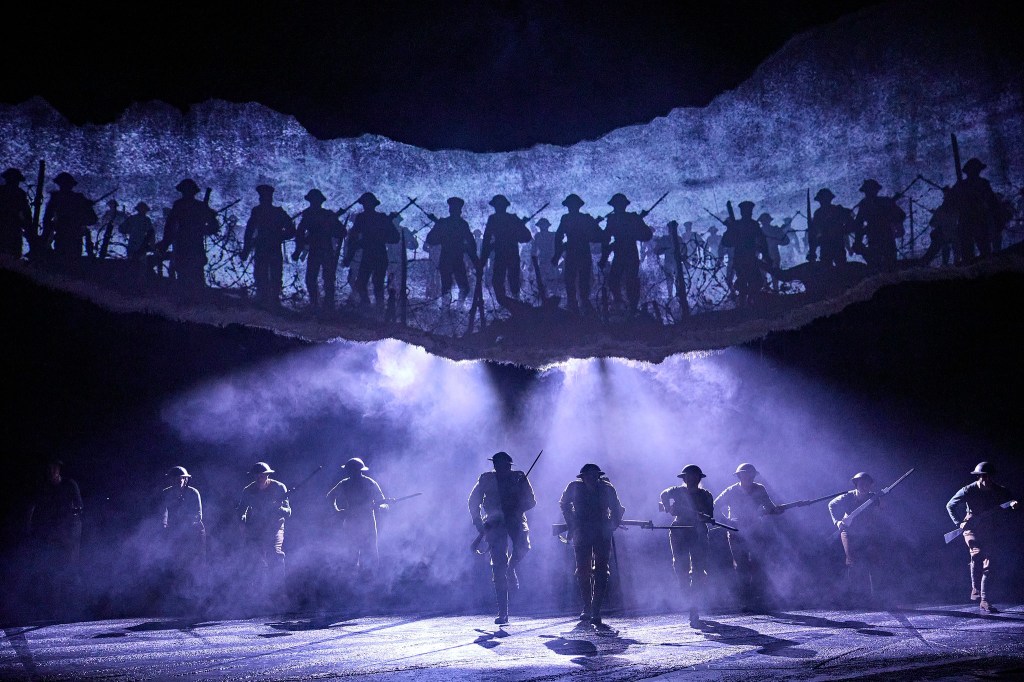
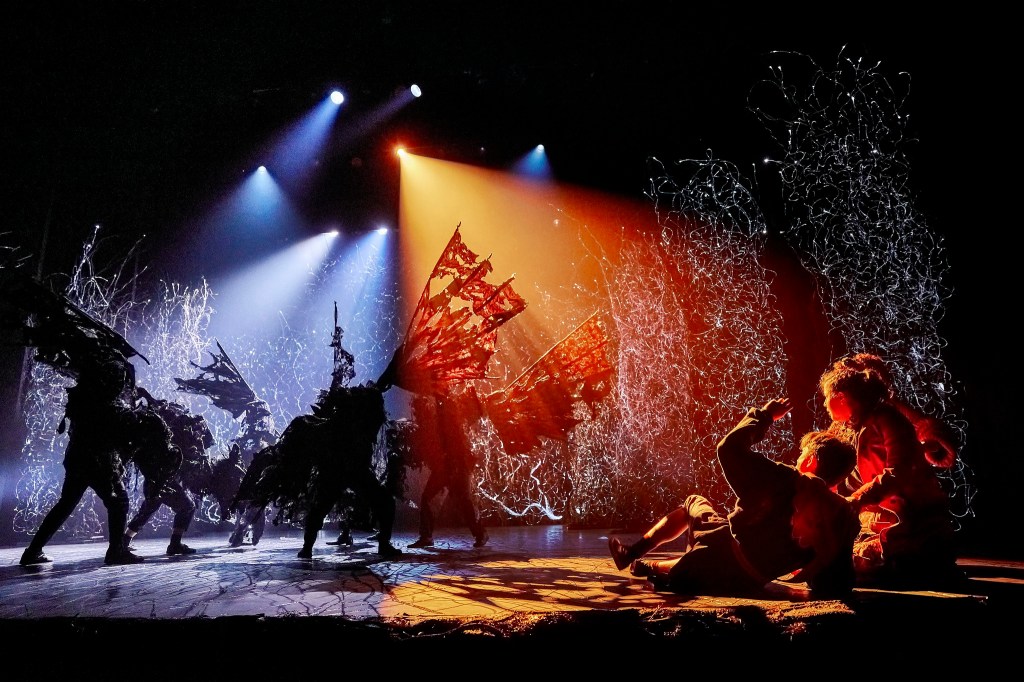
The set is minimal, with the idyllic Devonshire countryside and later the barbaric battlefields of the Western front made real using a mixture of drawings and animation, screened across white fabric at the top of the stage. The visuals lurch from the tranquil to the brutal and work in a unison with some spectacular lighting and thunderous sound design.
War Horse doesn’t pull its punches on the brutal nature of war. Characters come and go, with very little pomp and ceremony, all the death and destruction seen through the eyes of either Albert or Joey. We are fully exposed to the horrors of the frontline from both sides of the conflict, as well as the dangers for all the serving horses too. As you would expect, at times it’s bleak, even shocking but there is also plenty of warmth, humour and kindness, from Nick Stafford’s classy script, which shows the best and worst of humanity.
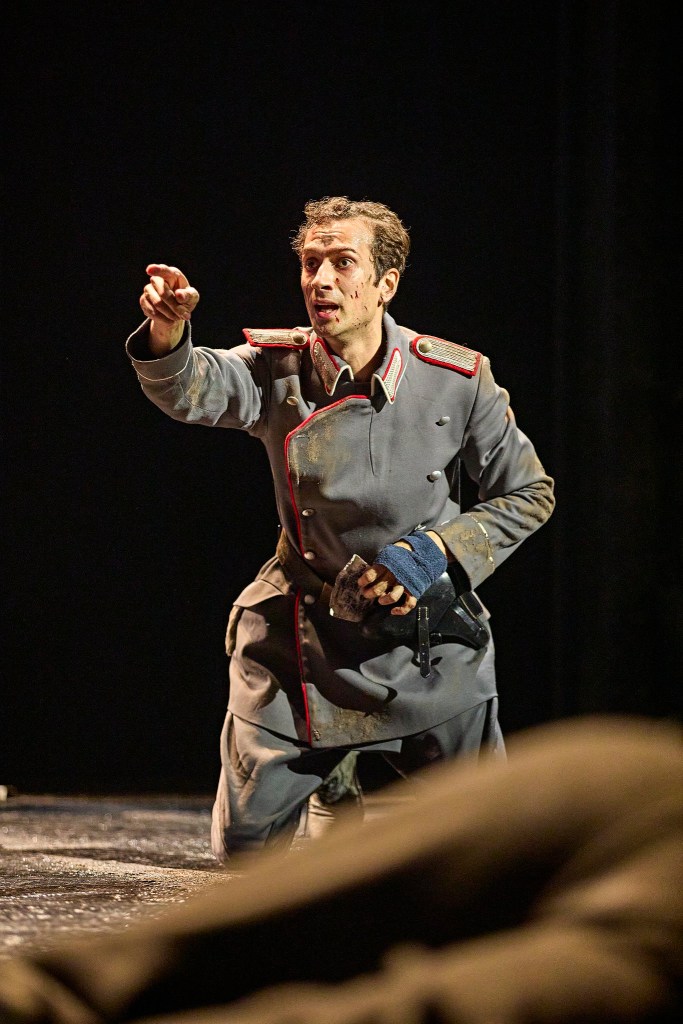
Tom Sturgess gives a fine central performance as Albert, a turn filled with warmth, and determination. In addition there is a solid outing from Alexander Ballinger as the German Captain Freidrich Müller. It’s a performance filled with anguish and compassion. With the subject matter it would be easy for the production to drift into melodrama but under Katie Henry’s direction the whole ensemble cast give measured and at times understated performances, which is one of the show’s key strengths.
The production showcases the extraordinary vocal talents of Sally Swanson who brings to life the compositions of Adrian Sutton and the lyrics of folk music legend Jonathan Tams. Swanson has a tremendous voice, as she glides from scene to scene, soundtracking moments of beauty between Albert and Joey, and the anguish and fallout from the war.
This is a sublime production that can be enjoyed by audiences young and old alike with some startling imagery that will live long in the memory coupled with a powerful message of hope. With a tour going to the end of 2024 and well into 2025 this magnificent beast of a show shows no signs of being put out to pasture, and on today’s performance it’s easy to see why.
War Horse is at the Lowry until Saturday 28th September. Tickets are available here.
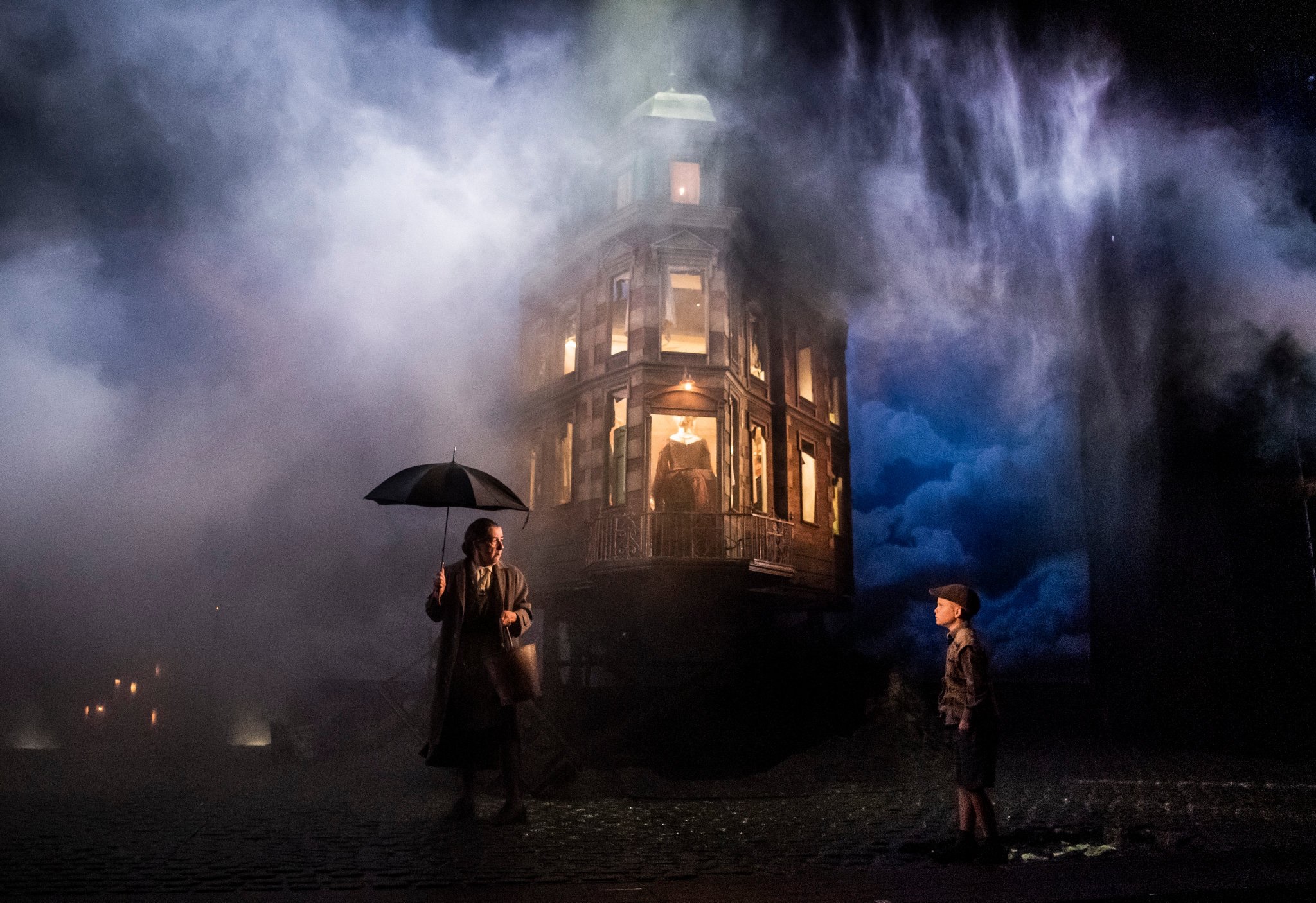
At the festive time, The Lowry, has always made some bold choices for their big Christmas show. Past shows have seen family favourites and classic works of literature brought to the Lyric Theatre stage with great success. Well, this Christmas the Lowry has made their boldest choice to date, with the National Theatre production of The Ocean at the End of the Lane and boy does it pay off. If the old saying of, “fortune favours the brave” is anything to go by then those rewards go to the audience members who will be treated to a gripping, powerful, fantasy, brought to life in truly jaw dropping fashion, with spectacular visuals and performances that will live long in the memory.
Based on the 2013 novel by Neil Gaiman and adapted by Joel Horwood, the production opens in the present day, as a nameless man (Trevor Fox), buries his father, he comes across a place familiar to him from his childhood, where he encounters a rather eccentric, yet familiar old lady. It is here that man is transported back to his 12th birthday where his world would change forever.
Set in the early 1980’s the nameless boy (Keir Ogilvy) has stumbled on a truly shocking incident, his father (Fox in a dual role) attempts to shield him from this, fortunately a young woman, Lettie Hempstock (Millie Hikassa) offers to take the boy to her family farm until the incident is cleared up.
It’s down on the farm that the boy meets Lettie’s family: her mum Ginnie (Kemi-Bo Jacobs) and her granny, Old Mrs Hempstock (Finty Williams), the eccentric lady we met at the start. Through his friendship with Lettie that the boy witnesses a series of pretty freaky occurrences such as lifeless fish, dead from swallowing a 50 pence piece, Lettie and her family’s ability to predict the future right before it happens, talk of creatures that regularly infiltrate our world, and finally a puddle of water that is a portal to alternate reality.
Back at home the boy struggles with recent events, in addition there is a far from perfect homelife: he is motherless, has clashes and petty squabbles with his sister (Laurie Ogden), and an inability to communicate with a father trying to do the best he can with his children.
The situation becomes all the worse, when the eponymous young man and Lettie do battle with one of these invading beasts and unwittingly unleash another creature. The being infiltrates the boy’s home in the guise of glamorous lodger, Ursula (Charlie Brooks) who morphs into exactly what the family crave, a mother figure to the children and a companion and lover to the father. Along with Lettie, and her family of strong-willed mystics, the boy must confront his fears in order to save his family, and himself from a monster that knows his every fear and every desire.
As productions go this is truly EPIC, and one that will astound, amaze and exhilarate its audience. After an initial gentle start where you try to figure out what’s going on, and what’s going to happen (I know all the fun stuff!) the action kicks off with a stunning and beautifully choreographed battle that begins a series of mind-blowing set pieces, which will enthral as they will send a shiver down the spine!
The performances are fantastic: Keir Ogilvy and Millie Hikasa are wonderful as the misfit, best friends, it’s a beautiful partnership filled with warmth, quirkiness and genuine friendship. The pair bounce off each other throughout and are the beating heart of the show. EastEnders Charlie Brooks, complete with Glen Close hair from Fatal Attraction is brilliant as wicked seductress, Ursula. Sometimes you wish Brookes would get to play a nice character for a change, but why should she when she does evil so well.
There are strong supporting performances throughout from Trevor Fox in a measured, restrained turn as the tired, beleaguered Dad, whilst Finty Williams and Laurie Ogden between them have the lion’s share of comedic lines.
Director Katy Rudd has masterfully brought this much cherished book to the stage using talent at the top of their game. The set design by Fly Davis is eerie, and intimidating, bringing the woods to life where most of the drama unfolds. Whilst the scenes in the Hampstock kitchen resemble that of a painting or a Peter Greenaway film.
The lighting and sound design by Paule Constable and Ian Dickinson respectively are pretty much perfect, atmospheric, and a proper shock to the senses when they need to be.
For older people like myself this is a hark back to fantasy adventure films of the 1980’s from Never Ending Story, Legend and The Return to Oz (the Wheelers I’m thinking of you!). Whilst younger audience members will associate this with Stranger Things. For fans of this genre, you’ll absolutely love this. However, it’s all that and so much more tackling issues such as loss, grief and the importance of talking to our loved ones.
It’s an unsettling, magical piece of theatre, which will blow you away and fully demonstrates just how good live theatre can be. I cannot urge you enough to go see this production this holiday season, so what you are waiting for go book your tickets NOW!
The Ocean at the End of the Lane is at the Lowry until 8th January, tickets available here.
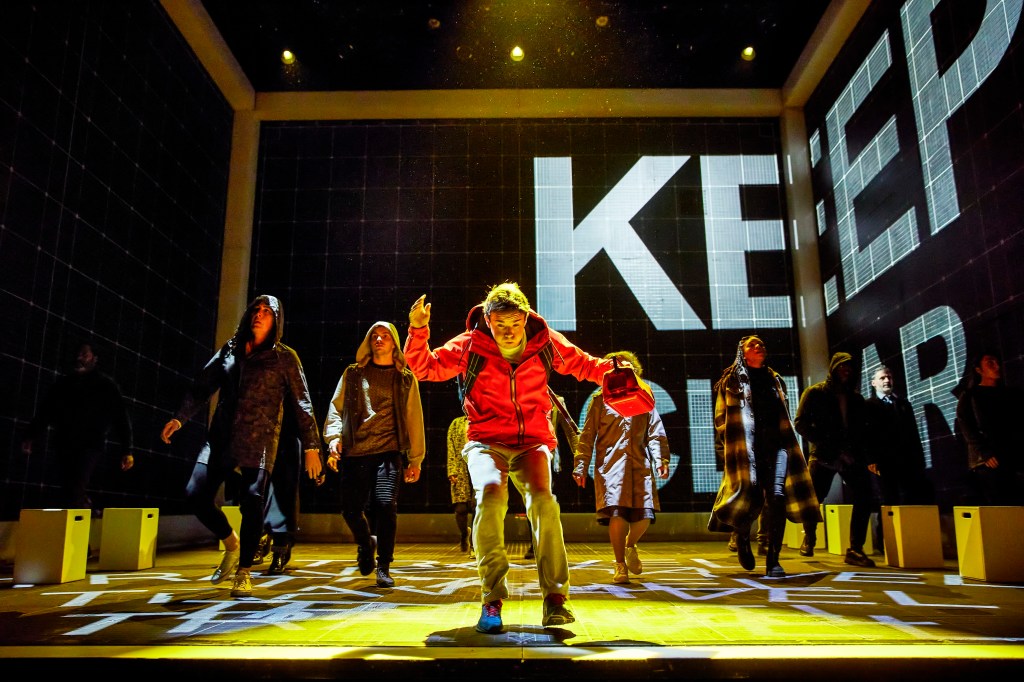
The National Theatre’s multi award-winning production The Curious Incident of the Dog in The Night-Time, retuned to the North West this week, taking up residency until Saturday 12th March at Manchester’s Opera House.
The stage adaptation of Mark Haddon’s international best-selling novel is both captivating and deeply moving. Telling the story of fifteen-year-old Christopher Boone (David Breeds) who at the very beginning of the play discovers the murder of his neighbour’s dog, Wellington. Immediately under suspicion himself, Christopher sets about on a thorough and detailed investigation to discover exactly who has caused Wellington’s demise.
Christopher is an extraordinary boy; complex and remarkable; he sees the world in super fine detail. Colours are more vivid, sounds are louder, people are confusing, and the world is often a very overwhelming place.
As the story develops, we learn more about Christopher’s complexities as he struggles with communication and physical touch, even from his parents in the most difficult of situations. This proves extremely challenging for his parents at times, which results in an extremely powerful alternative connection being portrayed where he uses only his fingertips to connect with them. You can really feel the pain his mother is going through in these scenes which are beautifully portrayed.
David Breeds makes for an excellent Christopher, physically giving his all to the role you desperately want him to succeed and are utterly transfixed by his every move. His interaction with his schoolteacher Siobhan portrayed perfectly by Rebecca Root is wonderful, this gorgeous pairing really complement each other, her belief in his abilities is unshakable while her ability to calm him when life gets overwhelming is truly special.
Movement is a huge part of what makes this play so exceptional, Director Marianne Elliot along with Movement Directors Scott Graham, Steven Hoggett and Adrian Sutton have created something extremely memorable. The piece is visually stunning while the cast mesmerise as their fluid movement is seamless throughout.
Designer Bunny Christie, Lighting Designer Paule Constable, Video Designer Finn Ross and Sound Designer Ian Dickinson give the audience a remarkable insight into the heightened sensory world Christopher lives in. A real standout scene being when Christopher goes on a journey to London. The use of sound, lighting and physical theatre really brings the busy, bustling London Underground to life and allows us to see the world through Christopher’s eyes. It shows starkly just how harrowing navigating the world can be with a social disorder.
This thought-provoking, funny, inspiring play proves once again why it’s one of The National Theatre’s most loved productions. It’s full of heart, packed with humour and most importantly hope. Visually stunning with unforgettable storytelling, Curious Incident is theatre at its finest.
The Curious Incident of the Dog in the Night-Time is on at Manchester’s Opera House until Saturday 12th March, tickets available here.
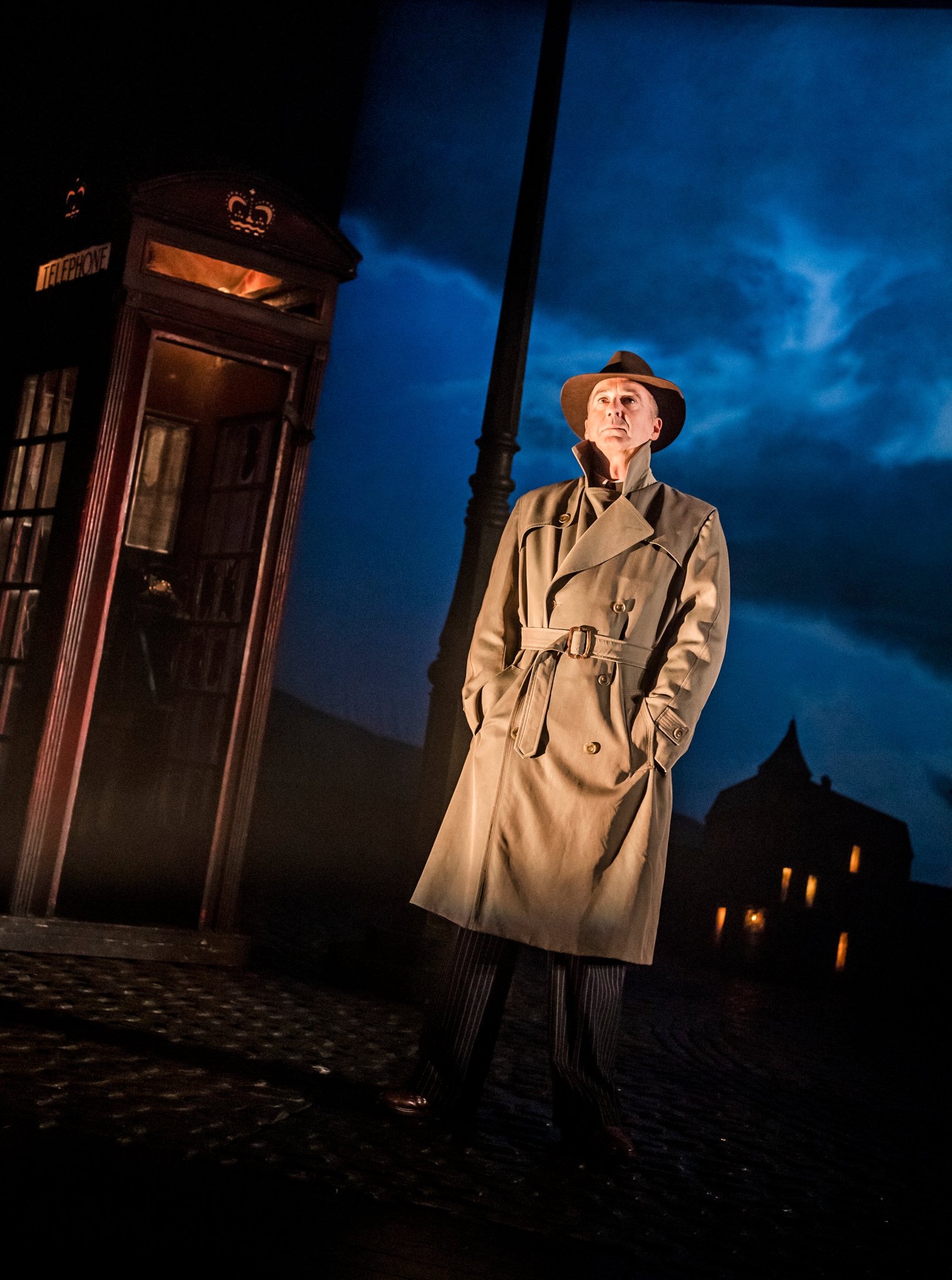
Having been seen by over 5 million people since its premiere at the National Theatre in 1992 Stephen Daldry’s ground-breaking production of J.B. Priestley’s classic thriller comes to the Lowry this week as part of a UK wide tour.
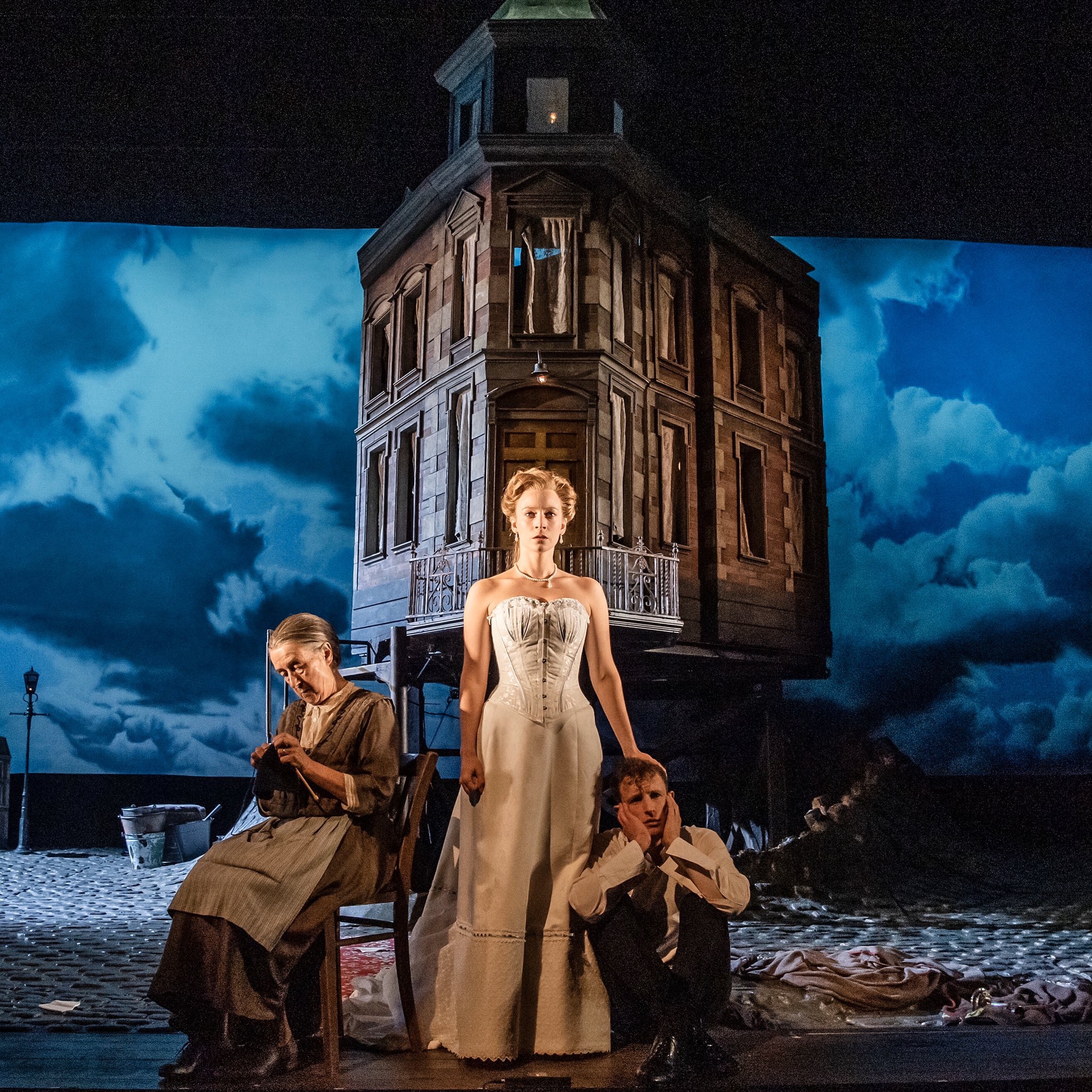
Celebrated by audiences and critics alike its dramatic edge and clever theatricality remains. Set amidst a bleak, ominous backdrop we see a strange almost doll-like house, claustrophobic and precariously balanced. The laughter and chattering of the family within rings out, they are as yet unaware of whom lies within the wings waiting to unravel and expose their harmonious gathering.
A young working-class girl has committed suicide and it is Inspector Goole’s belief that each and every member of this loathsome family has played some influential part in her tragic demise. Daldry’s radical reimagining of this theatre heavyweight is strong in its impact and stirring in its message, the theatre packed with GCSE pupils, a clear sign of the continued relevance of this captivating piece.
Liam Brennan takes on the role of Inspector Goole, initially calm yet commanding he both examines and exposes each member of the elitist Birling family meticulously. Cocooned by their privilege he draws them out one by one rocking their very foundations and exposing their cruel entitled behaviours.
Each character is developed fully and delivered convincingly by an incredibly strong cast with special mention going to Chloe Orrock as daughter Sheila Birling whose journey from spoilt and materialistic to unravelled, ashamed yet reflective offers real hope for change.
Daldry’s exceptional direction clearly illustrates that the change Priestley wishes to see in the world must come from the younger generation, where they repent and reflect, their parents scrabble round in the gutter grabbing at their silverware polishing it in the mud, still grappling for their place at the top of the social ladder. Silent character Edna, (Linda Beckett) maid to the Birling family observes the fall-out while becoming more and more relaxed in her manner as the family fall from grace.
Designer Ian MacNeil’s intricate set design is strikingly impressive while Rick Fisher’s lighting adds to the atmosphere and intensity pairing wonderfully with Stephen Warbeck’s ominous soundtrack.
Whilst socialist Priestley wrote the play as a blistering criticism of capitalist society it very much remains a play for today with its message of social responsibility and consequence strikingly relevant. The piece illustrates perfectly how everything is connected and how our own individual actions impact others while using its platform to call for a kinder, fairer and more compassionate world. This thrilling adaptation is both slick and stylish, delivering a message that will stay with you long after the curtain call.
An Inspector Calls is on at The Lowry until Saturday 18th January tickets available here.
When one of Salford’s most iconic plays comes back home to its birthplace, there’sbound to bea huge weight on the company performing it to get it right. The National Theatre set itself the challenge ofdoingjust that by making one of the first stops on its UK Tour ofShelagh Delaney’sA Taste of Honey, The Lowry.
Director BijanSheibani, who is at the helm of this production,has managed torise to the challenge though,as it received an encouraging reaction from the audience on press night.
Sheibanitakesthe play back to its rootsin thisboldincarnation, whichechoeshow it wasoriginallyperformed, adding the incorporation of music.There’s alive band onstage throughout,which accompanies the characters in solo numbers andplaysunderneath some of the dialogue, which helps evoke the mood of the piece.
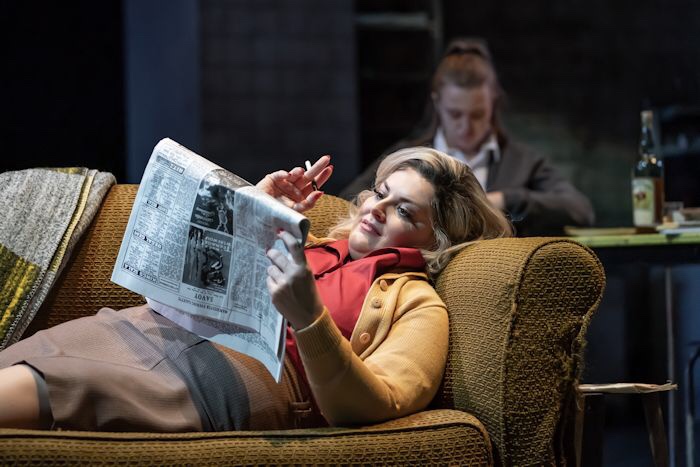
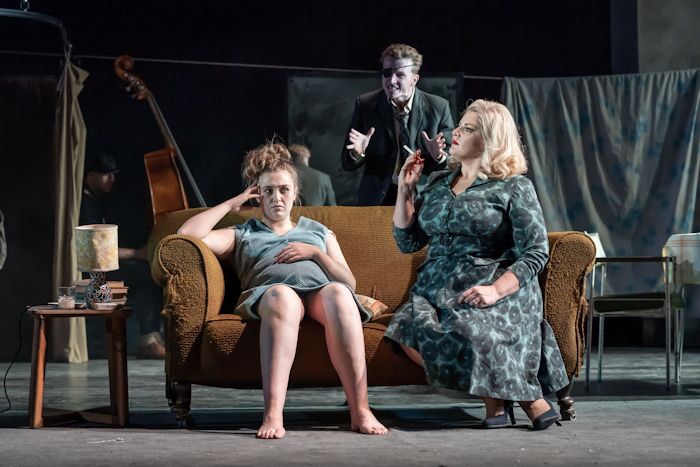
For those whoareunaware of the story behind the Shelagh Delaney classic,ATaste of Honey is essentially a grittynorther tale ofthelove-haterelationship betweena working-classsinglemotherHelenandher daughter Jo, set against the stark backdrop of 1950s Salford. The play was penned by 19-year-old Shelagh back in 1958 and it’s hard to believe that at such a young age the local girl, who had very little experience of seeing shows let alone writing them, could produce such prolific work which would resonate with generations to come.
Lancashire borntheatre and TVstar JodiePrengerputs inasolid performance as northern matriarch Helen making the mostofthe acid tongue humourgifted from Delaney and her natural comedic delivery, prompting huge amounts of laughter from the audience. We also get the chance to see Prenger put her impressive vocal chords to good use as she packs a punch with the opening number ‘A Good Man’ (a soulful track reminiscent of some of the late Amy Winehouse’s repertoire).
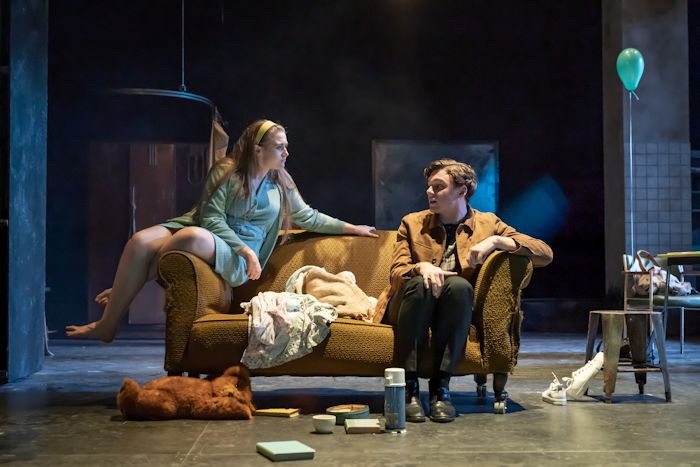
Gemma Dobson’s portrayal ofJocreates a characterthat’slike marmite–youlove hervulnerabilityone minutebutwant tothrottleherfor her outburststhe next. Dobson’s whining edge to Jogets alittle tedious inthe second halfof the play but overall her sweet sceneswith Jimmie(her sailor love interest)andGeofmake up foritand we see herperformanceof the troubled teenreally come into its own.
Despite the play beingprimarilyfocused around the two main female roles,Jo and Helen, the stand out performancecomes from one of the males in the cast,Stuart ThompsonasGeof. Thompsonis a delight to watch anddisplays a natural sensitivity as Jo’s gay best friend. Thompson manages to find a balance ofcampnessand caringin the roleofGeof,whostruggles with his worries of being an outcast in the 1950s societywhilst looking after his pregnant friend.
Elsewhere,Hildegard Bechtler’s contemporarydesign of the production adds to the bleakness of the piece with a minimalist set complete with stark and dingy lighting.Everythingseems shabby and in need ofTLC,except for Helen’s brash and glam outfits whichextenuate her desire to appear better than she isin reality – which you could say epitomises the phrase ‘all fur coat and no knickers’.
There have been numerous productions ofA Taste of Honeysince it opened on stage over 60 years ago and the National present a good versionhere,which really highlights the comedy and pathos of Delaney’s work.
A Taste of Honey is on at The Lowry until Saturday 21st September then begins a UK tour, furtherinformationcan be foundhere.
The National Theatre brings Shelagh Delaney’s ground-breaking play A Taste of Honeyto The Lowry this month as part of a new autumn UK tour. Returning the northern classic back to its roots, Bijan Sheibani’s production takes an enthralling look at working-class life in post-war Salford.
Jodie Prenger takes on the iconic role of Helen, a single mother who takes off with a car salesman leaving her feisty teenager Jo to fend for herself. Jo’s relationship with a sailor comes unstuck when after promising to marry her he heads off back to sea leaving art student Geoff to take on the role of surrogate parent. Things get even more interesting when Geoff innocently calls on Helen to help, opening the doors for this unconventional set up to unravel.
We were lucky enough to catch up with Jodie Prenger during rehearsals to hear a little more about the production and what it means to be tackling such an exciting role written by Delaney when she was just 19.
“I first watched it about 8 years ago now, a dear friend of mine Bobby Delaney (no relation) gave it to me to read and I absolutely fell in love with it.” Jodie explains “…it was so real, so honest and so tender. It was the mother and daughter relationship that really got me, for me, my Nan and all that side of the family were all from Manchester so it was just like hearing my Nan’s voice. The feistiness and the fight that my Nan had I saw a lot of that in Helen.”
Prenger has played many strong women on stage including the ultimate Scouse independent woman Shirley Valentine; we asked Jodie what is was about northern writing that makes for such a memorable and original piece. “Northern writing just has a real warmth…it’s witty, it’s tender, there’s a zest and spiciness to these strong female characters who I think are always interesting to watch in theatre, in film and TV. The way Shelagh Delaney wrote is just so great that the story comes to life and I just love reading it and watching it.” Explaining what makes the North so special Jodie said, “There’s a beating heart within the North, in Manchester and Salford and within the play itself. Even though people are up against so much they still fight and strive and still have that warm genuine humour. It’s like me and my Mum we can be battling royal but then one of us will say ‘oh have you finished then’ it’s a type of humour that you don’t often find in every corner of the UK.”
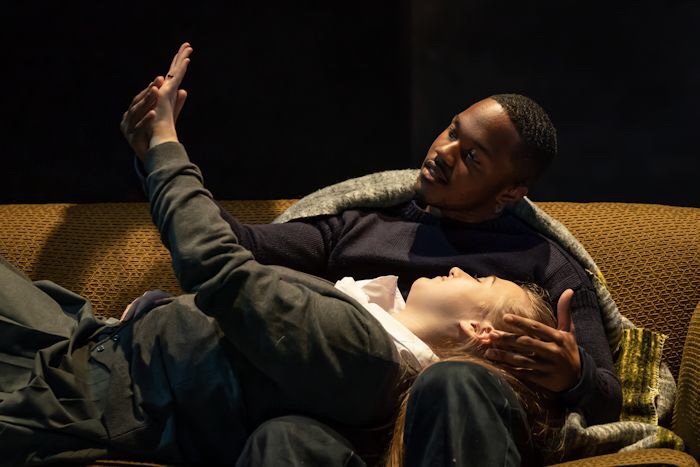
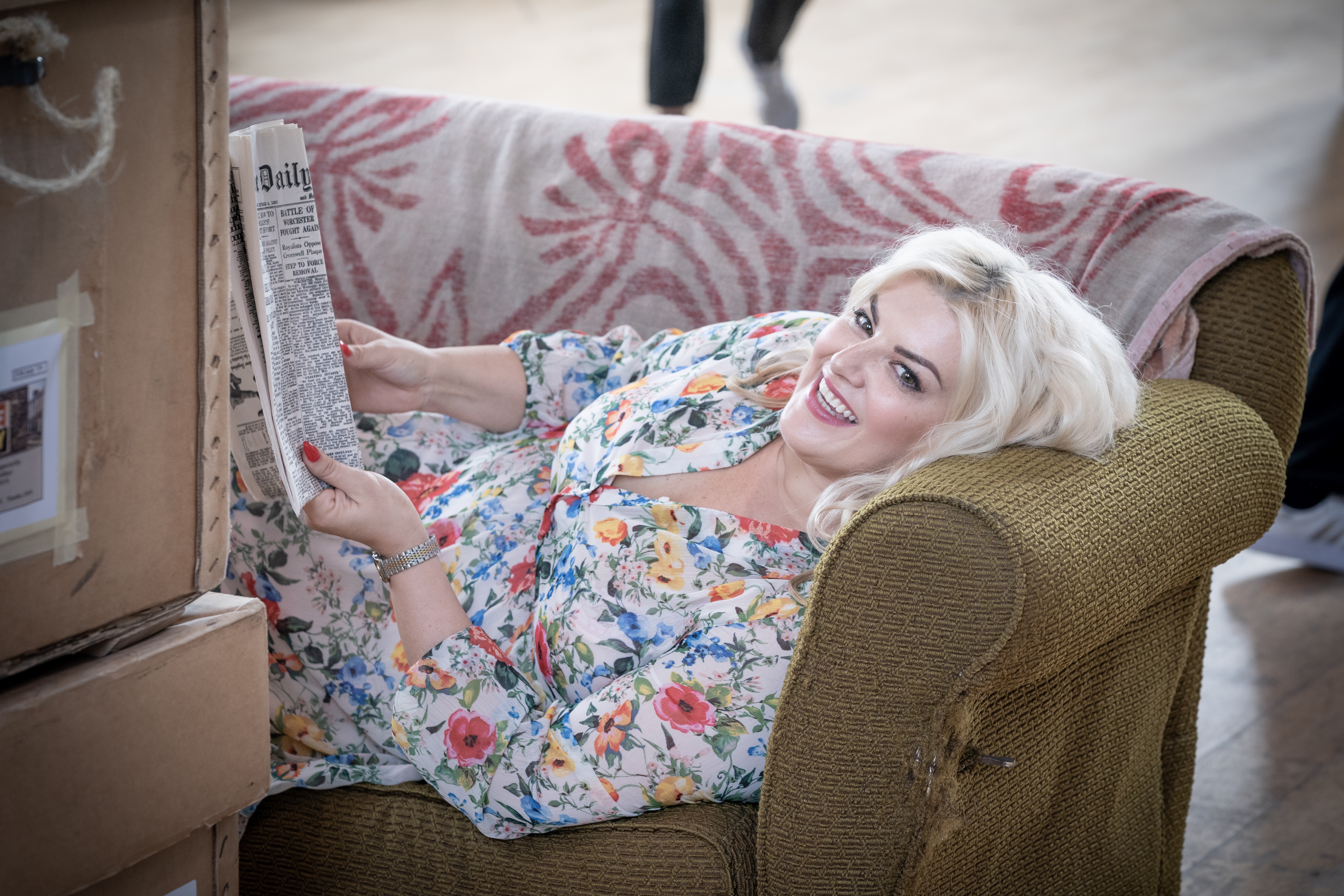
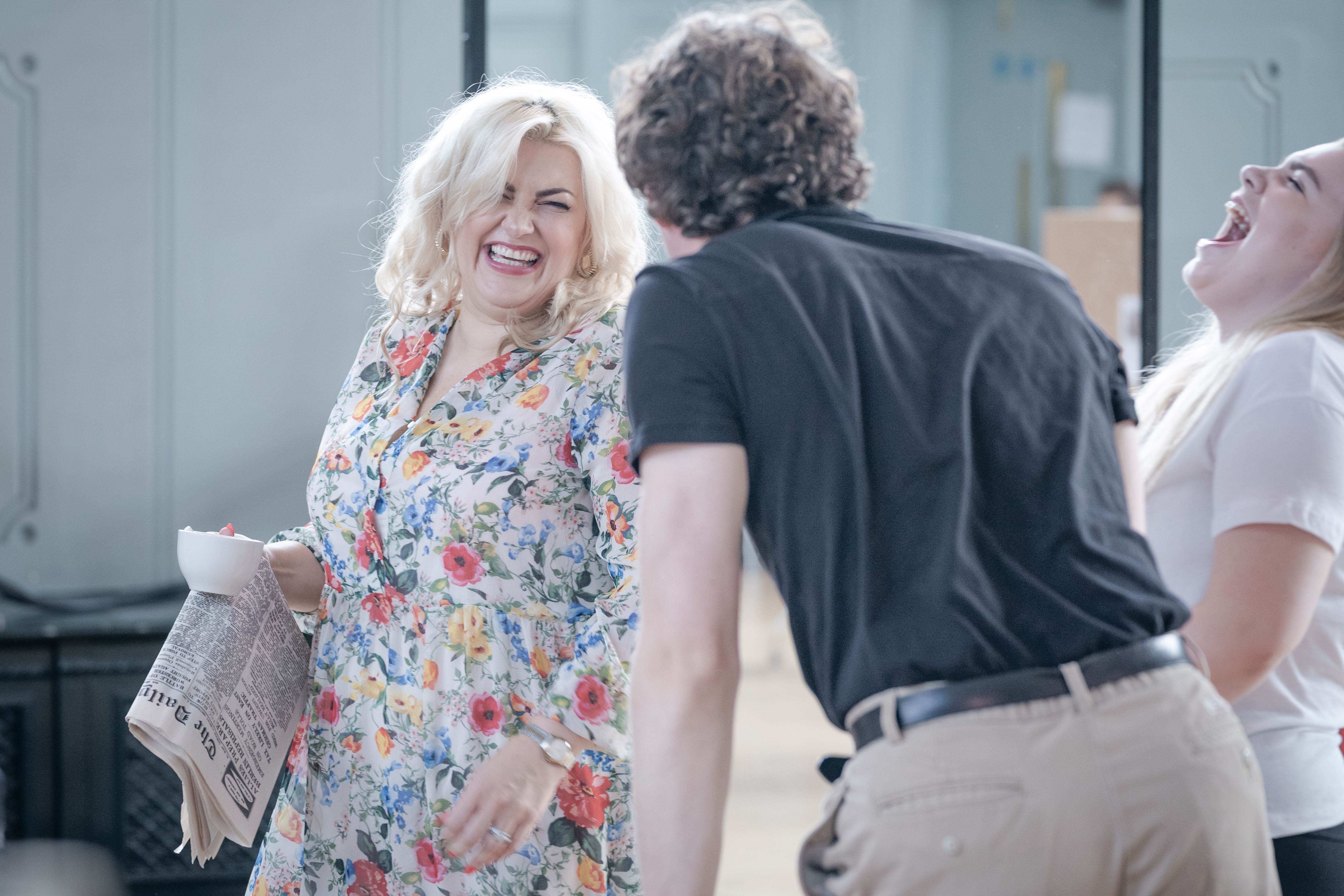
The play was famously seen a very taboo when it first premiered due to the themes and characters, “We’ve come a long way but we still have a long way to go, the cast were told they may have to evacuate the theatre when it was first put on, you’d not have that happen now, that wouldn’t even be entertained today but back then it was. I think we’re getting better well at least I hope we are. Yes back then it was taboo and although not so much now it’s still very, very poignant”.
Aged just 19 when she wrote this debut piece, Prenger sees Delaney as a courageous writer, “I think she unleashed a really strong genuine female voice which around that period was unknown. It was very brave, I think it’s the same kind of woman’s voice we’d hear today but then it seemed shocking and taboo.”
The role of Helen has famously been played by several incredible actresses including Angela Landsbury and Avis Bunnage, Jodie explained how she goes about making a character people know so well her own. “You do feel the pressure of those who have gone before you but that’s what gives you the drive to work hard and gives you the confidence to decide how you are going to create your character. It’s about my Nan’s ethic almost of rolling up your sleeves and getting stuck in. It’s important you develop the character how you want to develop her and that comes from working with your fellow cast members. I think she’s real; the only way you can play a character like her is by playing the truth.”
Drawing on her experiences with her own family when it comes to the mother daughter scenes Jodie states “Making the mother daughter relationship believable I think comes from taking your experiences and using them. Taking experience and inspiration from characters you’ve met along the way. Definitely the relationship you have yourself with your mother, sometimes I find although Helen and Jo are polar opposites they are also so similar I think that’s why they come up against each other so much.”
Set famously in the 1950’s Prenger explained how those elements will still very much be present but with some additional styling from designer Hildegard Bechtler. “It’s the same production team who worked on the 2014 production at the National, but what they are really, really set on is keeping those elements of the 1950’s but making it poignant for today. There’s music like Nina Simone, Peggy Lee and Amy Winehouse, there’s live jazz, there’s folk music. The aesthetic of Amy Winehouse really influences the design, her style, look and music. The costumes will be 1950’s but not so much starched dresses etc that it couldn’t be any other time but will hint at modern day as well, same with the props and set too.”
Launching the tour in Salford the birthplace of Shelagh Delaney feels appropriate; we were interested to hear Jodie’s thoughts on what her character Helen would make of 2019 Salford. “My brother Marco lives nearby and I can’t believe how much it’s changed, perhaps she’d find the nearest gin bar, she’d have a great choice. I’m sure she’d love it; you always love home don’t you. That’s what Shelagh Delaney was like, she says there’s not many places she’d like to live, maybe London but then she’d always come back home. Home is home.”
Fresh from its Olivier Award success Laura Wade’s new play Home, I’m Darling arrives at the Lowry this week as part of a limited UK tour.
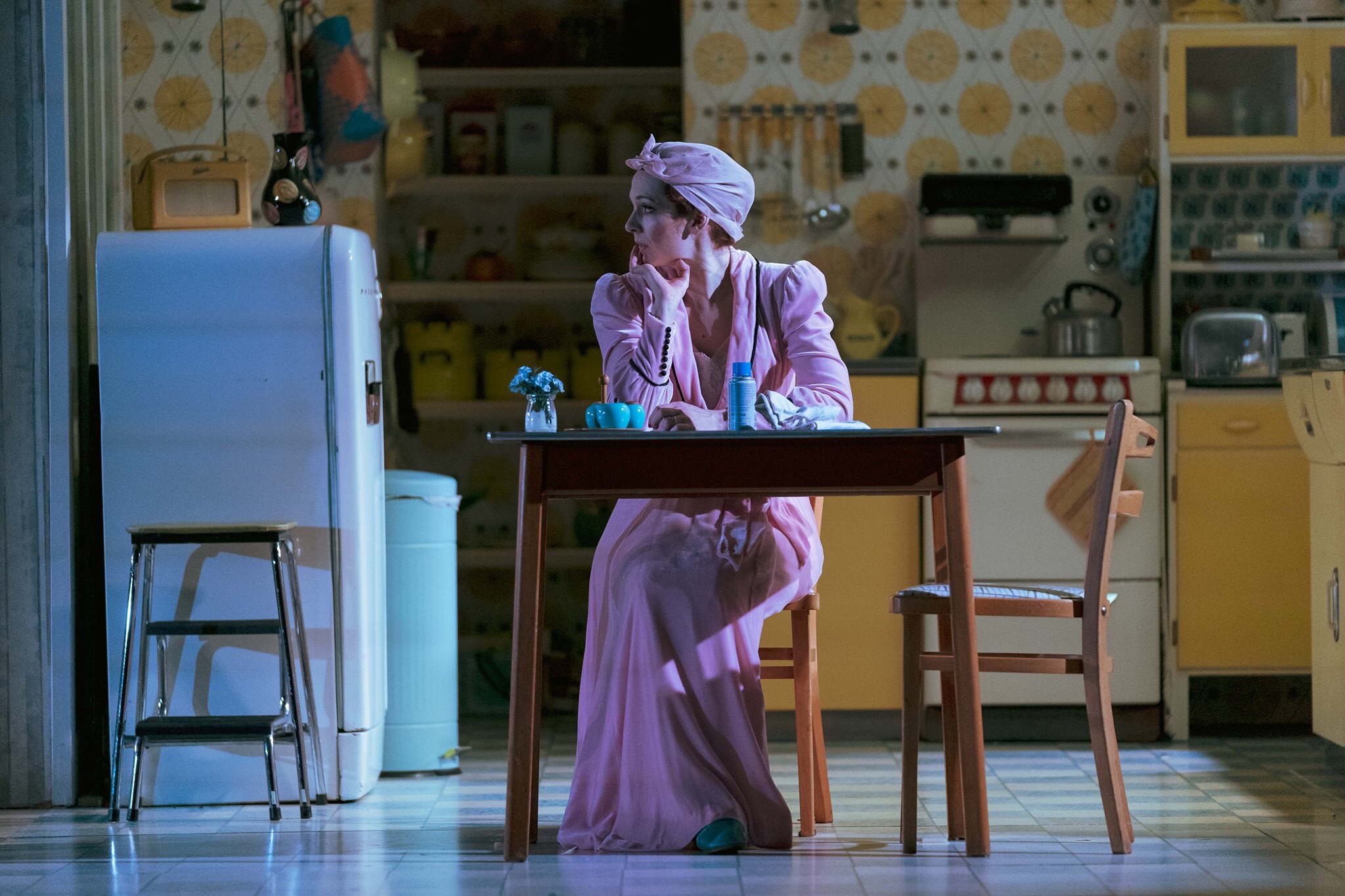
Co-produced by The National Theatre and Theatr Clwyd, Home, I’m Darling takes us into the perfectly stylised 1950’s home of Judy & Johnny; their bliss seemingly as bright as their primrose kitchen. Their marmalade is homemade while their gin gimlets are freshly poured as life in their 50’s bubble bounces along; that is until the rose tinted glasses begin to slip as this cleverly crafted comedy moves into choppier waters as the subtle analysis of gender divide and nostalgic perfection begins.
Judy’s made her choice: rebelling against her upbringing in a feminist commune eating lentil lasagne she now likes things shipshape, living a life of domestic bliss as a picture perfect housewife complete with pastel prom dress & devilled eggs on tap. While her mother argues against this misguided nostalgia insisting that the only people who were truly happy in the 1950’s where white, straight, men as choice, tolerance and acceptance were in very short supply.
Designer Anna Fleischle has created a magnificent 1950’s haven. The two level set a perfect home with living room and kitchen downstairs neatly topped by a bedroom and bathroom all connected by a central staircase. Director Tamara Harvey ensures the cast make full use of the visually stunning set as each corner of the house is explored and inhabited. The genius scene changes where cast members jive their way around the house add immensely to the charm of this initially playful piece.
Katherine Parkinson is excellent as the insecure domestic goddess Judy, insisting that her feminism is evidenced in the life choices she makes while she attempts to live harmoniously in an inaccurately imagined era.
Jo Stone-Fewings gives a strong performance as husband Johnny, increasingly frustrated with this nostalgic domesticity and what it means for their marriage.
Susan Brown shines as Judy’s Mum Sylvia, exasperated by her daughters life choices and desperate for her to start living life in the here and now, her scalpel-sharp monologue in Act II is sublime.
The strong cast work together wonderfully keeping the audience guessing throughout as to where this fascinating story will take us. Laura Wade’s script is both generous in its humour and sharp in its observations. Once the saccharine surface has been scratched the grit and relevance of this black comedy effectively take hold. Judy of course insists she is happy but the cracks in her gingham palace quickly show as money begins to run out while the fantasy lifestyle becomes a prison of her own making.
Judy’s indulgence for her ‘hobby’ which she clings onto for far too long impacts not only on her own but the life of husband Johnny who feels emasculated and embittered by his wife’s endless care and devotion. The constantly shifting perspectives engage as well as entertain; add to this a hefty dose of humour, superb cast and stunning set and you have a uniquely brilliant production.
Home I’m Darling is on at The Lowry until Saturday 27th April tickets available here.
Following on from a much celebrated sold-out run at the National Theatre earlier this year this new version of Ibsen’s iconic Hedda Gabler arrives at the Lowry until Saturday 4th November.
Reimagined by Olivier and Tony Award-winner Patrick Marber and directed by Ivo vanHove, also an Olivier and Tony award-winner, the production is modernised and accessible yet still stays true to Ibsen’s original work.
Newlywed Hedda (Lizzy Watts) is bored, admitting she ‘settled’ because she felt old, the absolute last thing she actually feels by this marriage and her life however is settled. She’s retuned to a place that suffocating and soulless, a new home where nothing yet has it’s place, certainly not Hedda.
Overcome constantly by the desire to control and take charge of everyone and everything around her Hedda thrives on the destruction of harmony. Constantly battling the demons within, Hedda’s release seems to come from hurting, upsetting and even destroying others. She can be cruel yet is clearly damaged, sharp yet desperately vulnerable, wild yet ultimately trapped.
Hedda wants to be free, she wants the freedom she sees men have yet everyone wants a piece of her, they want to touch her, to be with her, to dictate what she does with her body, to claim ownership. Marber’s focus on Hedda’s relationships offers a real depth to this piece as an audience we try to understand and even sympathise with the damaged, manipulative and often cruel Hedda. She tempts the alcoholic to drink, twists concern for mistrust and family love for suffocating meddling.
Lizzy Watts portrays Hedda beautifully, she shines in the cleverly reimagined production, she is feisty yet vulnerable, struggling with demons which consume her entirely, she is cruel yet clever captivating the audience entirely as she physically embodies the torment and complexity of Hedda, she looks uncomfortable in her own skin as the world weighs down all around her and her inner turmoil threatens to consume. Supported by an incredibly strong cast this is a truly impressive performance.
National Theatre continue to raise the bar high with this bold, atmospheric and entirely engaging production. Jan Versweyveld’s set and lighting design are both superb, the apartment is a sparsely furnished box, which we never leave, almost becoming asylum like as the piece develops and further illustration of Hedda’s confinement and absolute boredom with life where even the timid Thea has the courage to follow her heart. Joni Mitchell’s “Blue” plays between scenes, a further gentle nod to Hedda’s dissatisfaction with her lot.
National Theatre entirely succeed in making a play familiar to so many feel entirely fresh and unpredictable. Powerful, intense and utterly captivating.
On at The Lowry until Saturday 4th November tickets available here www.thelowry.com/events/hedda-gabler
First staged at the Bristol Old Vic, where the story was performed over two evenings, director Sally Cookson brings her acclaimed production on tour, presenting Bronte’s much loved classic as a thrilling and inventive performance beautifully staged in the Lowry’s Lyric theatre.
While many will be familiar with the story of Jane Eyre for some it’s one of those novels that you may have always intended to read but never quite got there, it is the biography of orphan girl Jane Eyre (Nadia Clifford) and bares striking similarity to Brontë’s own life, raised in the North of England Jane is taken in by her Uncle after the heartbreaking death of her parents, much to the disgust of his cruel wife, Jane’s Aunt, Mrs Reed (Lynda Rooke). When Jane’s Uncle becomes unwell, he asks Mrs Reed to promise to raise Jane as her own, sadly although she provides a house for Jane to dwell in she certainly doesn’t offer the love and warmth of the promised home subjecting Jane to a life of misery and abuse from not just her Aunt but her Cousins as well. At 10 years old she shipped off to Lowood, a school for orphaned girls, where she continues to experience a cruel and unforgiving life, despite this Jane manages to form a strong bond with her school friend Helen Burns (Hannah Bristow), tragedy however is never far away and Jane suffers more gut-wrenching loss.
Eventually Jane becomes a teacher at Lowood but yearns for change and adventure, she advertises herself as a Governess and is soon summoned to Thornfield Hall to educate Edward Rochester’s (Tim Delap) French ward Adele. As the developing friendship between Jane and Rochester begins to build strange happenings within the house start to occur risking both the safety and the future of both Jane and Rochester.
The staging of this production is immediately striking upon entering the theatre; set designer Michael Vale uses wooden pallets to create various levels and platforms accompanied by multiple ladders and steps which are used to maximum effect by the cast. Aideen Malone’s lighting design is bold and dynamic, creating and changing the atmosphere dramatically throughout the production.
The small cast take on a multitude of roles throughout the play and are magnificent, their characterisation outstanding and utterly captivating. They strive to ensure we see Brontë’s work is just as relevant today as it was then; they deliver each and every character with commitment and style. The piece feels fresh and inspiring as the spirited and strong Jane fights for her own freedom and fulfilment. Jane is told early on in the play after being punished by her Aunt in the red room, “Perhaps you should learn to keep your passions under control” something we soon realise is a thing Jane in order to be true to herself could never do. Nadia Clifford is superb in the role of Jane, yearning for liberty and adventure her spirit is strong and her need for fulfilment, physically, spiritually and mentally never wavers. Clifford is mesmerising, charismatic and captivating you immediately warm to her and are desperate for her to succeed. SallyCookson uses several cast members to verbalise Jane’s inner thoughts, this works beautifully, illustrating just how strong and determined Jane truly is as she battles with herself to do what she believes is right as heart-breaking as it may be.
Melanie Marshall as Bertha Mason, the ‘lunatic in the attic,’ is superb, frequently appearing through musical interludes her vocals are hauntingly brilliant and pack a real punch. The effect feels almost like a musical narrative, with hugely inventive and highly original song choices that flow beautifully from one scene to the next offering more depth to an already magnificent production. The entire cast give their all; they make for a tight ensemble and move fluidly from one role to the next, accompanied by on stage musicians who add a further creative layer to this inventive piece.
Jane Eyre is a truly exceptional piece of theatre, groundbreaking and utterly captivating. Brontë’s much loved masterpiece is delivered with freshness and intelligence, you can’t help but think how pleased she would be to see her Jane portrayed with such heart and soul. The National Theatre in partnership with Bristol Old Vic once again succeed in bringing a true masterpiece to life, full of passion, intensity and originality, an absolute must see.
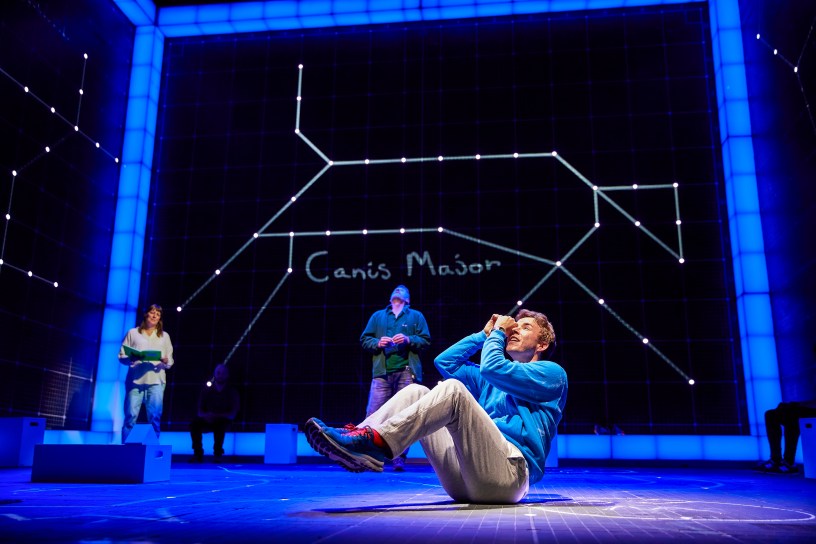
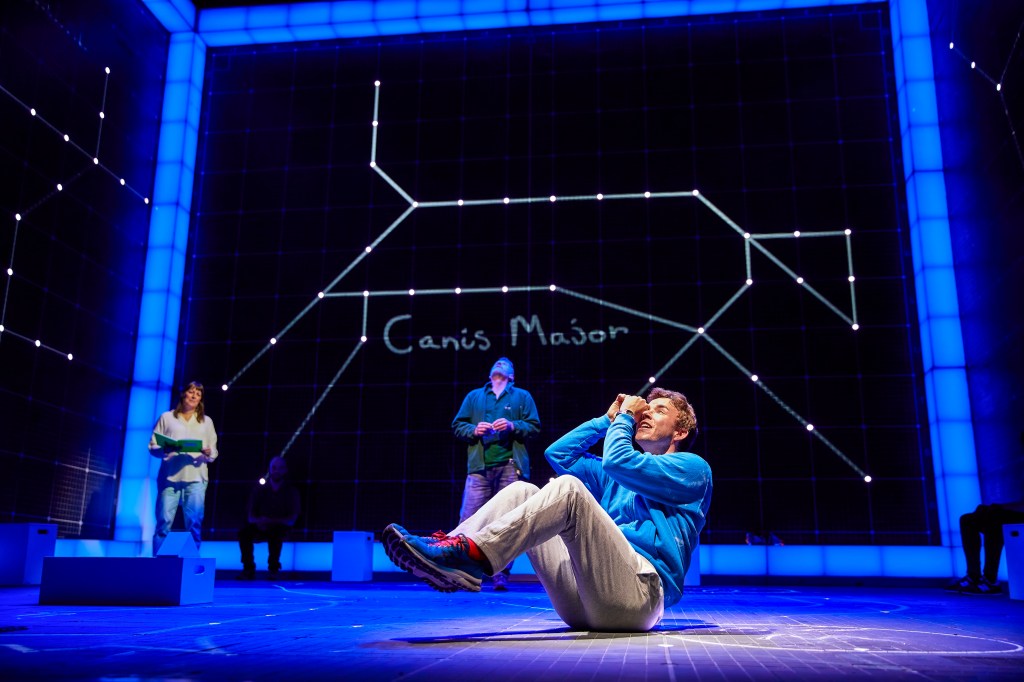
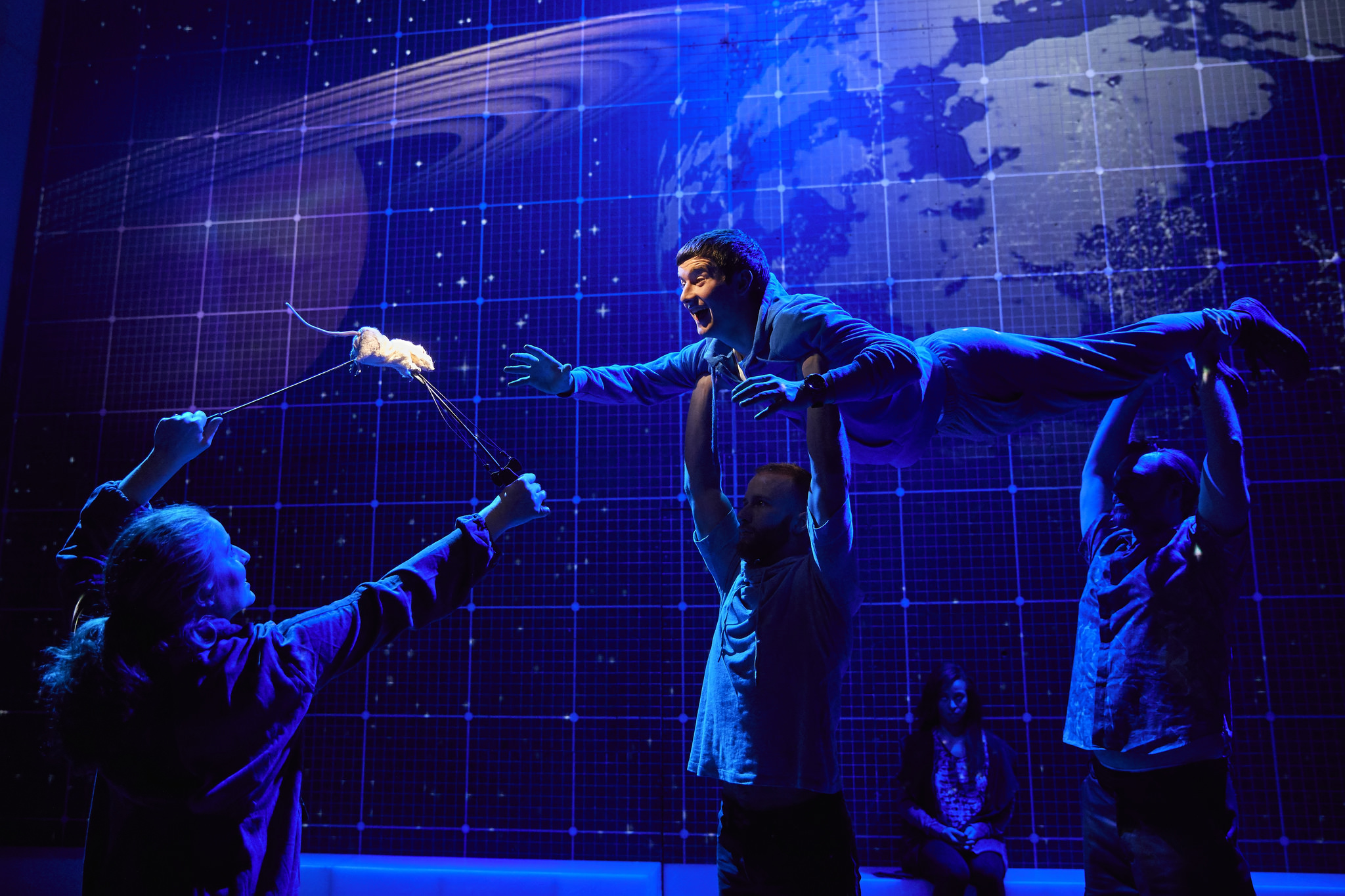
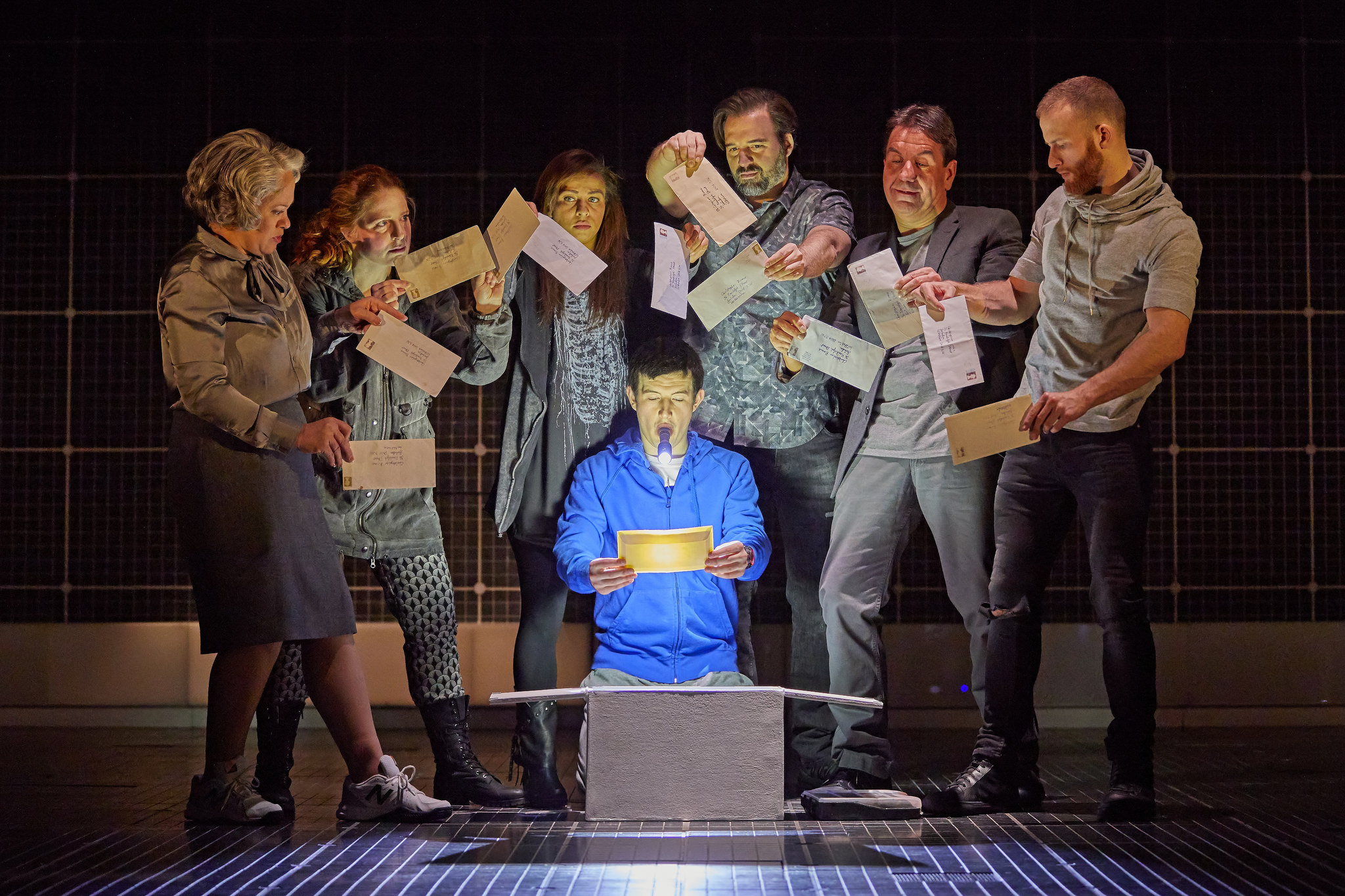
Returning to The Lowry as part of a new 25 city tour, The National Theatre’s multi-award winning production The Curious Incident of the Dog in The Night-Time, is as spellbinding and incredibly moving as ever. Adapted by Stockport born Simon Stephens and directed by Manchester’s own Marianne Elliott, Curious introduces us to a very, very special person, the utterly extraordinary, Christopher Boone.
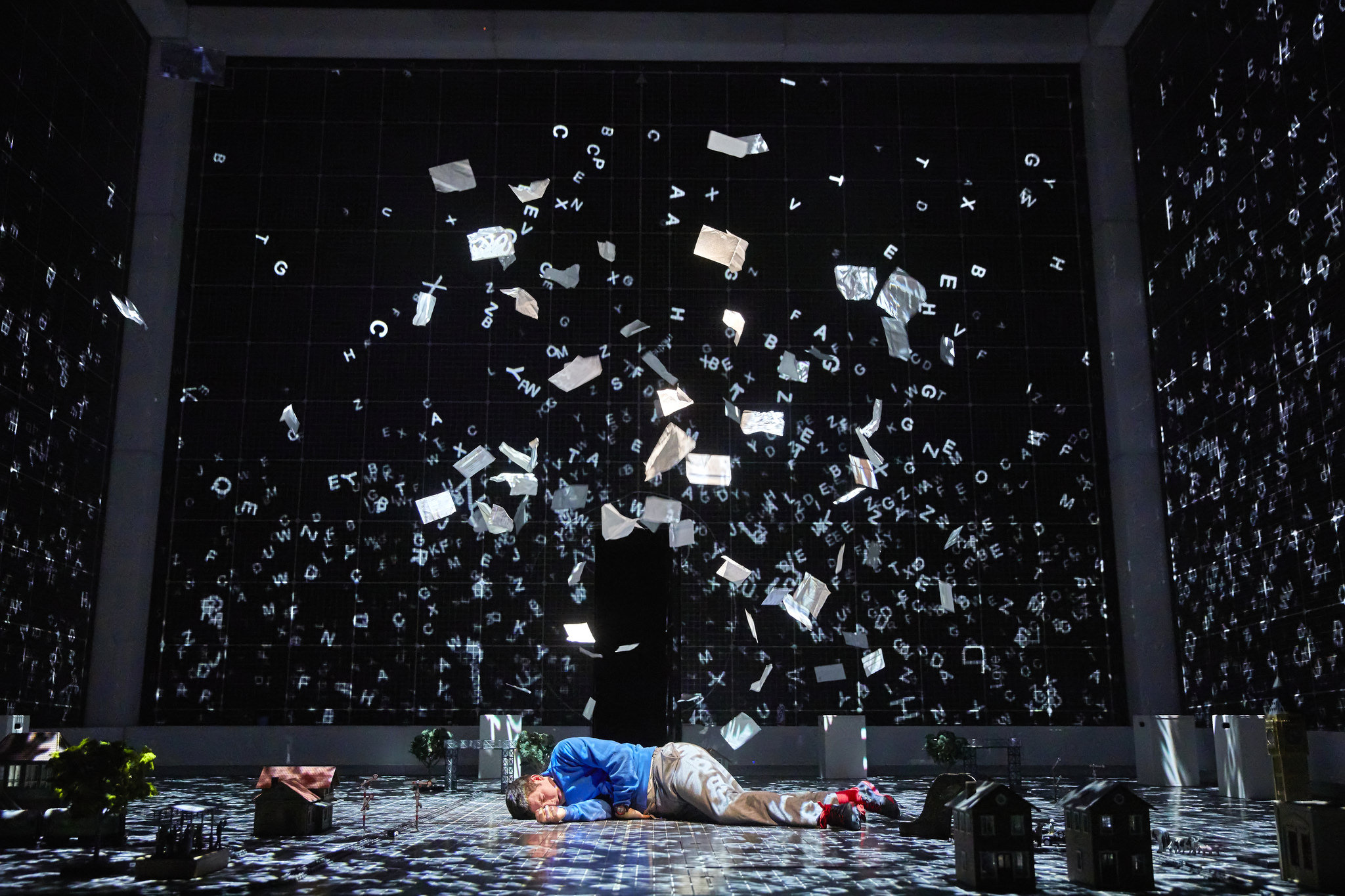
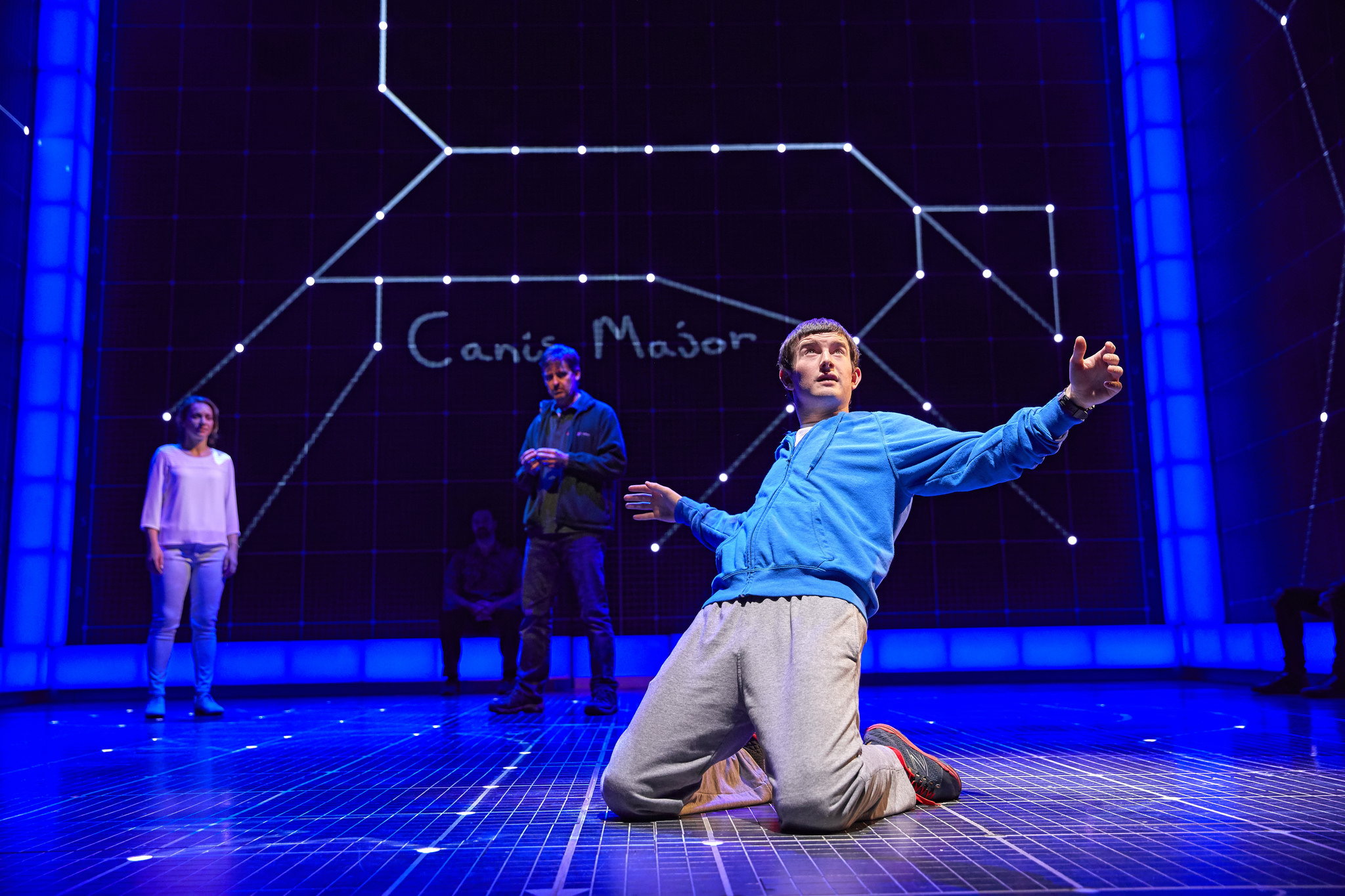
The story follows fifteen year old Christopher (Scott Reid) upon his alarming discovery of the murder of his neighbour’s dog Wellington, whom he has found speared with a garden fork. Christopher, wrongfully under suspicion makes it his mission to solve the mystery of the murder by documenting the facts he discovers through his thorough and detailed investigations. Christopher is a complex yet truly remarkable boy, like many autistic people Christopher sees the world very differently to perhaps you and I, for one he truly ‘sees’ the world, he notices each and everything around him, he observes and processes every physical detail in his environment, colours, sounds, textures, everything Christopher sees is in exact and minute detail. His brain is as complex as it is fascinating, metaphors don’t make sense and people are generally confusing.
Scott Reid as Christopher is fantastic, he makes such a physically and emotionally challenging role appear effortless, he is hugely likeable and engages the audience from his very first scene, you quite literally fall in love with Reid’s Christopher, you want him desperately to succeed and to be happy, safe and secure. The relationship he has with Siobhan (Lucianne McEvoy) his teacher is beautiful; she calms and soothes Christopher when things get too much and he stops being able to process the endless information his brain is constantly receiving, more importantly she totally and utterly believes in him.
As the story develops we soon realise that Christopher like many people on the Autistic Spectrum is uncomfortable with touch, the amount of physical contact he will engage in is minimal and must be on his terms, this is beautifully directed and makes for some of the most poignant and emotional scenes in whole production as we witness Christopher’s parents battle to simply comfort their child.
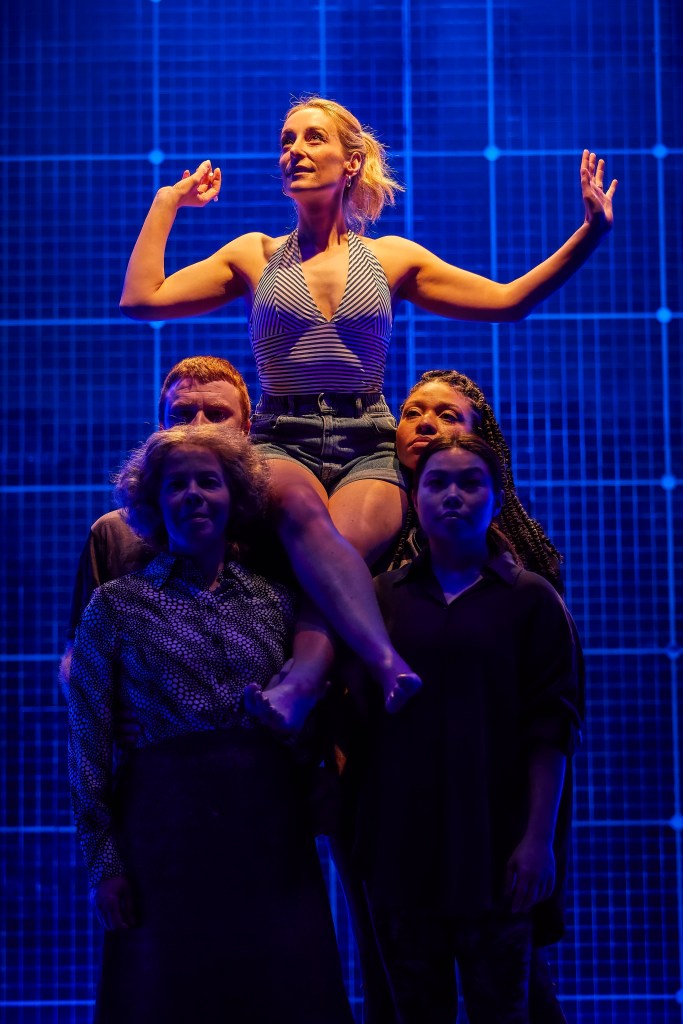
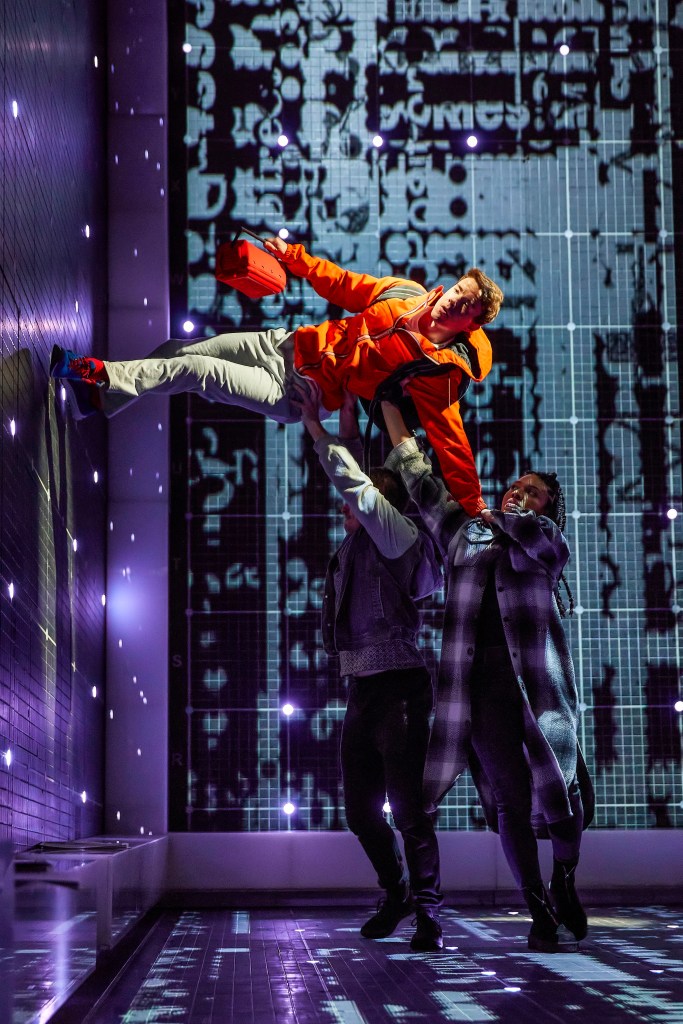
Director Marianne Elliot along with Movement Directors Scott Graham, Steven Hoggett and Adrian Sutton have created something truly unique with their cast, from weightlessly floating through space to the trauma of using the unwelcoming and chaotic underground the way the cast move is mesmerising. The organisation and exact movement of the cast is outstanding, their fluid movement so intricate.
Complementing the brilliant cast is a truly stunning set, it is in effect part of the cast as it is so involved in every aspect of what happens on stage, the cast and the set at times almost become one, moving fluidly together to astonishing effect. Designer BunnyChristie, Lighting Designer Paule Constable, Video Designer Finn Ross and Sound Designer Ian Dickinson have created something truly magical here.
Curious is a production that leaves an huge impact, at times heart-warming and funny it is also through provoking and incredibly moving, without doubt an absolute must see.













 The play was famously seen a very taboo when it first premiered due to the themes and characters, “We’ve come a long way but we still have a long way to go, the cast were told they may have to evacuate the theatre when it was first put on, you’d not have that happen now, that wouldn’t even be entertained today but back then it was. I think we’re getting better well at least I hope we are. Yes back then it was taboo and although not so much now it’s still very, very poignant”.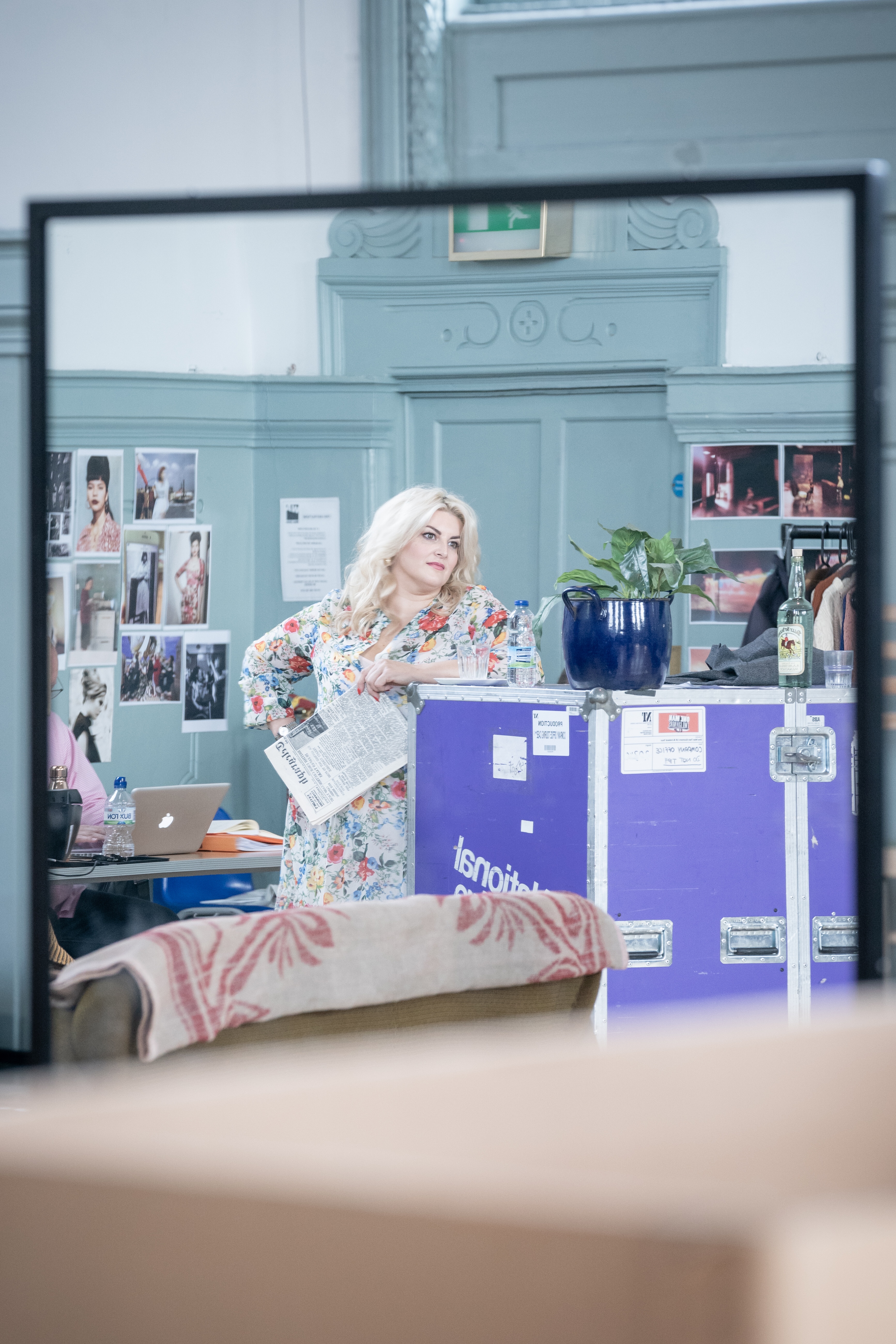





 Opening Night