The Merchant of Venice 1936

Reviewed by Matt Forrest

Opening Night verdict ⭐⭐⭐⭐
When picking a film at the cinema, we often like to know what genre of film we’re
off to see, so hopefully there’ll be no nasty surprises for us. Surely the same would
have been said when William Shakespeare was knocking out plays with such
gusto. One play that has often proved difficult to pigeonhole is The Merchant of
Venice, listed as a comedy, mainly because there is a wedding, a spot of farce
and (spoiler alert), no one dies!

However, over time the play has been reappraised due to its problematic
antisemitism. Director Brigid Larmour and Tracy-Ann Oberman are the latest to
tackle this troublesome play, their ambitious artistic choices pay dividends
with this bold, thought-provoking adaptation.

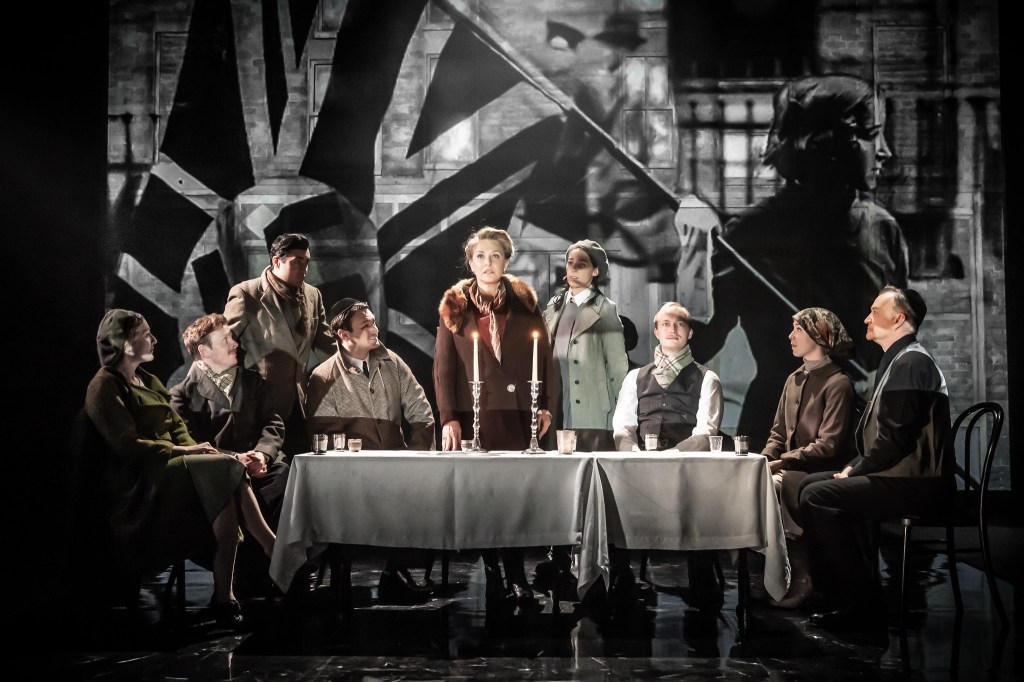
In their reworking, The Merchant of Venice 1936, the action is shifted to London’s
East End: where the rise of Oswald Mosley’s British Union of Fascists sees the
persecution of the local Jewish community. Here Oberman’s Shylock runs her
money-lending business. She is a strong, feisty Jewish businesswoman, who’s
devotion to her faith is only matched by her love for her family, especially her
daughter, Jessica (Gráinne Dromgoole) evident in a beautifully staged family
gathering at the start of the production.

Shylock is approached by Bassanio (Gavin Fowler), a socialite who has designs
on a wealthy heiress, Portia (Georgie Fellows). Bassanio, asks his friend, Antonio
(Joseph Millson), a local merchant and member of the BUF, to act as a guarantor
in order for him to secure a loan from Shylock. Antonio and Shylock despise each
other, yet the savvy money lender agrees to the loan, but the price Antonio must
pay if he is late with the repayment is a pound of his own flesh. As tensions rise in
the community, romances blossom, and fortunes fall, whilst Shylock and Antonio
are heading for a collision that neither are willing to back down from.

Oberman’s steely Shylock anchor’s the production from the outset, her revenge
mission sets the tone for the unpleasantness that follows. It’s a performance filled
with passion and swagger, ensuring that when the inevitable sucker punch comes you feel her heartbreak all the more. She is more than equalled by Millson’s slimy,
restrained but no less menacing black-shirted Antonio. They are supported by a tremendous cast, with special mentions for Evie Hargreaves’ portrayal of Mary Gobbo (also in a duel as Nerissa) who manages to get under your skin with her treacherous ways. Whilst Georgie Fellows, excels as the thoroughly unpleasant Portia.

Under Brigid Larmour stewardship the production thrives in its 1936 setting. It’s a
harsh world, where you are on high alert ready for the situation to escalate. It’s a
testament to the cast and direction that when that moment comes it rather takes you by surprise.

Liz Cooke’s grimy set design works tremendously well at selling the audience the
fear, and isolation of Cable Street. Whilst her costume design especially for the
more affluent characters look stunning: they dazzle as they showcase not just their
wealth, but their prejudices too. The production is intercut with video footage of the rise of the BUF, on the march through Britain. It’s a terrifying yet timely reminder of a part of Britain’s past that some conveniently choose to forget.

Despite the unsatisfying end to Shakespeare’s play, Larmour and Oberman give
us an optimistic conclusion, with a Oberman delivering a personal powerful
message of unity that will remain with me for some time to come and goes to
highlight the importance of theatre to not just entertain but remind us what it is to be
human.

The Merchant of Venice 1936 runs until 1st March, tickets are available here.
Twelfth Night

Reviewed by Nikki Cotter

Opening Night verdict ⭐⭐⭐⭐

Having brought audiences a boundary breaking version of A Midsummer Night’s Dream in 2022, Not Too Tame return to Shakespeare North Playhouse this month with their inspired interpretation of Twelfth Night, with the aim to rock your socks off!

This modernised version centres the action within the music industry, there’s raunch, romance and a whole lot of riffing as this Shakespeare classic is given the rock star treatment. Utterly irreverent and a whole lot of fun this is Shakespeare for today. There’s a glorious mix of modern language which marries perfectly with Shakespeare’s script, it’s extremely funny, a little bit naughty and as far from stuffy as you can possibly get.

This is the second co-production between Warrington based Not Too Tame and Shakespeare North Playhouse and it’s clear both know this stage and setting well. Director Jimmy Fairhurst ensures his cast use every inch of the stunning Cockpit Theatre, making this production all the more exhilarating as you wait in anticipation of who will appear next, from where and when. The theatre becomes the cast’s playground and it’s clear for all to see just how much fun they’re having with it.

Twelfth Night is often described as one of Shakespear’s greatest comedies and Not Too Tame have gone full throttle with this, the production is bursting with top quality comedic moments, well-timed delivery and wisecracks galore. There is of course the classic Shakespeare tropes of unrequited love, mistaken identities, and subterfuge as separated twins Viola (Georgina Frost) and Sebastian (Tom Sturgess) arrive in Illyria each thinking the other is dead. This is Illyria as you’ve never seen it before, no longer is it a shipwreck that separates the siblings but a euphoric night on the nose candy.

Frost and Sturgess are both excellent in their roles, the addition of multiple genres of music to this innovative production allows them to show their talent as singers while Dean Fairhurt’s musical composition gifts them with great opportunities to lyrically progress the story.

Jack Brown as Sir Toby Belch and Reuben Johnson as Sir Andrew Aguecheek are hilarious, Brown nails it as the odious Sir Toby, the hard-drinking, hard-partying, high-spirited (or is that just high?) uncle of Olivia (Purvi Parmar). His pairing with Reuben Johnson is perfection, as Jonson gives us a hilarious Tim, Nice-But-Dim-esque interpretation of Sir Andrew, the two together are a joy.

Purvi Parmar as Olivia is excellent, while Louise Haggerty as Feste gets the party started right from the off. Returning to Shakespeare North Kate James takes on the roles of both Maria and Antonia and delivers both brilliantly.

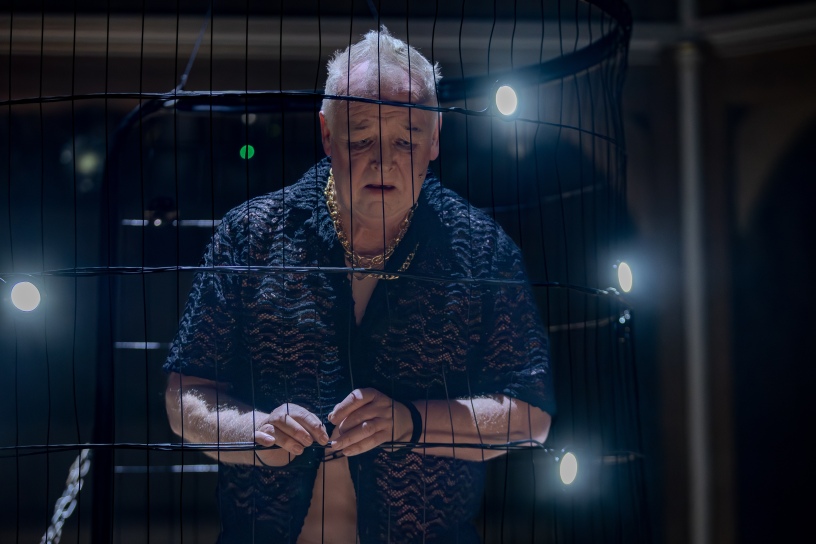
Then of course we come to Les Dennis who shines as Malvolio, there is little Les hasn’t done in his incredible career and now he can well and truly say he’s not only ticked performing Shakespeare off his list but he’s well and truly knocked it out the park. His Malvolio is multifaceted, starting off as a confident, sharp suited tour manager and transforming entirely in Act 2 in a scene I don’t think anyone will forget in a long time – iconic! A gifted actor he has the ability to draw you in and break your heart a little as he shifts impressively from victimiser to victim.

This is Shakespeare with sass, spunk and seriously bangin’ beats. The relocating of the action does at times in Act 1 make the story a little more complex to follow but once you’re on board the anthemic beats and knock-out cast will whip you up and carry you along for this feelgood ride. If music be the food of love, play on, and on and on!

Twelfth Night is on at Shakespeare North Playhouse until Saturday 29th June tickets available here.

Measure for Measure

Reviewed by Matthew Forrest

Opening Night verdict ⭐️⭐️⭐️⭐️

Hey, have you heard the one about the powerful older man who offered a young woman help in return for sexual favours? You’d be forgiven for thinking I’m speaking of the latest scandal to engulf Westminster or Hollywood but I’m referring to the plot of William Shakespeare’s Measure for Measure.

Measure for Measure is the is the final production for the Royal Shakespeare Company’s mini residency at the Lowry. Despite being four years shy of its 400-year anniversary this is a story that arguably has more resonance now than it ever has: the ill treatment of women and abuse of power by unscrupulous and seemingly omnificent men.

Set in Vienna at the turn of the 20th century, the Duke of Vienna has taken a sabbatical, leaving his deputy, Angelo in charge. Angelo is harsh and swift at implementing law and order to the city, while a young man Claudio, falls foul of the new changes to the law. He is sentenced to death for impregnating  his fiancé.  Claudio’s Sister Isabella, who is training as a nun hears of her brother’s plight and is soon up before Angelo pleading for her sibling’s life. The interim leader agrees to clemency in return Isabella must sleep with him. Isabella is repulsed by the very notion of this, but what can she do? Go up against the most powerful man in the city, it’s her word against his and who would believe her.  Isabella soon encounters a kindly friar, who agrees to assist  her with a plot to bring down Angelo, however the friar is really the Duke of Vienna returning to the area so he can get a a true measure of the city.

It is easy to see why this is referred to as one of Shakespeare’s more “problematic” works. On the one hand, this is a story about the abuse of power, as well as the wretched treatment of women. Whilst at the same to there are some comedic elements to the production in the form of the Duke’s deception and host of colourful yet despicable characters including the cunning pimp, Pompey, and slimy sycophant Lucio.  Director Gregory Doran manages to reign in all these elements to tell an engaging, fluid, and entertaining story, which does not shy way from the more despicable facets of the narrative.

Sandy Grierson is fantastic as loathsome Angelo; there is an understated menace to his performance, helped by the fact that he has more a passing resemblance to a certain Russian head-of-state.  Antony Byrne is also on fine form as the Duke, he is both strong and flawed, whilst his exchanges with Joseph Arkley’s Lucio offer up some of the productions lighter moments. However, at the centre of the production is exceptional performance by Lucy Phelps as Isabella, sometimes strong, sometimes vulnerable, it is her angst riddled turn that highlights the gravitas of the situation.

The superb acting works hand in hand with the high production values, there is very little in the way of set set design; instead, a change of location is signified by the use of projected images at the back of the stage.  Save for a few chairs and the use of two-way mirrors, set design is minimal which if anything intensifies the claustrophobia of the situation. The stage at the Lowry seemed to grow, as the narrative continues leaving the characters firmly in the spotlight, with no place to hide. In addition, the score by composer Paul Englishby, opens with a beautiful waltz, but soon shifts into darker territory, providing a sense of menace and foreboding.

Despite being on uncomfortable ground with its subject matter, this is an accessible, engaging production that is made even more fascinating by its relevance today. This may not be one of the ‘bards’ best-known plays but it is filled with twists and turns, none more so than the close 10 seconds of the play which add to the cynical nature to this intelligent piece

Measure for Measure is at the Lowry till 5th October. Tickets available:  here.

Tags: Measure for Measure, William Shakespeare, Gregory Doran, Drama, Theatre, Sandy Grierson, Antony Byrne, Lucy Phelps, Joseph Arkley