

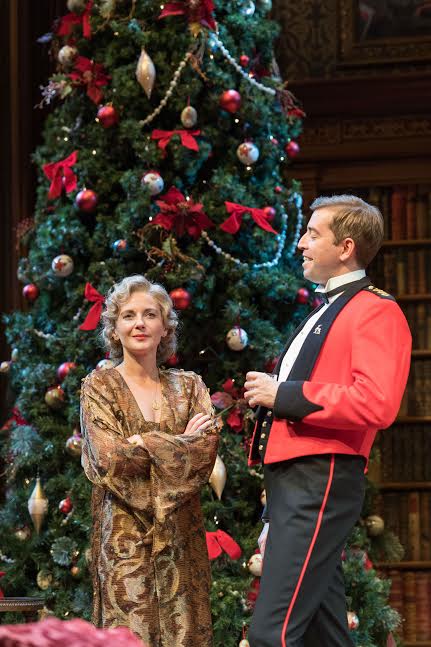
Now that we have witnessed the Royal Shakespeare Company’s Edward Bennett electrocuted inside a giant Christmas tree, the festive season can officially begin!
What better way to mark the conclusion of 2016 – and the 400th anniversary of Shakespeare’s death – than with two of the Bard’s best-loved comedies, played on consecutive nights at the Opera House Manchester, with the same cast?
Director Christopher Luscombe and production manager Paul Hennessey’s grand experiment examines the long-rumoured synergies between Love’s Labour’s Lost and Much Ado About Nothing – setting them in the same country estate (modelled on Charlecote Park, near Shakespeare’s Stratford-upon-Avon) and bookmarking them in summer and winter, before and after the Great War.
Both deliver a witty, sparring couple; a supporting cast of characters that include a policeman, a curate and many domestic servants; masked encounters between lovers; and – one of Shakespeare’s favourite devices – endless cases of mistaken identity.

Associate director Guy Unsworth concludes that Shakespeare ‘deliberately shows us two sides of the same coin’ and ‘does indeed want us to view them as an extended double-bill’… Mark thee well!
Anon – immersing ourselves in Much Ado About Nothing’s wintry scenes on a cold Mancunian night – we encounter fast-talking, resolutely single bachelorette Beatrice (Lisa Dillon), who declares: ‘I had rather hear my dog bark at a crow than a man swear he loves me’. The equally marriage-adverse Benedick (Edward Bennett) has just returned from the war, yet it is Beatrice’s quick-fire degradations of his character – spoken at a masked dance – that leave him mortally wounded.
Their union seems doomed until their eavesdropping antics reveal a surprising fact… they are each madly in love with the other. These revelatory conversations – staged by Benedick and Beatrice’s family and friends, for their benefit – are some of the funniest scenes in the production. Bennett’s comedic antics inside the family Christmas tree solicit great guffaws of appreciation from the audience; it feels inevitable when he breaks the fourth wall – dissolving into barely suppressed laughter himself.
In another plot, Beatrice’s cousin Hero (Rebecca Collingwood), who radiates chastity and goodness, is due to be married to besotted Claudio (Tunji Kasim); however, he jilts her at the altar when her name is sullied by an accusation of infidelity. With Beatrice and Benedict’s – and Hero and Claudio’s – unions both hanging in the balance, could it be that all hopes rest on hapless constable Dogberry (Nick Haverson) riding to the rescue?
Gripped in a fit of body spasms and crashing around the set, it feels as though he is perilously close to tumbling from the stage; Haverson gives every fibre of his being to the slapstick comedic stylings of Dogberry. Along with Lisa Dillon, his performance is a highlight among the sublime cast – assembled by Gabrielle Dawes and Helena Palmer.
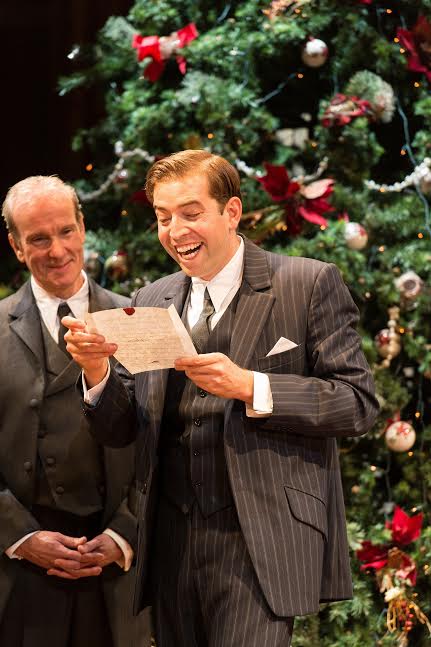
Designer Simon Higlett has created a sumptuous Christmas card-style stage – rich, festive and twinkling. His team seamlessly interchange between the house and its grounds by virtue of a large sliding truck and the sub-stage trap. It’s as ingenious as it is beautiful – complemented by Melody Wood’s sumptuous period costumes that brilliantly encapsulate fashion on the cusp of the 1920s.
This is the second time that composer Nigel Hess has scored the two plays for the RSC, but with exception of a couple of affection quotes, he has revisited them again with completely new music. To further explore the cohesion between the comedies, he uses musical cross-references between the two productions. It’s a triumph, with nuances that complement the on-stage gusto and frivolity to perfection.
Christmas is a season of laughter and good cheer – and you will find both in these sparkling, immaculate productions by one of our nation’s greatest treasures: the Royal Shakespeare Company.
Love’s Labour’s Lost and Much Ado About Nothing are on at Opera House Manchester until Saturday, 3 December.
 Opening Night