

Reviewed by Matt Forrest
Opening Night verdict ⭐⭐⭐⭐
When picking a film at the cinema, we often like to know what genre of film we’re
off to see, so hopefully there’ll be no nasty surprises for us. Surely the same would
have been said when William Shakespeare was knocking out plays with such
gusto. One play that has often proved difficult to pigeonhole is The Merchant of
Venice, listed as a comedy, mainly because there is a wedding, a spot of farce
and (spoiler alert), no one dies!
However, over time the play has been reappraised due to its problematic
antisemitism. Director Brigid Larmour and Tracy-Ann Oberman are the latest to
tackle this troublesome play, their ambitious artistic choices pay dividends
with this bold, thought-provoking adaptation.

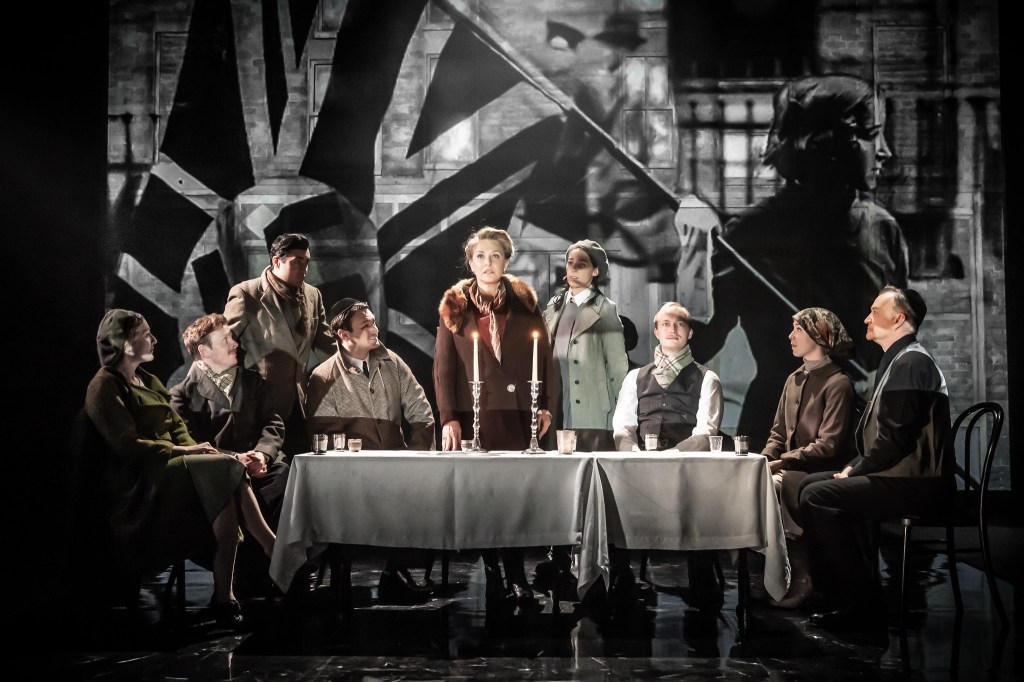
In their reworking, The Merchant of Venice 1936, the action is shifted to London’s
East End: where the rise of Oswald Mosley’s British Union of Fascists sees the
persecution of the local Jewish community. Here Oberman’s Shylock runs her
money-lending business. She is a strong, feisty Jewish businesswoman, who’s
devotion to her faith is only matched by her love for her family, especially her
daughter, Jessica (Gráinne Dromgoole) evident in a beautifully staged family
gathering at the start of the production.
Shylock is approached by Bassanio (Gavin Fowler), a socialite who has designs
on a wealthy heiress, Portia (Georgie Fellows). Bassanio, asks his friend, Antonio
(Joseph Millson), a local merchant and member of the BUF, to act as a guarantor
in order for him to secure a loan from Shylock. Antonio and Shylock despise each
other, yet the savvy money lender agrees to the loan, but the price Antonio must
pay if he is late with the repayment is a pound of his own flesh. As tensions rise in
the community, romances blossom, and fortunes fall, whilst Shylock and Antonio
are heading for a collision that neither are willing to back down from.

Oberman’s steely Shylock anchor’s the production from the outset, her revenge
mission sets the tone for the unpleasantness that follows. It’s a performance filled
with passion and swagger, ensuring that when the inevitable sucker punch comes you feel her heartbreak all the more. She is more than equalled by Millson’s slimy,
restrained but no less menacing black-shirted Antonio. They are supported by a tremendous cast, with special mentions for Evie Hargreaves’ portrayal of Mary Gobbo (also in a duel as Nerissa) who manages to get under your skin with her treacherous ways. Whilst Georgie Fellows, excels as the thoroughly unpleasant Portia.

Under Brigid Larmour stewardship the production thrives in its 1936 setting. It’s a
harsh world, where you are on high alert ready for the situation to escalate. It’s a
testament to the cast and direction that when that moment comes it rather takes you by surprise.
Liz Cooke’s grimy set design works tremendously well at selling the audience the
fear, and isolation of Cable Street. Whilst her costume design especially for the
more affluent characters look stunning: they dazzle as they showcase not just their
wealth, but their prejudices too. The production is intercut with video footage of the rise of the BUF, on the march through Britain. It’s a terrifying yet timely reminder of a part of Britain’s past that some conveniently choose to forget.

Despite the unsatisfying end to Shakespeare’s play, Larmour and Oberman give
us an optimistic conclusion, with a Oberman delivering a personal powerful
message of unity that will remain with me for some time to come and goes to
highlight the importance of theatre to not just entertain but remind us what it is to be
human.
The Merchant of Venice 1936 runs until 1st March, tickets are available here.


 Opening Night