To Kill a Mockingbird

Reviewed by Nikki Cotter

Opening Night verdict ⭐⭐⭐⭐⭐
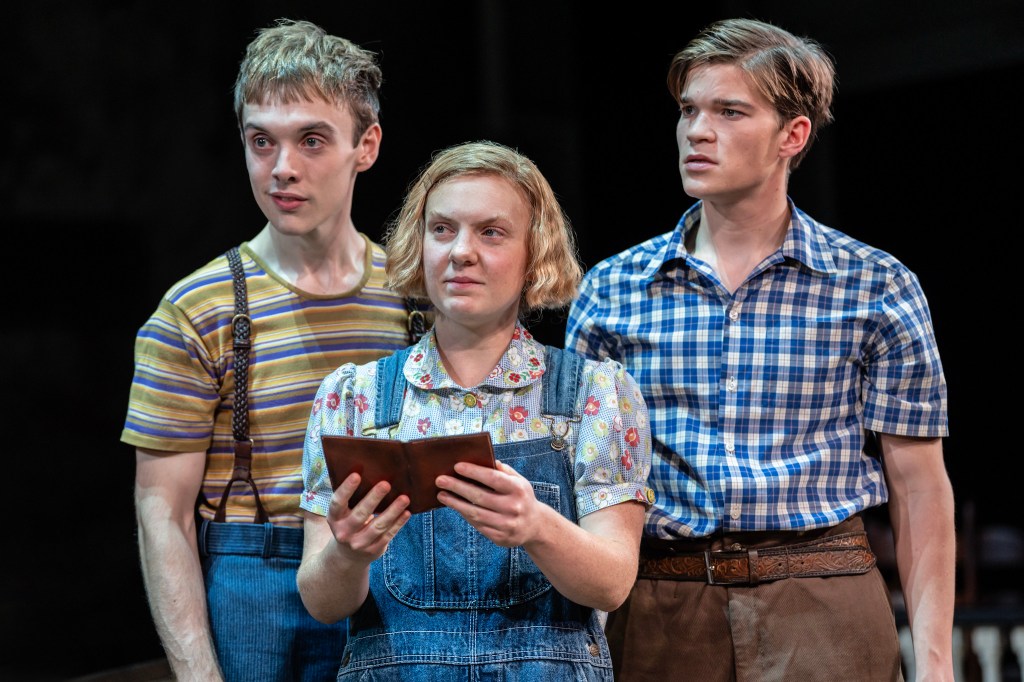
Oscar winning writer Aaron Sorkin’s stage adaptation of Harper Lee’s literary classic To Kill a Mockingbird arrived at the Lowry this week as part of its first ever UK tour. Having received rave reviews on both Broadway and in the West End this much anticipated production directed by Tony award-winning director Bartlett Sher, is bold, necessary and profoundly affecting.

Set in the racially charged American South during the 1930s, To Kill a Mockingbird introduces us to important themes and unforgettable characters. Racial injustice, social inequality, human morality, male pride, empathy and the loss of innocence are woven into the tapestry of this captivating piece as we follow incredible character arcs that grip us from the start.

Lee introduces us to Alabama lawyer Atticus Finch (played tonight by John J. O’Hagan) who, committed to fighting injustice takes on the controversial case of Tom Robinson, (Aaron Shosanya) a local black man who has been falsely accused of raping white teenager, Mayella Ewell (Evie Hargreaves). This decision both impacts and exposes Finch’s children Scout (Anna Munden) and Jem (Gabriel Scott) to the harsh realities of racism and prejudice while posing questions about their own moral integrity and ability for empathy.

Events are told through the eyes of Scout, older brother Jem and Dill Harris (Dylan Malyn) who is visiting the neighbourhood for the summer. All three excel enormously in bringing a child-like innocence to their roles, high-spirited and filled with adventure they bring an easy light to the shade of this often-dark story, making Act 2 all the more impactful as innocence is lost and heartbreaking truths are revealed. Special mention must go to Dylan Malyn, making his professional debut as Dill, his joyful innocence feels all the more devastating as the reality of his homelife is later revealed.
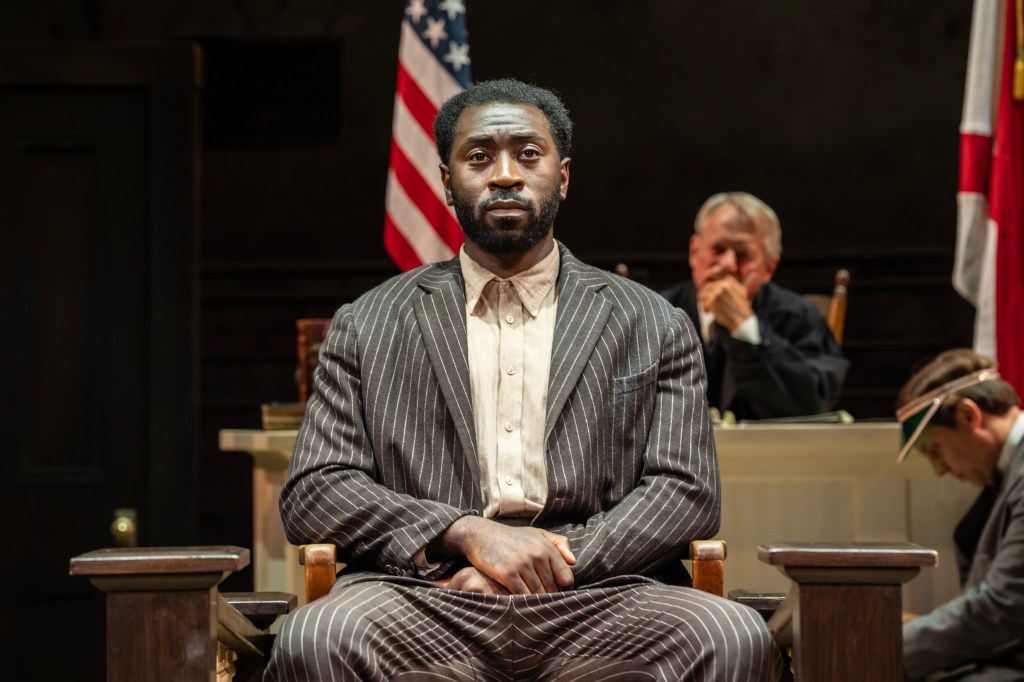
Sorkin’s decision to have the courtroom action feature throughout the play rather than in one climactic scene works superbly, a decision which ensures the pace never wanes as the three children cleverly narrate flashbacks ensuring the storytelling remains clear and entirely captivating.

John J. O’Hagan makes for a tremendous Atticus Finch, he is calm, considered and utterly committed to the role, he carefully explores and exposes the emotional depth of Atticus as the story unfolds and he’s truly tested by the moral limitations of those around him. His scenes with Andrea Davy as an excellent Calpurnia act as a powerful example of the novels themes of moral integrity.

Oscar Pearce gives a dedicated performance as the loathsome Bob Ewell while Richard Dempsey as prosecuting attorney Horace Glimer is every inch as odorous as you’d expect him to be. Aaron Shosanya is utterly devastating in his portrayal of the falsely accused Tom Robinson. His quiet resignation to his wholly abhorrent fate is heartbreaking to watch, yet despite the cruelty and injustice he remains dignified throughout.

This is a stunning adaptation which succeeds entirely in bringing Lee’s characters to vivid life. While the source material was written in 1960 its themes, language and terrifying injustice sadly do not feel alien in today’s society particularly when we think about Trump’s America. This Mockingbird is powerful, engrossing and deeply poignant. Sorkin successfully retains the core essence of Lee’s classic novel while exposing a modern relevance reminding every theatregoer that we’re not just a viewing audience but morally we each have a societal role and responsibility to play.

To Kill a Mockingbird is on at The Lowry until Saturday 24th January tickets are available here.
The Merchant of Venice 1936

Reviewed by Matt Forrest

Opening Night verdict ⭐⭐⭐⭐

When picking a film at the cinema, we often like to know what genre of film we’re
off to see, so hopefully there’ll be no nasty surprises for us. Surely the same would
have been said when William Shakespeare was knocking out plays with such
gusto. One play that has often proved difficult to pigeonhole is The Merchant of
Venice, listed as a comedy, mainly because there is a wedding, a spot of farce
and (spoiler alert), no one dies!

However, over time the play has been reappraised due to its problematic
antisemitism. Director Brigid Larmour and Tracy-Ann Oberman are the latest to
tackle this troublesome play, their ambitious artistic choices pay dividends
with this bold, thought-provoking adaptation.

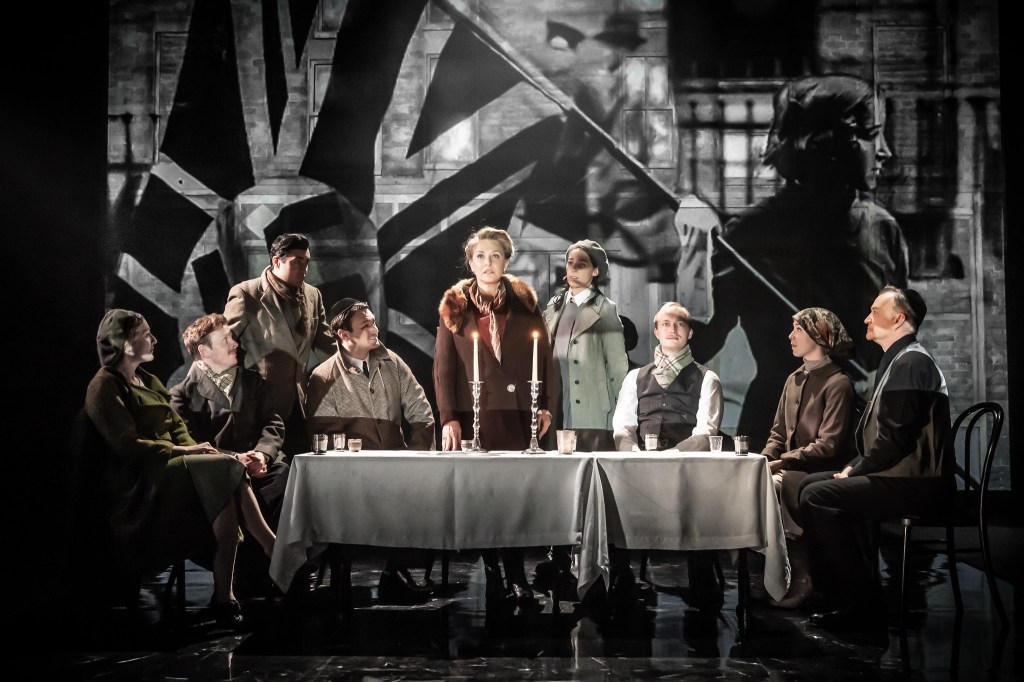
In their reworking, The Merchant of Venice 1936, the action is shifted to London’s
East End: where the rise of Oswald Mosley’s British Union of Fascists sees the
persecution of the local Jewish community. Here Oberman’s Shylock runs her
money-lending business. She is a strong, feisty Jewish businesswoman, who’s
devotion to her faith is only matched by her love for her family, especially her
daughter, Jessica (Gráinne Dromgoole) evident in a beautifully staged family
gathering at the start of the production.

Shylock is approached by Bassanio (Gavin Fowler), a socialite who has designs
on a wealthy heiress, Portia (Georgie Fellows). Bassanio, asks his friend, Antonio
(Joseph Millson), a local merchant and member of the BUF, to act as a guarantor
in order for him to secure a loan from Shylock. Antonio and Shylock despise each
other, yet the savvy money lender agrees to the loan, but the price Antonio must
pay if he is late with the repayment is a pound of his own flesh. As tensions rise in
the community, romances blossom, and fortunes fall, whilst Shylock and Antonio
are heading for a collision that neither are willing to back down from.

Oberman’s steely Shylock anchor’s the production from the outset, her revenge
mission sets the tone for the unpleasantness that follows. It’s a performance filled
with passion and swagger, ensuring that when the inevitable sucker punch comes you feel her heartbreak all the more. She is more than equalled by Millson’s slimy,
restrained but no less menacing black-shirted Antonio. They are supported by a tremendous cast, with special mentions for Evie Hargreaves’ portrayal of Mary Gobbo (also in a duel as Nerissa) who manages to get under your skin with her treacherous ways. Whilst Georgie Fellows, excels as the thoroughly unpleasant Portia.

Under Brigid Larmour stewardship the production thrives in its 1936 setting. It’s a
harsh world, where you are on high alert ready for the situation to escalate. It’s a
testament to the cast and direction that when that moment comes it rather takes you by surprise.

Liz Cooke’s grimy set design works tremendously well at selling the audience the
fear, and isolation of Cable Street. Whilst her costume design especially for the
more affluent characters look stunning: they dazzle as they showcase not just their
wealth, but their prejudices too. The production is intercut with video footage of the rise of the BUF, on the march through Britain. It’s a terrifying yet timely reminder of a part of Britain’s past that some conveniently choose to forget.

Despite the unsatisfying end to Shakespeare’s play, Larmour and Oberman give
us an optimistic conclusion, with a Oberman delivering a personal powerful
message of unity that will remain with me for some time to come and goes to
highlight the importance of theatre to not just entertain but remind us what it is to be
human.

The Merchant of Venice 1936 runs until 1st March, tickets are available here.