The Strange Case of Dr Jekyll & Mr Hyde

Reviewed by Matt Forrest

Opening Night verdict ⭐️⭐️⭐️⭐️
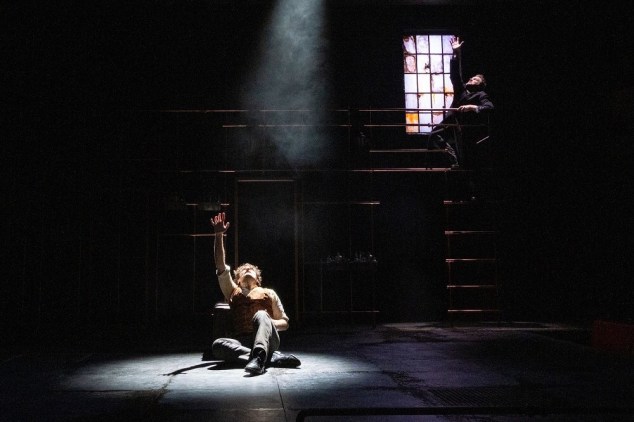
Since opening it’s doors for the first time in 2017 the Storyhouse has often made some bold and brave choices for their in-house productions Whether a fresh take on an old classic, a brand new or rarely seen production being brought to life, they always offer up something intriguing and unique and their latest production The Strange Case of Dr Jekyll & Mr Hyde is no exception.

Based on the novella by Robert Louis Stevenson, this adaptation for the stage by Glynn Maxwell is a new take on a classic story that we think we know like the back of our own hands but do we really?

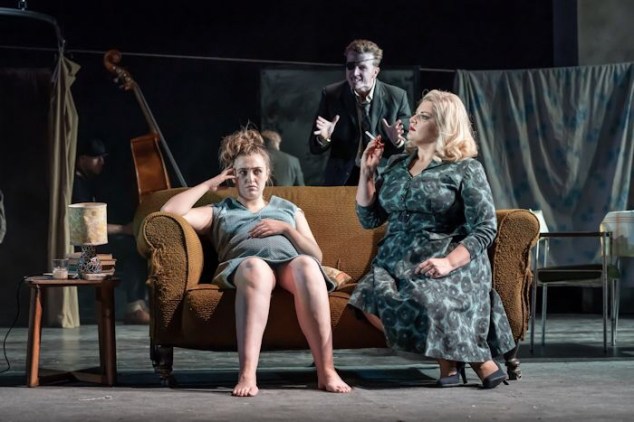
Retaining its Victorian London setting, we find a young girl selling matches, she is viciously attacked in a mysterious assault. The next morning Dr Jekyll (Edward Harrison) is troubled by the memory of the match girl but confused at having a pocket full of matches but no recollection of how they got there. 

Dr Jekyll writes to his old friend and former assistant, Lady Gabriel (Natasha Bain) for guidance. However, Lady Gabriel is focused more on the letters of her niece Rose (Rosa Hesmondhalgh), a curious, feisty, independent young women seeking adventure and a place to stay in London town. 

With London besieged by a series of grizzly murders, Lady Gabriel hasn’t the time nor the inclination to help her old friend, her main concern is that of the safety and wellbeing of Rose. However, soon Rose’s curious nature rubs off on her Aunty, this coupled with her intrigue of Dr Jekyll’s work on the splitting of the soul as well the mystery surrounding the deliverer of the letters from Jekyll, a Mr Hyde (Matthew Flynn) lead the pair to a meeting with the Doctor.

Whilst at Jekyll’s house, Lady Gabriel and the Doctor have a private meeting, which Rose is certainly not invited to attend, this leads the inquisitive adventurer to go exploring when she stumbles upon Jekyll’s labratory, his journal and another encounter with Mr Hyde that puts her and and her aunty in great danger.

There is so much to admire about this production that it’s difficult to know where to start. The creative team behind the show have taken a great many risks with narrative, style and presentation and the risks reward the audience with an original, atmospheric and psychological chiller that has a great deal of relevance in the 21st century.
Maxwell’s script is an update on Stevenson’s source material, still there at it’s core is that battle, between  good and evil, and the duality of human nature, whilst making the decision to explain Jekyll/Hyde’s behaviour as that of addiction, a need to step from the dark into the light, which adds an intriguing layer. We also have a strong female presence in this adaptation, which is missing in the source material. The character of Rose is a new character, and one that is yet to be troubled and trapped by the world around her.

Under Psyche Stott excellent direction, we have four very different performances, Natasha Bain gives a strong, world weary, turn, a matriarchal figure of the piece. Rosa Hesmondhalgh is a breath of fresh air as Rose, adding light relief throughout but this is much more than a comedic performance, here is someone that the world hasn’t corrupted yet, but she is far from naïve. 

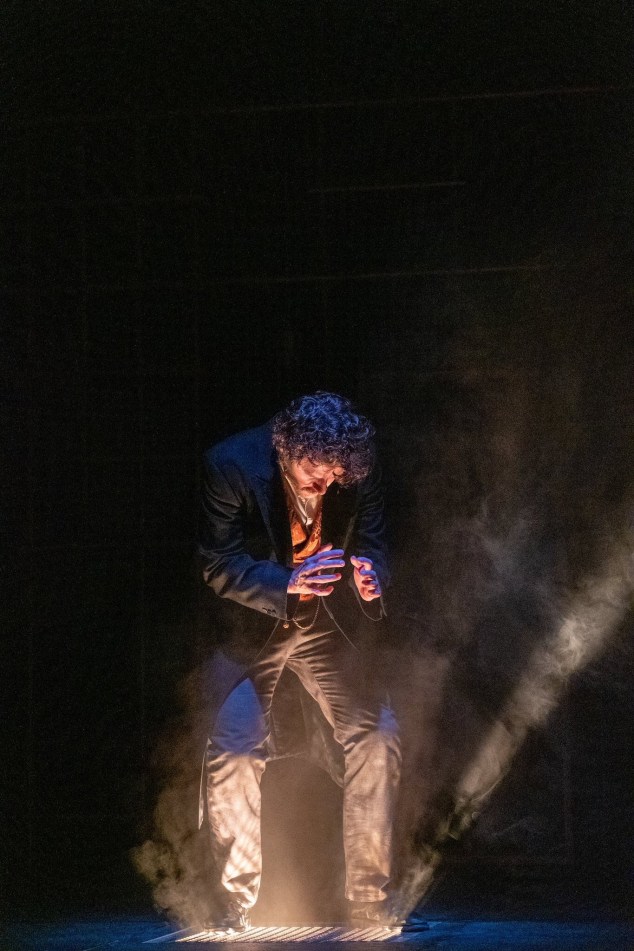
Often in productions one actor plays both Dr Jekyll and Mr Hyde, however we have Edward Harrison on good form as the frazzled unhinged, mad professor, whilst Matthew Flynn is menacing as his alter ego, I swear he grew in size as the play reached its conclusion. Flynn must wrestle with some poetic yet tongue-twisting dialogue, however he masters it skilfully.


What does make the production that extra special is involvement of choreographer,  Paul Bayes Kitcher, whose work with Harrison and Flynn really pays dividends, especially during the transformation scenes. 

Additionally, the sound design by Adrienne Quartly ratchets up the tension throughout, add into the mix a simple yet intriguing stage design of glowing copper pipes, Victorian lamps and secret passages and you have an innovative, thrilling and original piece of gothic theatre.


The Strange Case of Dr Jekyll & Mr Hyde is on at the Chester Storyhouse till the 19
th October. Tickets available here. 
Measure for Measure

Reviewed by Matthew Forrest

Opening Night verdict ⭐️⭐️⭐️⭐️

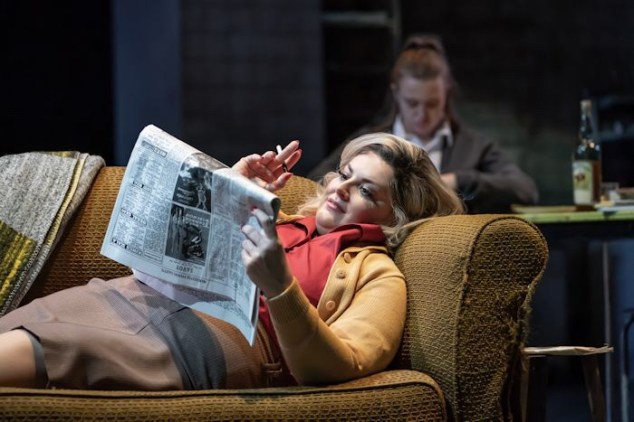
Hey, have you heard the one about the powerful older man who offered a young woman help in return for sexual favours? You’d be forgiven for thinking I’m speaking of the latest scandal to engulf Westminster or Hollywood but I’m referring to the plot of William Shakespeare’s Measure for Measure.

Measure for Measure is the is the final production for the Royal Shakespeare Company’s mini residency at the Lowry. Despite being four years shy of its 400-year anniversary this is a story that arguably has more resonance now than it ever has: the ill treatment of women and abuse of power by unscrupulous and seemingly omnificent men.

Set in Vienna at the turn of the 20th century, the Duke of Vienna has taken a sabbatical, leaving his deputy, Angelo in charge. Angelo is harsh and swift at implementing law and order to the city, while a young man Claudio, falls foul of the new changes to the law. He is sentenced to death for impregnating  his fiancé.  Claudio’s Sister Isabella, who is training as a nun hears of her brother’s plight and is soon up before Angelo pleading for her sibling’s life. The interim leader agrees to clemency in return Isabella must sleep with him. Isabella is repulsed by the very notion of this, but what can she do? Go up against the most powerful man in the city, it’s her word against his and who would believe her.  Isabella soon encounters a kindly friar, who agrees to assist  her with a plot to bring down Angelo, however the friar is really the Duke of Vienna returning to the area so he can get a a true measure of the city.

It is easy to see why this is referred to as one of Shakespeare’s more “problematic” works. On the one hand, this is a story about the abuse of power, as well as the wretched treatment of women. Whilst at the same to there are some comedic elements to the production in the form of the Duke’s deception and host of colourful yet despicable characters including the cunning pimp, Pompey, and slimy sycophant Lucio.  Director Gregory Doran manages to reign in all these elements to tell an engaging, fluid, and entertaining story, which does not shy way from the more despicable facets of the narrative.

Sandy Grierson is fantastic as loathsome Angelo; there is an understated menace to his performance, helped by the fact that he has more a passing resemblance to a certain Russian head-of-state.  Antony Byrne is also on fine form as the Duke, he is both strong and flawed, whilst his exchanges with Joseph Arkley’s Lucio offer up some of the productions lighter moments. However, at the centre of the production is exceptional performance by Lucy Phelps as Isabella, sometimes strong, sometimes vulnerable, it is her angst riddled turn that highlights the gravitas of the situation.

The superb acting works hand in hand with the high production values, there is very little in the way of set set design; instead, a change of location is signified by the use of projected images at the back of the stage.  Save for a few chairs and the use of two-way mirrors, set design is minimal which if anything intensifies the claustrophobia of the situation. The stage at the Lowry seemed to grow, as the narrative continues leaving the characters firmly in the spotlight, with no place to hide. In addition, the score by composer Paul Englishby, opens with a beautiful waltz, but soon shifts into darker territory, providing a sense of menace and foreboding.

Despite being on uncomfortable ground with its subject matter, this is an accessible, engaging production that is made even more fascinating by its relevance today. This may not be one of the ‘bards’ best-known plays but it is filled with twists and turns, none more so than the close 10 seconds of the play which add to the cynical nature to this intelligent piece

Measure for Measure is at the Lowry till 5th October. Tickets available:  here.

Tags: Measure for Measure, William Shakespeare, Gregory Doran, Drama, Theatre, Sandy Grierson, Antony Byrne, Lucy Phelps, Joseph Arkley


A Taste of Honey

Reviewed by Michelle Eagleton

Opening Night verdict ⭐️⭐️⭐️⭐️

When one of Salford’s most iconic plays comes back home to its birthplace, there’s bound to be a huge weight on the company performing it to get it right. The National Theatre set itself the challenge of doing just that by making one of the first stops on its UK Tour of Shelagh Delaney’s A Taste of Honey, The Lowry. 

Director Bijan Sheibani, who is at the helm of this production, has managed to rise to the challenge though, as it received an encouraging reaction from the audience on press night.

Sheibani takes the play back to its roots in this bold incarnation, which echoes how it was originally performed, adding the incorporation of music. There’s a live band onstage throughout, which accompanies the characters in solo numbers and plays underneath some of the dialogue, which helps evoke the mood of the piece.

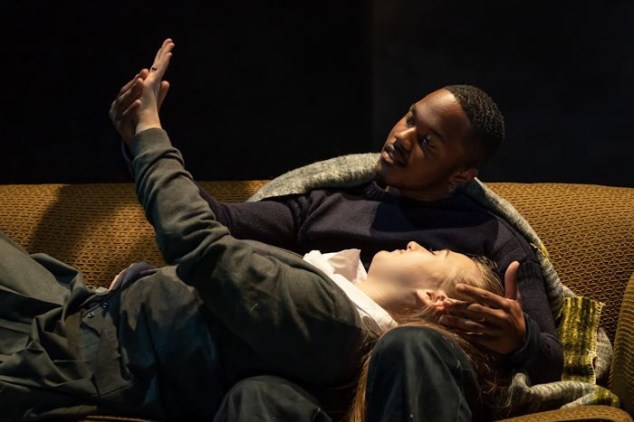
For those who are unaware of the story behind the Shelagh Delaney classic, A Taste of Honey is essentially a gritty norther tale of the love-hate relationship between a working-class single mother Helen and her  daughter Jo, set against the stark backdrop of 1950s Salford. The play was penned by 19-year-old Shelagh back in 1958 and it’s hard to believe that at such a young age the local girl, who had very little experience of seeing shows let alone writing them, could produce such prolific work which would resonate with generations to come. 

Lancashire born theatre and TV star Jodie Prenger puts in a solid performance as northern matriarch Helen making the most of the acid tongue humour gifted  from Delaney and her natural comedic delivery, prompting huge amounts of  laughter from the audience. We also get the chance to see Prenger put her impressive  vocal chords to good use as she packs  a punch with the opening number ‘A Good Man’ (a soulful track reminiscent of some of the late Amy Winehouse’s repertoire).

Gemma Dobson’s portrayal of Jo creates a character that’s like marmite  you love her vulnerability one minute but want to throttle her for her outbursts the next. Dobson’s whining edge to Jo gets a little tedious in the second half of the play but overall her sweet scenes with Jimmie (her sailor love interest) and Geof make up for it and we see her performance of the troubled teen really come into its own.

Despite the play being primarily focused around the two main female roles, Jo and Helen, the stand out performance comes from one of the males in the cast, Stuart Thompson as Geof. Thompson is a delight to watch and displays a natural  sensitivity  as Jo’s gay best friend. Thompson manages to find a balance of campness and caring in the role of Geof, who struggles with his worries of being an outcast in the 1950s society whilst looking after his pregnant friend.

Elsewhere, Hildegard Bechtler’s contemporary design of the production  adds to the bleakness of the piece with a minimalist set complete with stark and dingy lighting. Everything seems shabby and in need of TLC, except for Helen’s brash and glam outfits which extenuate her desire to appear better than she is in reality – which you could say epitomises  the phrase ‘all fur coat and no knickers’.

There have been numerous productions of A Taste of Honey since it opened on stage over 60 years ago and the National present a good version here, which really highlights the comedy and pathos of Delaney’s work.

A Taste of Honey is on at The Lowry until Saturday 21st September then begins a UK tour, further information can be found here.

Macbeth

Reviewed by Michelle Ewen

Opening Night verdict ⭐️⭐️⭐️⭐️

“Double, double toil and trouble…”

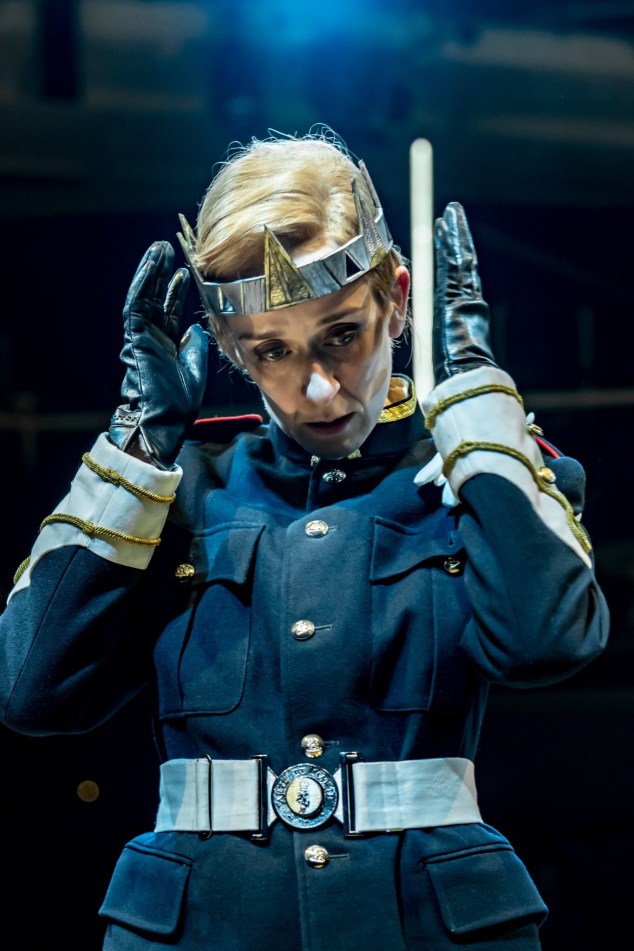
In an era when the mere suggestion of a female Bond is enough to break the Internet, the Royal Exchange enters the fray with possibly the first ever mixed-gender professional production of MACBETH to have cast a woman in the lead.

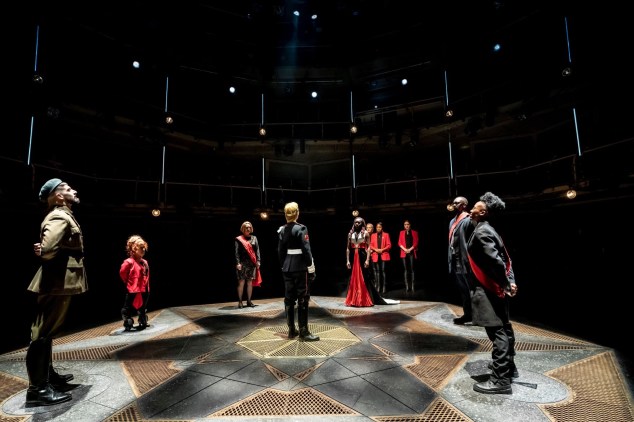
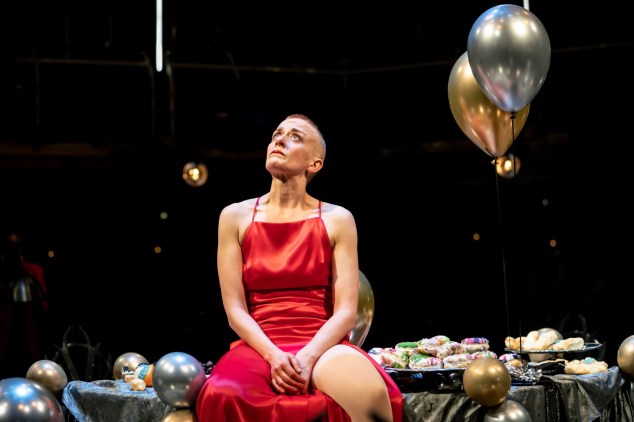
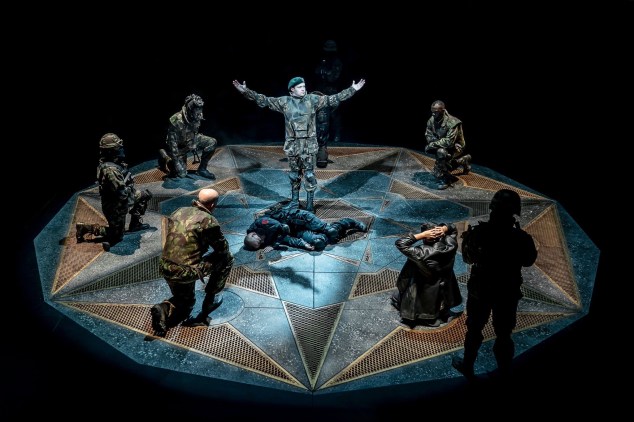
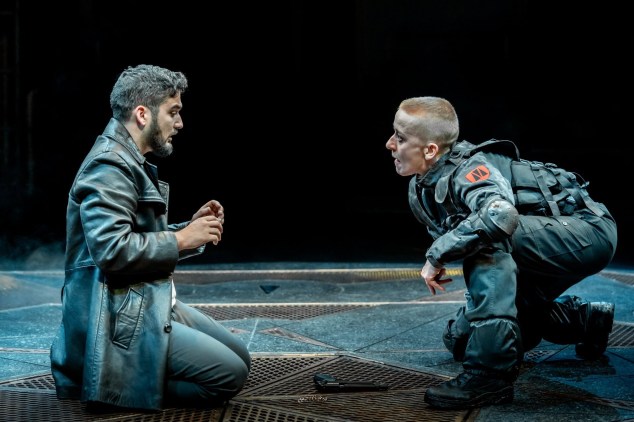
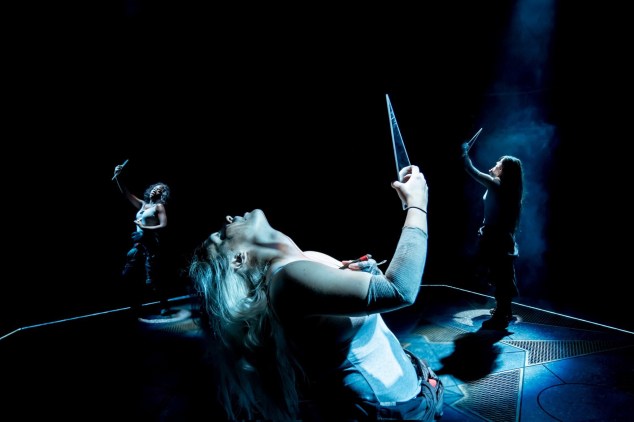
That’s right, hang on to your coronets… Shakespeare’s titular character is played by a FEMALE. And what a woman she is! Dressed in combats, shaven-headed and brandishing assorted weaponry, Lucy Ellinson’s Macbeth is decorated for her valour; gripped by murderous ambition; and then strung up for her sins.

She parties in a blood-red ballgown, assassinates her Queen and shares her bed with a strong woman of colour, who prays: “Unsex me here and fill me from the crown to the toe topfull of direst cruelty”. (It’s enough to make your average Daily Mail reader’s head spin!)

In a further gender reversal, Duncan is played by Alexandra Mathie. It is an arresting moment when she enters the stage – a sharp bob framing a face that would usually bristle with whiskers.

Let us be clear, however… this is not about watching an inclusive ‘woke’ production. Every actor has earned their place and, with gender politics swept off the table, you’re free to focus on characterisation.

Macbeth is presented as an ambitious, conniving and deceitful person – not a woman breaking stereotypical convention – and in a major departure from classic portrayals, Lady Macbeth (Ony Uhiara) relies on scorn and reason instead of her womanly wiles.

They are part of an ensemble that is a tour de force. Each character is carefully etched and singularly memorable – delivering classic scenes with admirable gusto.

As brave and noble Banquo, Theo Ogundipe makes for a tender father and terrifying ghost, whilst Nima Taleghani and Rachel Denning bring comic relief as Lennox and the Porter/Lady Macduff.

Witches Nicola May-Taylor, Charlotte Merriam and Bryony Davies are scene-stealers whenever they appear – as “foul and fair” a motley crew as you could ever hope to encounter.

Christopher Haydon’s direction is spectacular, with the arrival of Banquo’s ghost at the feast his pièce de résistance. (Playful and sinister, think heads on platters, giant teddy bears and a malevolent game of musical chairs!)

Here, a special mention also to Designer Oli Townsend, Lighting Designer Colin Grenfell and Sound Designer Elena Pena, who infuse the whole production with a post-modern, industrial and militaristic feel.

Balloons, gunshots and strobe lights puncture the interior of ‘the round’ as – under the tutelage of Movement Director Lucy Hind – the players hurtle in through doors, drop down on ropes and swing from ladders with knife blades pointing venomously.

With no seat no more than 9m from the stage, MACBETH makes full use of the 360-degree performance space, which is a feat of engineering in itself. Suspended in the Grade II listed building, it is the perfect metaphor for this thrillingly entertaining show – a thoroughly modern offering rooted in the classic tradition of the theatre.

MACBETH is on at the Royal Exchange Theatre until 19 October. Ticket information can be found here.

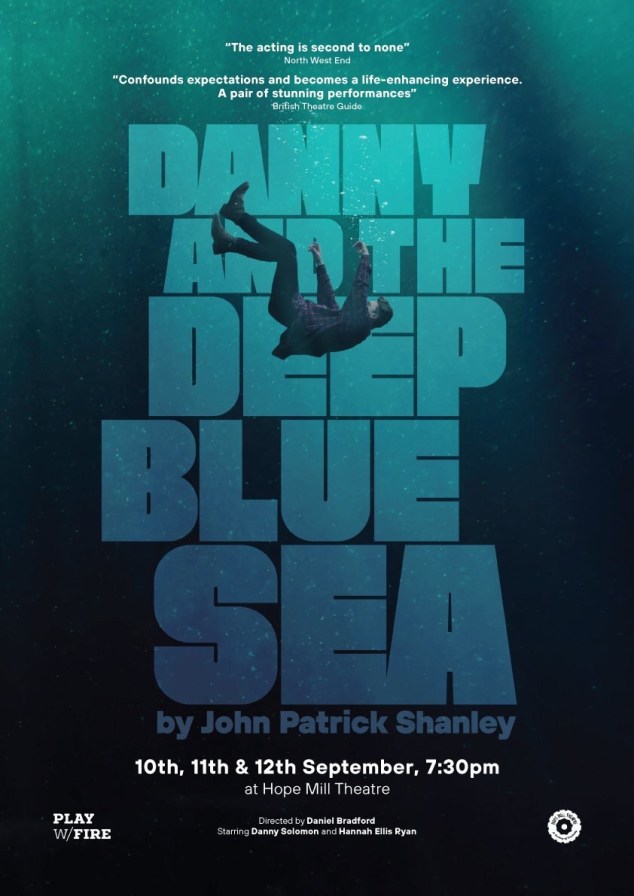
Danny and the Deep Blue Sea

Reviewed by Nikki Cotter

Opening Night verdict ⭐️⭐️⭐️⭐️

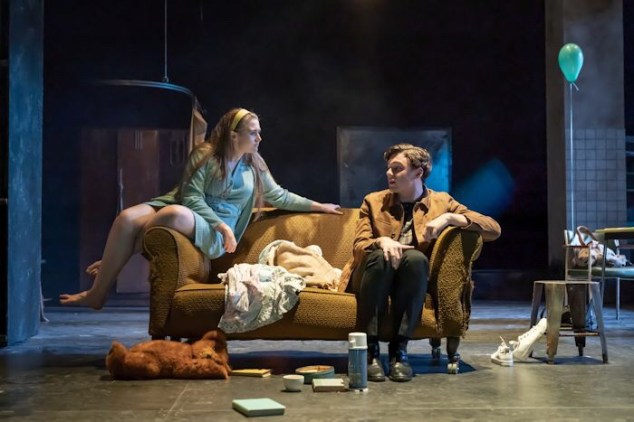
Written in 1984 by John Patrick Stanley, Danny and the Deep Blue Sea is a intensely compelling study of two lonely lives, both trapped in desperate and destructive spirals of self-loathing who come together in search of both companionship and redemption.

Volatile Danny (Danny Solomon) speaks with his fists, lashing out at anyone and everyone in a bid to protect his fractured self. He is unpredictable and alarming yet somehow Roberta (Hannah Ellis Ryan) is not afraid. Burdened by her own trauma she is riddled with self-hatred and a warped sense of a need for punishment for her abusive past.

A simple set of scattered bar furniture and an old mattress complete with crumpled bedclothes make to the set. A glimmer of moonlight seeps in from above while a porcelain doll dressed in white offers a hint of Roberta’s past.

As the barbed bickering deepens into aggressive exchanges a sharing of secrets begins allowing both characters to develop unpredictably. Danny’s vulnerability begins to show as his defences slip while their fleeting post-coital redemption shows their shared desperation for elusive love and happiness. They are messed up, bad, burdened and bruised yet touchingly real and heart-achingly raw.

Both Danny Solomon and Hannah Ellis Ryan convince entirely in their roles. As an audience member you are in that bar in the Bronx with them, you feel every moment of heartache in the bedroom and share in their despair and awkward humour. Director Daniel Bradford ensures the emotional charge of both performances slaps you in the face keeping you guessing throughout, never knowing where these tormented souls will take you next. Drowning in despair one moment while gleefully flinging arms around each other the next. Powerful and affecting theatre once again from Play With Fire Productions.

Catch Danny and the Deep Blue Sea until Thursday 12th September at Hope Mill Theatre tickets available here.

Writer Henry Filloux-Bennett talks TOAST

HFB

When Nigel Slater released his 2004 autobiography TOAST: The Story of a Boys Hunger, it’s doubtful he ever imagined it would be made into a BBC film let alone become a critically-award winning play which after wowing the West End is now touring the country to packed audiences every night.

Here at Opening Night we were lucky enough to catch up with writer Henry Filloux-Bennett ahead of the shows return to The Lowry to hear a little more about the process of taking the book from page to stage as well as what audiences can expect from this heart-warming adaptation which critics have described as ‘delicious’.

Opening Night: “How did you first become aware of the autobiography and did you read it with the intention of adapting it for the stage?”

Henry Felloux-Bennett: “I was a cook working in London, weirdly in the same hotel that Nigel works in at the end of the book, I was knackered as kitchen hours are stupidly long and I didn’t have any money so I had to live outside of London and commute in. To keep me awake, I would read a book. I was given TOAST one Christmas and it was the first book I picked up as I left one day. I just started reading it on the bus back and forth from the kitchen not only did the story resonate because he has an interesting upbringing and then goes into cooking and I thought – ‘Oh that’s like me’, but also I didn’t have anything to do with theatre but I sort of wanted to do something in theatre, and I thought: ah, that could be the show.”

Toast 1

ON: “Once you’d decided to create the piece was it an instant yes from Nigel?”

HFB: “I tried originally to get the rights for a show in Edinburgh but Nigel said no, thank God because ten years later, the play became much more of a considered thing. Back then, I would have just done it in two hours and hoped for the best. It would have been rubbish so thank God he did say no.”

ON: “Your perseverance clearly paid of as 10 years later Nigel finally gave his backing to the adaptation.”

HFB: “Yes, the Lowry was doing a festival called Week 53 and it was about coming-of-age, Nigel also turned 60 the year it started so I think that had something to do with it. I think also it was something to do with this festival because it wasn’t a big glamorous West End show. We were trying to create this small experience for a very limited number of people that I hoped showed I genuinely wanted to do it. I think a lot of adaptations happen because it’s going to make money – I think he worried about that, not that it would be a big cash cow but that it was cynical. I just thought, oh we can get some foodies to come and see this.”

Toast 4

ON: “What is the starting point when taking a book from page to stage?”

HFB: “I think one of the big challenges of adapting any book to stage is how you a make it interesting to watch. Obviously if you’re reading a book you can be totally absorbed in it. You can enjoy the characters and you can enjoy the plot, but actually when you’re faced with watching something that sort of takes it in a different direction. The challenge with TOAST is that it’s not a narrative-based book, it skips around quite a lot. Finding a journey to go on, from start to finish, was a massive challenge because it doesn’t flow in a linear way. But that’s what made it more fun as well because I didn’t have to stick to normal storytelling rules.”

ON: “Did Nigel have an absolute veto on anything?”

HFB: “Mainly language. There is a bit where they go to Bournemouth on holiday and there is a line about looking out on the sea and the guy who used to play Nigel once said ocean instead of sea. Apparently, that is a massive no-no because Nigel would never have said ocean in the 60s. It’s the details – like making the labels for the damson jam props. He made a lot of props. The general shape of the play he’s always been quite happy with because he understands that you send a book out into the world and it’s up to everyone else how they deal with it”.

Toast

ON: “Were you worried about Nigel Slater’s reaction to what you had produced?”

HFB: “I was terrified about Nigel’s response. I think you always think that what you’re doing you quite like but then you have to present it to people who’ve never read it before and you have to present it to the person who it’s about, who wrote the thing itself – that’s terrifying. He was very nice about it. He said he wouldn’t read it until I was happy with it, which was a massive bonus because we didn’t know each other. I might’ve massacred his memoir, which would’ve been awful. Touch wood, I haven’t done that. But he was very generous in saying do whatever you need to do. When I was writing it, I read an interview with Lee Hall, who wrote the screen play for the film. And Lee Hall basically said that you can’t care the person is still alive and you can’t care about the person reading it. You have to write the thing you need to write. If the person hates it you can change it, which he did a little bit, but you have to write the thing that you want to write and don’t worry that there’s a real-life Nigel Slater who will be there at some point. It was great advice, which I followed.”

Toast 2

ON: “Why do you think the tastes and smells are so important in both the autobiography and the play?”

HFB: “If you read the book, which you absolutely should, you’ll know that all the chapters are named after food, like Apple Pie, Marshmallows or Digestive Biscuits. Angel Delight was what I responded to when I read it. Butterscotch Angel Delight is probably the best thing ever invented, it’s an amazing pudding and it takes five minutes to make – who wouldn’t love it? It’s those memories – and the smells. Everyone knows the smell of certain things. If you open a packet of digestives, you know that smell. The same with toast. If you think about it, everyone can tell what toast smells like, just when it’s just starting to burn a little bit. All of those things are in his chapters so we had to respond to that in the play.”

ON: “How involved has Nigel been in the process?”

HFB: “He was literally involved from day one. He was there for the workshop week with The Lowry six months before we made the show and then he was there for every step of the way with the food. I think the tech period for him was the most exciting bit because he works in TV so he’s not used to being involved with how the sets get made. At The Lowry, he made half the props with us. He was literally in the dressing room making labels. I’ve still got the label he made for the Damson Jam bottle, it’s my favourite thing. Oliver, who is the Executive Chef at The Lowry’s Pier Eight, worked very closely with Nigel and James [Thompson], our Food Director, to create things that everyone would get to taste. Nigel came up for tastings and was like ‘this bit needs this’ and ‘it needs a bit more sharpness in the lemon meringue tarts’ so he was really involved.”

Toast 5

ON: “Does any cooking take place on stage?”

HFB: “Yes, I’m not going to tell you what. But there is a scene when we cook on stage. Have you ever seen Billy Elliot? In the script I wanted to copy the bit where he does the angry dance and he can’t express himself any other way. There’s a moment in the play when Nigel gets told something and he doesn’t know how to respond. In my head the only way he could’ve responded was to cook and so it’s meant to be the angry dance for Nigel. It’s a really interesting thing because there is no talking for nearly five minutes. It’s quite intense and Giles had to learn how to cook that dish perfectly. Hopefully it resonates and you’ll find it interesting, but for some people it’s the only bit that I didn’t write and it’s the bit that people cry at. That bit certainly gets people because they can smell and see. The sound of food cooking in a frying pan is amazing, especially in a theatre”.

TOAST returns to The Lowry where it first premiered in 2018 on Monday 11th November for a limited one week run until Saturday 16th November. Tickets available here.
Interview | Jodie Prenger | A Taste of Honey

The National Theatre brings Shelagh Delaney’s ground-breaking play A Taste of Honey to The Lowry this month as part of a new autumn UK tour. Returning the northern classic back to its roots, Bijan Sheibani’s production takes an enthralling look at working-class life in post-war Salford.

Jodie Prenger takes on the iconic role of Helen, a single mother who takes off with a car salesman leaving her feisty teenager Jo to fend for herself. Jo’s relationship with a sailor comes unstuck when after promising to marry her he heads off back to sea leaving art student Geoff to take on the role of surrogate parent. Things get even more interesting when Geoff innocently calls on Helen to help, opening the doors for this unconventional set up to unravel.

We were lucky enough to catch up with Jodie Prenger during rehearsals to hear a little more about the production and what it means to be tackling such an exciting role written by Delaney when she was just 19.

I first watched it about 8 years ago now, a dear friend of mine Bobby Delaney (no relation) gave it to me to read and I absolutely fell in love with it.” Jodie explains “…it was so real, so honest and so tender. It was the mother and daughter relationship that really got me, for me, my Nan and all that side of the family were all from Manchester so it was just like hearing my Nan’s voice. The feistiness and the fight that my Nan had I saw a lot of that in Helen.”

Prenger has played many strong women on stage including the ultimate Scouse independent woman Shirley Valentine; we asked Jodie what is was about northern writing that makes for such a memorable and original piece. “Northern writing just has a real warmth…it’s witty, it’s tender, there’s a zest and spiciness to these strong female characters who I think are always interesting to watch in theatre, in film and TV. The way Shelagh Delaney wrote is just so great that the story comes to life and I just love reading it and watching it.” Explaining what makes the North so special Jodie said, “There’s a beating heart within the North, in Manchester and Salford and within the play itself. Even though people are up against so much they still fight and strive and still have that warm genuine humour. It’s like me and my Mum we can be battling royal but then one of us will say ‘oh have you finished then’ it’s a type of humour that you don’t often find in every corner of the UK.”

The play was famously seen a very taboo when it first premiered due to the themes and characters, “We’ve come a long way but we still have a long way to go, the cast were told they may have to evacuate the theatre when it was first put on, you’d not have that happen now, that wouldn’t even be entertained today but back then it was. I think we’re getting better well at least I hope we are. Yes back then it was taboo and although not so much now it’s still very, very poignant”.

Aged just 19 when she wrote this debut piece, Prenger sees Delaney as a courageous writer, “I think she unleashed a really strong genuine female voice which around that period was unknown. It was very brave, I think it’s the same kind of woman’s voice we’d hear today but then it seemed shocking and taboo.”

The role of Helen has famously been played by several incredible actresses including Angela Landsbury and Avis Bunnage, Jodie explained how she goes about making a character people know so well her own. “You do feel the pressure of those who have gone before you but that’s what gives you the drive to work hard and gives you the confidence to decide how you are going to create your character. It’s about my Nan’s ethic almost of rolling up your sleeves and getting stuck in. It’s important you develop the character how you want to develop her and that comes from working with your fellow cast members. I think she’s real; the only way you can play a character like her is by playing the truth.” 

Drawing on her experiences with her own family when it comes to the mother daughter scenes Jodie states “Making the mother daughter relationship believable I think comes from taking your experiences and using them. Taking experience and inspiration from characters you’ve met along the way. Definitely the relationship you have yourself with your mother, sometimes I find although Helen and Jo are polar opposites they are also so similar I think that’s why they come up against each other so much.”

Set famously in the 1950’s Prenger explained how those elements will still very much be present but with some additional styling from designer Hildegard Bechtler. “It’s the same production team who worked on the 2014 production at the National, but what they are really, really set on is keeping those elements of the 1950’s but making it poignant for today. There’s music like Nina Simone, Peggy Lee and Amy Winehouse, there’s live jazz, there’s folk music. The aesthetic of Amy Winehouse really influences the design, her style, look and music. The costumes will be 1950’s but not so much starched dresses etc that it couldn’t be any other time but will hint at modern day as well, same with the props and set too.”

Launching the tour in Salford the birthplace of Shelagh Delaney feels appropriate; we were interested to hear Jodie’s thoughts on what her character Helen would make of 2019 Salford. “My brother Marco lives nearby and I can’t believe how much it’s changed, perhaps she’d find the nearest gin bar, she’d have a great choice. I’m sure she’d love it; you always love home don’t you. That’s what Shelagh Delaney was like, she says there’s not many places she’d like to live, maybe London but then she’d always come back home. Home is home.”

A Taste of Honey opens at The Lowry on Friday 13th September and runs until Saturday 21st September, tickets available https://thelowry.com/whats-on/nt-a-taste-of-honey/


Mythos: A Trilogy

📷 David Cooper

Reviewed by Nikki Cotter

Opening Night verdict ⭐️⭐️⭐️⭐️⭐️

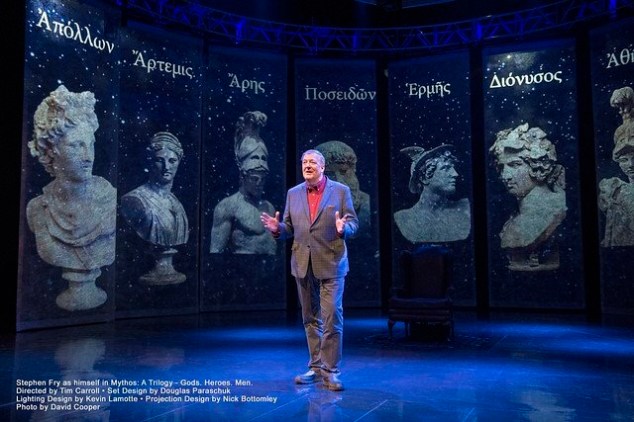
Fresh from taking the Edinburgh Fringe by storm, Stephen Fry brings his one-man trilogy to the Lowry as part of his first UK tour in almost 40 years.

Mythos: A Trilogy based on his best selling books Mythos and Heroes allows Fry to focus on a different subject matter in each of the three shows starting firstly with Gods, then secondly Heroes before thirdly and finally taking on Men.

Effortlessly charming and unquestionably entertaining Fry weaves through the history of Greek mythology right from the origins of the Ancient Greek Gods all the way through to the realisation that mortal man had progressed so far that perhaps the glorious Gods who’d ruled with such majestic power were no longer needed. Each and every story is packed with brilliant and witty observations as the Great Gods are brought to splendid and spectacular life.

Sitting centre stage on a throne-like leather armchair, Fry, a natural storyteller draws his audience in as though huddled round a campfire: his knowledge and enthusiasm bursting to be shared. Large screens surround him as projections of animations and classical paintings play out.

Stories roll off Fry’s tongue captivating the audience while delving deep into the origins of the Greek Gods. The names of the Original 12 Gods, their children, their cousins, heroes, creatures and mortals are reeled off effortlessly as Fry adds depth to his delivery with witty anecdotes and entertaining ad libs.

Stories are made accessible with Fry designating regional accents to the various individuals and comparing their personalities to modern day references, Heracles for example is a Brummie while Titan is described as being a “bit of an emo”.

As well as Fry’s captivating storytelling he adds various interactive elements to each show firstly in the form of the ancient version of trivial pursuit, in this case ‘mythical pursuit’. Audience members are invited to pick a subject from which Fry regales the listeners with interesting facts about said subject. In addition to this Fry opens up his oracle during the interval giving audience members an opportunity to email their burning questions in the hope of Mr Fry selecting theirs for discussion at the start of Act II. Sadly on this occasion even the oracle was stumped when the word Brexit emerged.

Wonderfully this Herculean sharing of what can only be described as an encyclopaedic knowledge never feels overwhelming or inaccessible. Fry’s warm and playful nature ensures every audience member feels part of this mythological ride and will leave the theatre armed with both a huge respect for the ancient Greeks and plenty of interesting facts to wow their friends and family with thus achieving Fry’s aim of returning to a storytelling society.

Mythos: A Trilogy covers all bases, there is love, war, heroism and devilment, with each and every story told with passion and joyful delight. The ancient is brought to wondrous life in this epic trilogy of olympic storytelling we have just one request: please Mr Fry don’t leave it another 40 years.

Mythos: A Trilogy can be seen at various locations across the country further information can be found here.

Letter To Boddah

64441462_496479654454538_5024441734306725888_n

Reviewed by Matt Forrest

Opening Night verdict ⭐️⭐️⭐️⭐️⭐️

In the song Hey, Hey, My My (Out of the Blue) Godfather of grunge Neil Young muses the statement: “It’s better to burn out, than to fade away”.  Sadly, this was a question posed in Kurt Cobain’s suicide letter, tragically titled Letter to Boddah.

Writer Sarah Nelson has used this desperately heart-breaking event as the inspiration behind her play, also titled Letter to Boddah. Set entirely in the disabled toilet of a Tesco store, we find childhood friends Billy (Sam Glen) and Neil (Jordan Reece): the pair are dressed in full military combats, armed to the teeth and carrying a ruck sack packed full of explosives ready to blow up the supermarket, its customers, and if necessary themselves.  What has brought these two to this point? Is there any going back for the pair?

Nelson has written a pitch-black comedy drama which explores themes of friendship, grief, domestic abuse and lost potential. Taking a setting more associated with that of a British ‘sitcom’, we are treated to some razor-sharp one-liners and darkly comedic dialogue, mixed with moments of heartbreak, as well as a few twists that will have you on the edge of your seat.

Both leads are excellent. Sam Glen puts in an intense, gut-wrenching turn as grief-stricken Billy, whilst Jordan Reece plays Neil to perfection, striking the right balance between comedy sidekick and unhinged psychopath.  The chemistry between the two is outstanding and fully believable, which makes their actions seem all the more desperate. The two manage to captivate and entirely hold your attention throughout.

This is an important production that addresses issues of male depression and suicide, as well as containing strong political themes of globalisation, and commentary on a lost generation without a voice. Powerful, dark, shocking and packed full of humour, with a finale filled with tension. This is an outstanding piece of work that deserves to be seen by as many people as possible, and on the strength of the quality on display tonight, will surely find an audience.

Letter to Boddha is on at the Edinburgh Fringe throughout August at C CUBED (Venue 50) daily at 1:15pm tickets available here.


Henry V

Reviewed by Nikki Cotter

Opening Night verdict ⭐️⭐️⭐️⭐️⭐️

Petty political point-scoring, a none democratically elected leader making decisions shaping the future of our nation, decisions driven by a lust for power…sound familiar? Nope this isn’t a political commentary of the UK right now but Shakespeare’s Henry V.

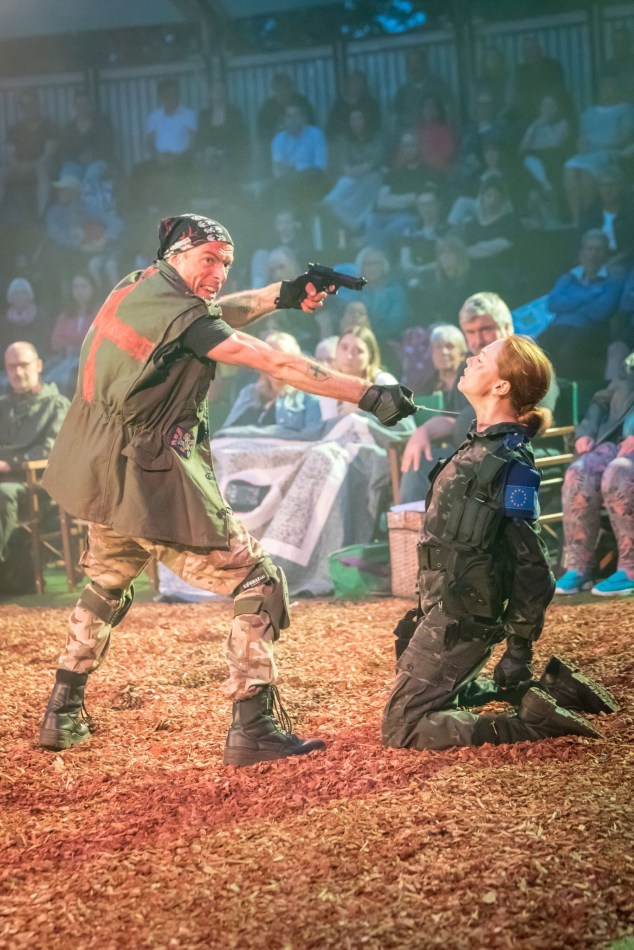
Director Loveday Ingram places the production amidst the current political climate, (or should that be crisis?) St George’s crosses fly high as soldiers swill down booze while chants of ‘England ’til I die’ ring out from the yellow vests.

Shakespeare’s France very much represents the EU with the cast dressed in familiar vibrant blue as yellow starts billow in the breeze.

It may be 2019 but Henry V feels more pertinent now than ever before as Shakespeare’s social and political observations continue to ring true, centuries after they were first penned.

Joseph Millson takes on the role of the heroic leader. Persuasive and full of charm one moment, ruthless and murderous the next. Millson revels in the complexity of the monarch exploring every layer with subtlety and style.

He tackles Shakespeare’s famous “Once more to the breach, dear friends” monologue with a solid and rousing conviction: his army literally chomping at the bit, breathless for the battle to begin. In contrast the commanding warrior loses all composure when attempting to woo Katherine, faltering over his words as he bashfully fumbles in French.

Millson is supported by an impressively strong cast notably Samuel Collings as Pistol, Seren Vickers as Fluellen and Vanessa Schofield as Scroop/High Constable while Mitesh Soni and Sarah-Jane Potts inject some well delivered humour as Alice and Katherine.

Director Loveday Ingram and her cast not only find the heart of Henry V but also the humour too in this solid and potent production as keen observations of the human spirit play out.

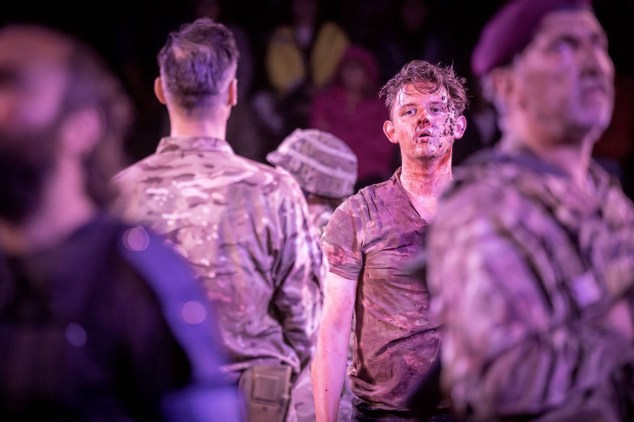
Vulnerabilities of leaders are masked with chest pumping and posturing while the battlefield scenes remind us of the catastrophic consequences of decisions driven by political self-promotion. The scene after the battle of Agincourt packing a deeply emotional punch as the cast hauntingly sing to the skies.

Andrew Patterson’s dynamic lighting design adds atmosphere and depth while Paul Benzing’s fight direction adds authenticity and impact.

This is a cleverly constructed piece which will stay with audiences long after viewing. Vibrant storytelling at its finest.

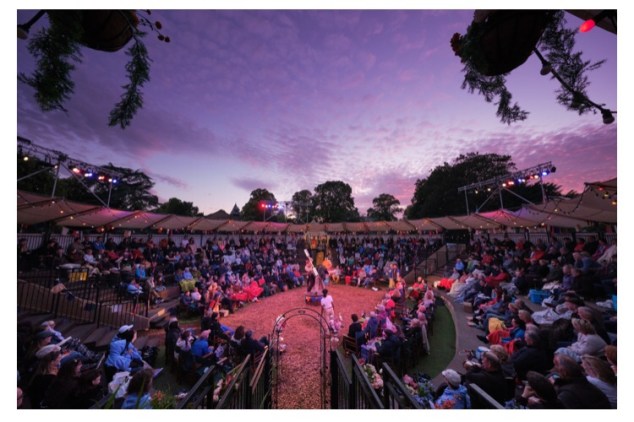
Henry V is on at Grosvenor Park Open Air Theatre until Sunday 25th August tickets available here.

Twelfth Night

Reviewed by Nikki Cotter

Opening Night verdict ⭐️⭐️⭐️⭐️

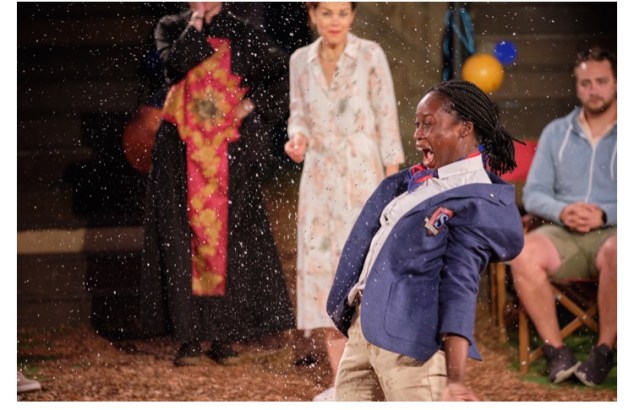
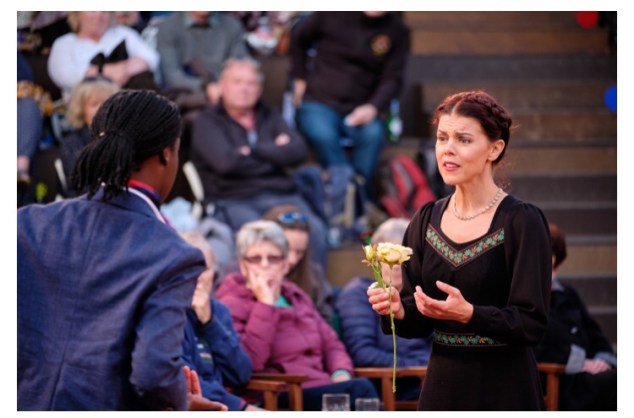
Twelfth Night has long been known as one of Shakespeare’s greatest comedies; in celebration of their 10th birthday Grosvenor Open Air Theatre are happy to prove why.

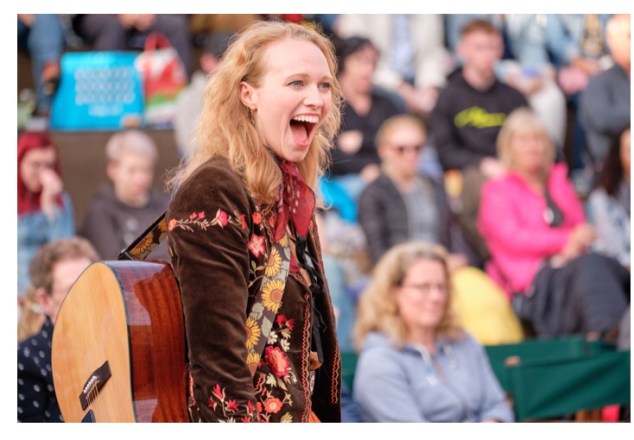
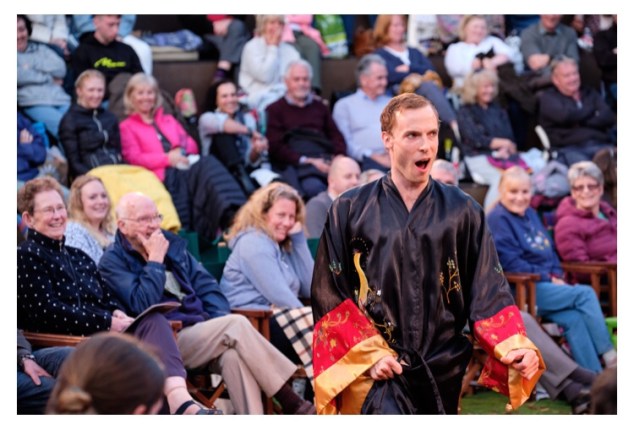
Locating the action in the Bohemian Balkans the celebratory festival vibe is strong, there’s flowers in hair while the drink is free flowing. The abundance of music and laughter indicate that Director Julia Thomas is prepared embrace the fun of this comedic and jubilant production.

This is an ode to the joyful and silly; there’s mistaken identities, unrequited love, a shipwreck, subterfuge as well as a whole host of entertaining characters.

The talented cast deliver Shakespeare’s verse with clear conviction while their enthusiasm and wit gives the piece both a light and accessible feel.

Separated twins Viola (Whitney Kehinde) and Sebastian (Marc Benga) each arrive on the shores of Illyria after a shipwreck; Viola first, allowing her 3 days of getting acquainted with the locals, enough time for two to fall in love with her while another two attempt to fight her albeit while she’s now dressed as as a man (Cesario) in a bid to keep the spirit of the brother she believes to be dead alive.

Kehinde is excellent as Viola/Cesario, cool and commanding she handles the confusion and complexities of life in Illyria with sass and style.

Sarah-Jane Potts shines as Olivia, hot in pursuit of her happy ending while Samuel Collings brings the house down as the put upon Malvolio whose transformation from stiff upper lipped steward to stocking wearing, downward dog facing smiler is pure genius.

Mitesh Soni is an absolute joy as Sir Andrew Aguecheek. His physical comedy, facial expressions and nice but dim personality really bringing this piece to life. Kudos to Soni for successfully delivering Shakespeare’s prose whilst flossing, impressive!

Jessica Dives as Feste takes on the form of a modern day wandering minstrel, offering an almost narrator like musical accompaniment while adding a wonderfully melodic energy to proceedings.

Director Julia Thomas isn’t afraid to embrace the silly or the slapstick and is greatly rewarded for her choices. Her cast embrace the opportunity, having a lot of fun with the piece while the audience reap the benefits.

A stand out moment which really embodies the playful nature of the production is the hilarious fight scene, outrageously farcical and absolute comedy perfection. The frequent witty exchanges between cast and audience further add to the playfulness and accessibility of this piece.

A highlight of Chester’s summer season for ten years now with productions as strong as this there is no doubt the Grosvenor Park Open Air Theatre will be celebrating birthdays for many years to come.

Outrageously good fun for all the family.

Twelfth Night is being performed at various dates over the summer further information and tickets can be found here.

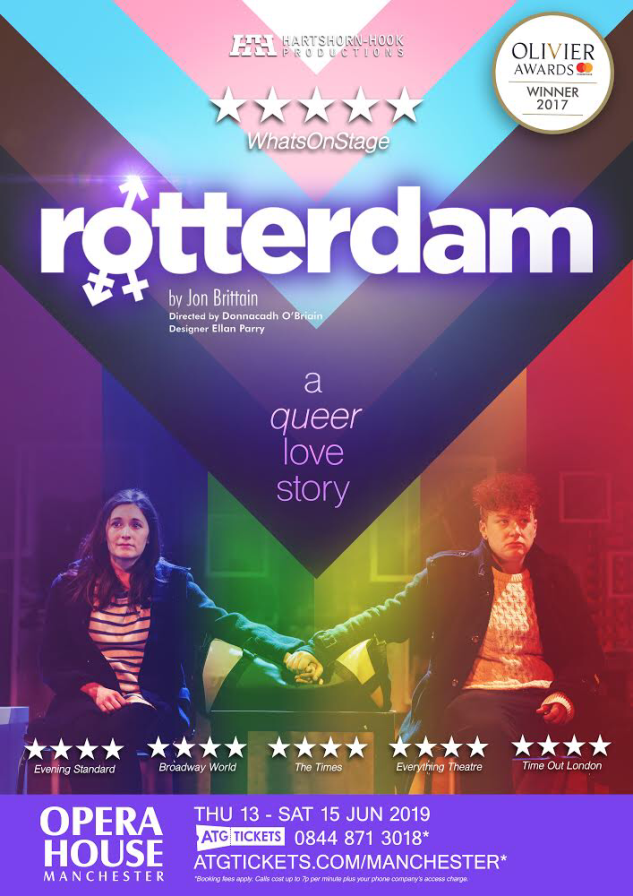
Rotterdam


Reviewed by Matt Forrest

Opening Night verdict ⭐️⭐️⭐️⭐️

Every once in while a play comes along that really strikes the right chord, one that you would encourage as many people as possible to go and see, writer Jon Brittain’s Rotterdam is that play!

First performed in 2015, this Olivier Award winning play offers an honest, raw portrayal of gender dysphoria and the impact that it can have not just on the individual but their loved ones as well.

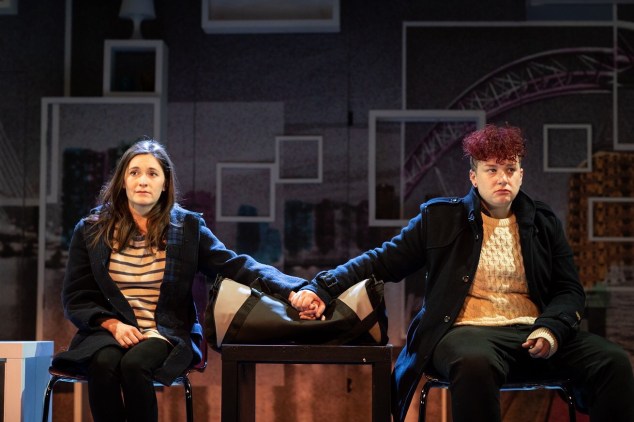
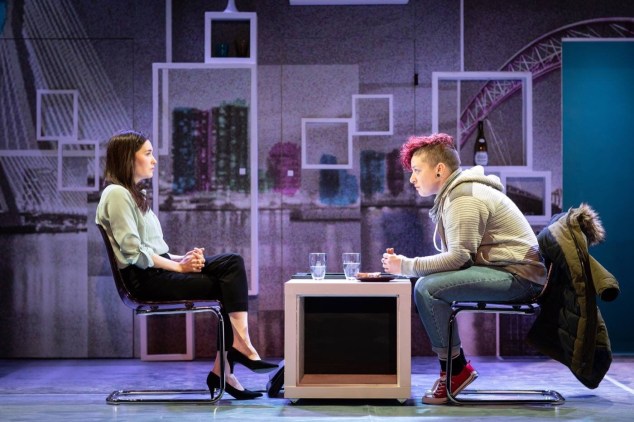
Set in the Dutch city of Rotterdam, a vibrant port town where people come and go as much as the cargo that passes through its docks; however, this isn’t the case for Alice (Rebecca Banatvala) and her partner Fiona (Lucy Jane Parkinson).

The pair have been living there for seven years now, with both trying to come to terms with who they are. It’s New Years Eve and Alice has finally decided to come out as gay to her parents, with much encouragement from Fiona. However, before Alice undertakes this brave step, Fiona also has a confession to make that she wishes to be recognised as a man and would like to be called Adrian from now on.

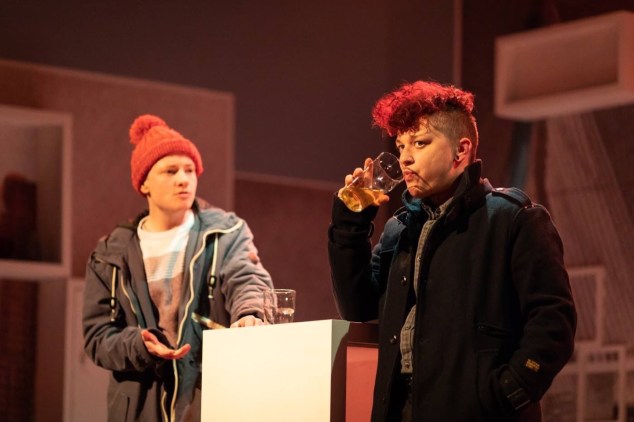
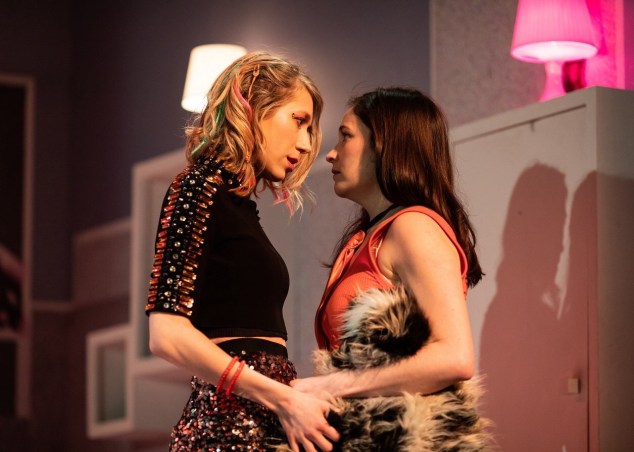
This revelation has a huge impact on the pair and their relationship as Adrian seeks acknowledgement from a world that he sees will not accept him as a man, whilst Alice questions her own sexuality. Through their journey of discovery, the pair are supported by Lelani, (Stella Taylor) Alice’s free-spirited work colleague, who has more than friendship on her mind as it pertains to Alice. Making up the quartet, is Josh (Paul Heath) Fiona/Adrian’s brother who is also the former boyfriend of Alice.

This could so easily fall into a ‘preachy’ message driven play about transgender issues, instead focusing on the impact Adrian’s decision to transition impacts on those around him. The script handles its subject intelligently and sensitively, whilst pulling no punches. There are moments of levity throughout with some sharp, funny throw away lines.

The cast under Donnacadh O’ Brian, skilful direction are superb, with Parkinson giving a raw at times feral turn as Adrian: filled with conflict and heartbreak. Whilst Banatvala is also outstanding giving a more restrained but no less gut-wrenching turn as Alice. Both Taylor and Heath are on good form in their supporting roles, with the pair turning in great comedic performances, demonstrating a gift for timing and delivery.

There are some plot contrivances that test plausibility, such as Josh’s decision to stick around despite losing the women he loves to his sibling, but this is a minor quibble on what is a weighty, heartfelt, powerful piece of theatre that will make you laugh and may even cause you to get the odd bit of sand in your eye too.

Transgender issues despite having some media coverage are still hugely unrepresented. Productions like Rotterdam are much needed and important to help educate and hopefully create more positive conversations. This however is not the shows key drawing power, that comes because it is a beautifully told story about the struggles of relationships and real life that will resonate with us all.

Rotterdam is at the Manchester Opera House till 15th June. Tickets available here.